
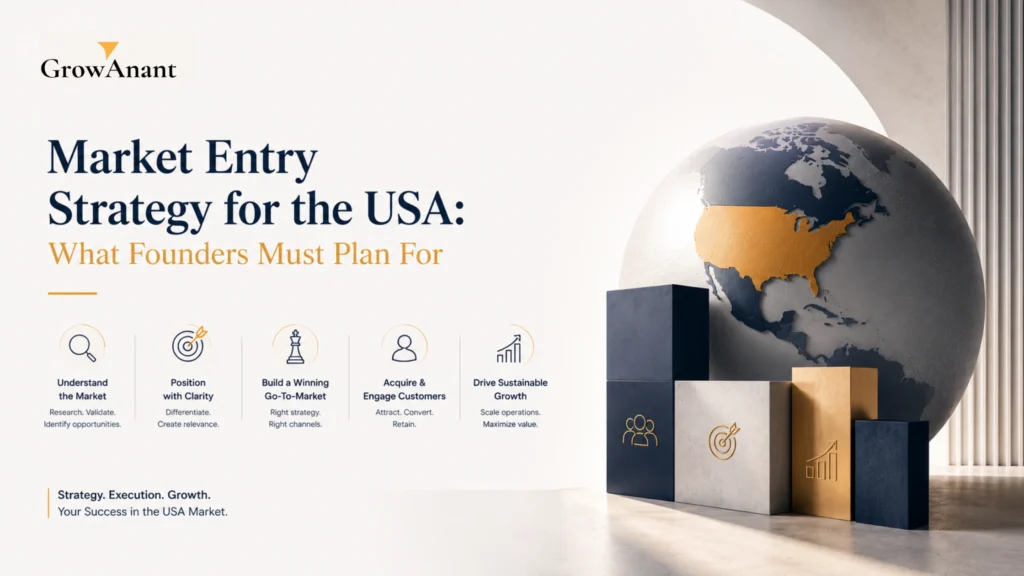
Entering the U.S. market represents one of the largest growth opportunities available to startups, SaaS companies, professional service firms, and growth-stage businesses. The market offers significant demand, large customer bases, and strong purchasing power.
At the same time, it is one of the most competitive business environments in the world.
Many founders assume that success in one country automatically translates to success in the United States. In reality, expanding into the U.S. often requires a completely different approach to positioning, customer acquisition, pricing, and revenue generation.
A successful market entry strategy USA requires more than launching marketing campaigns or hiring sales representatives. It requires strategic planning, customer understanding, operational readiness, and a structured growth framework.
This is why many businesses seek go to market strategy consulting, growth strategy consulting, or business strategy consulting USA expertise before making significant investments.
The goal is not simply entering the market.
The goal is building a repeatable path to revenue.
Why the U.S. Market Is Different
The United States remains one of the most attractive markets globally, but it operates differently from many international markets.
Founders entering the U.S. often discover that customer expectations, competitive intensity, and buying behavior differ significantly from what they have experienced elsewhere.
Understanding these differences early can reduce costly mistakes and improve the effectiveness of a market entry strategy USA.
Competition density
The first challenge many businesses encounter is competition.
Regardless of industry, most categories in the U.S. already contain:
- Established incumbents
- Venture-backed challengers
- Specialized niche providers
- Emerging startups
For example, a SaaS company entering the U.S. may find dozens of competitors targeting the same audience.
A consulting business may compete against:
- Boutique firms
- Large consulting organizations
- Fractional specialists
- Industry-specific advisors
This density creates a critical requirement: differentiation.
A company cannot rely solely on product features.
Instead, founders must answer:
- Why should a customer choose us?
- What problem do we solve differently?
- What measurable value do we provide?
This is where B2B marketing strategy consulting and startup growth strategy consulting often become valuable because differentiation influences every downstream growth activity.
Buyer expectations
U.S. buyers tend to evaluate vendors differently than many international markets.
They often expect:
- Clear positioning
- Fast response times
- Transparent pricing
- Strong customer support
- Demonstrated expertise
Decision-makers typically research extensively before engaging with sales teams.
As a result, businesses need:
- Strong websites
- Clear messaging
- Trust-building content
- Credibility indicators
For founders, this means customer acquisition frequently starts long before the first sales conversation.
Sales cycles
Many international companies underestimate the complexity of U.S. buying processes.
B2B sales cycles frequently involve:
- Multiple stakeholders
- Procurement reviews
- Budget approvals
- Security assessments
- Executive signoff
The larger the organization, the more structured the process becomes.
A practical framework is:
| Company Type | Typical Buying Complexity |
| SMB | Moderate |
| Mid-Market | High |
| Enterprise | Very High |
Understanding these realities helps businesses build realistic forecasts and effective go to market strategy consulting plans.
Legal, Pricing & Compliance Considerations
A strong market entry strategy USA extends beyond marketing and sales.
Operational readiness matters.
Entity setup basics
Most businesses entering the United States evaluate structures such as:
- LLCs
- C-Corporations
- Subsidiaries
- U.S. branches
The right structure depends on:
- Tax considerations
- Funding plans
- Legal requirements
- Growth objectives
Founders should seek professional legal and accounting guidance before establishing a U.S. entity.
The objective is to build a structure that supports long-term scalability rather than solving only immediate market-entry needs.
Pricing psychology in the U.S.
Pricing often requires more adjustment than founders expect.
A common mistake is directly converting prices from another market.
U.S. buyers evaluate pricing differently.
Several factors influence pricing perception:
- Competitive alternatives
- Expected outcomes
- Market positioning
- Risk reduction
- Customer support expectations
For example, underpricing can sometimes reduce trust rather than increase demand.
Many companies discover that value-based pricing performs better than cost-based pricing when entering the U.S.
This is particularly important for firms pursuing SaaS growth consulting, professional services, or high-value B2B offerings.
A useful pricing review checklist includes:
✓ Competitive positioning reviewed
✓ Pricing aligned to customer value
✓ Packaging clearly defined
✓ Upsell opportunities identified
✓ Revenue model validated
GTM Adjustments for U.S. Buyers
A successful market entry strategy USA often requires adapting the entire go-to-market motion.
The objective is not to change the product unnecessarily.
The objective is to ensure the market understands and trusts the value proposition.
Messaging localization
Localization is frequently misunderstood.
Many companies assume localization means changing spelling or terminology.
True localization involves adapting messaging to:
- Customer priorities
- Industry language
- Market maturity
- Competitive context
For example:
A feature-focused message may perform poorly in the U.S. if competitors already offer similar functionality.
Instead, messaging often needs to emphasize:
- Business outcomes
- Revenue impact
- Operational efficiency
- Competitive advantage
This is why go to market strategy consulting frequently begins with positioning work before any marketing investment occurs.
A simple messaging framework:
| Component | Question |
| Audience | Who are we targeting? |
| Problem | What challenge do they face? |
| Outcome | What business result improves? |
| Proof | Why should they trust us? |
Proof & trust signals
Trust plays a major role in U.S. buying decisions.
Particularly for:
- SaaS companies
- Professional services firms
- International businesses entering the market
Common trust signals include:
- Customer case studies
- Testimonials
- Industry certifications
- Security standards
- Media mentions
- Partner relationships
Founders often underestimate how much proof is required before prospects engage.
Without trust signals, demand generation efforts can become significantly less efficient.
Many organizations investing in growth consulting services, revenue growth consulting, or growth consulting services USA support discover that trust-building assets improve conversion rates across the entire funnel.
A practical trust-building checklist:
✓ Customer success stories available
✓ Industry expertise demonstrated
✓ Website credibility established
✓ Clear company information provided
✓ Customer outcomes documented
Some growth-stage businesses work with strategic growth partners such as GrowAnant to strengthen positioning, demand generation systems, and go-to-market execution before scaling customer acquisition efforts.
Common U.S. Entry Mistakes
Many market-entry challenges are predictable.
Understanding them in advance can reduce risk and improve growth efficiency.
Copy-paste international GTM
One of the most common mistakes is assuming the existing go-to-market model will work unchanged.
Companies often:
- Reuse messaging
- Replicate pricing
- Duplicate sales motions
- Maintain identical positioning
This approach rarely performs as expected.
The U.S. market frequently requires adjustments in:
- Positioning
- Demand generation
- Sales strategy
- Customer acquisition processes
Businesses pursuing business growth consulting and growth roadmap consulting often discover that adaptation is necessary even when the product itself remains unchanged.
Over-investing in ads early
Another common mistake is treating advertising as the primary solution.
Founders often launch:
- Paid search campaigns
- LinkedIn advertising
- Display campaigns
Before validating:
- Positioning
- Messaging
- ICP fit
- Sales process effectiveness
The result is frequently:
- Rising acquisition costs
- Low conversion rates
- Poor lead quality
- Inefficient spending
A better decision framework is:
| Before Scaling Ads | Why It Matters |
| ICP Clarity | Improves targeting |
| Messaging Validation | Improves conversion |
| Sales Readiness | Improves close rates |
| Trust Signals | Increases credibility |
| Funnel Visibility | Improves optimization |
This approach reduces wasted spend and supports sustainable growth.
Growth partners such as GrowAnant often help companies establish these foundational systems before aggressive scaling begins. The objective is predictable growth rather than temporary acquisition spikes.
Frequently Asked Questions
No. While competition is intense, opportunities remain significant for companies with clear differentiation, strong positioning, and a well-defined market entry strategy USA. Success depends less on market saturation and more on solving meaningful customer problems better than available alternatives.
Timelines vary based on industry, business model, and market readiness. Many companies spend several months validating positioning, refining their go-to-market approach, and establishing operational infrastructure before achieving consistent traction.
Not always. Many businesses successfully enter the U.S. market using remote teams, outsourced expertise, or fractional leadership models. However, local market knowledge, customer understanding, and strong go-to-market execution remain essential regardless of team location.
References
Source: U.S. Small Business Administration: https://www.sba.gov
Source: U.S. Census Bureau: https://www.census.gov