
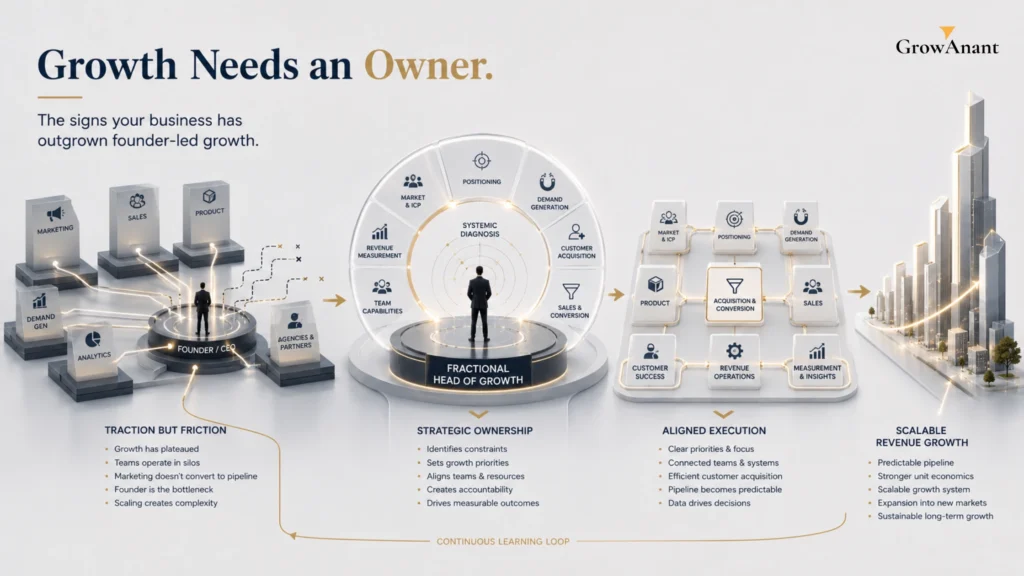
A Fractional Head of Growth provides senior growth leadership to companies that need strategic direction, cross-functional alignment, and stronger revenue systems without immediately hiring a full-time executive. For many growth-stage businesses, the need becomes clear when business growth slows, marketing activity increases without measurable pipeline impact, and founders remain responsible for coordinating growth decisions.
A growth consultant may diagnose individual problems, but fractional leadership typically goes further by helping teams prioritize opportunities, connect marketing and sales execution, establish accountability, and build repeatable growth systems.
The central question is not whether your company needs more marketing activity. It is whether the business has sufficient strategic ownership to turn its resources, teams, and market opportunities into sustainable revenue growth.
Growth has plateaued
Growth plateaus are rarely caused by one isolated marketing problem.
A B2B SaaS company may continue generating traffic and demos while new customer revenue remains flat. A professional services firm may produce leads but struggle with qualification and conversion. A founder-led business may have reached its current size through referrals, relationships, and founder involvement but lack a scalable acquisition system.
The common problem is that the business has outgrown the systems that created its earlier success.
A growth plateau can appear through several indicators:
| Indicator | Strategic Concern |
| Revenue growth is slowing | Existing acquisition channels may be reaching their limits |
| Customer acquisition costs are rising | Channel economics or market positioning may be weakening |
| Pipeline is inconsistent | The company lacks repeatable demand creation |
| Conversion rates are declining | Messaging, qualification, sales execution, or customer fit may be misaligned |
| Growth depends on one channel | The business has significant concentration risk |
| Teams are executing more activities | Increased activity is not producing proportional business outcomes |
Leadership teams often respond by increasing advertising budgets, publishing more content, hiring additional salespeople, or expanding into new channels.
These actions can increase complexity without solving the underlying problem.
The better approach is to identify the constraint limiting the next stage of growth.
That constraint may involve positioning, customer segmentation, pricing, product adoption, demand generation, sales conversion, retention, or internal execution.
A Fractional Head of Growth helps leadership evaluate the entire revenue system rather than optimizing isolated channels. The role can include elements of growth strategy consulting, business growth consulting, and operational leadership, but with greater accountability for turning strategy into coordinated execution.
For example, a U.S. SaaS company experiencing stagnant pipeline may initially believe it needs more B2B lead generation services. Analysis may reveal that the larger problem is unclear differentiation, broad ICP targeting, and low demo-to-opportunity conversion.
Increasing lead volume would amplify inefficiency.
Strategic leadership should address the growth constraint before scaling acquisition.
Teams lack alignment
Marketing, sales, product, and leadership teams often operate with different priorities.
Marketing may optimize traffic and lead volume. Sales may focus on closing immediate opportunities. Product teams may prioritize adoption and feature development. Founders may push for rapid revenue expansion.
Each function can perform well individually while the overall growth system remains fragmented.
This creates several operational problems:
- Marketing generates leads that sales does not prioritize.
- Sales feedback does not influence messaging or campaigns.
- Product insights are disconnected from customer acquisition strategy.
- Teams use different definitions of qualified pipeline.
- Channel investments are made without shared revenue priorities.
- Growth initiatives lack clear ownership.
The issue is not necessarily poor execution.
It is the absence of coordinated growth leadership.
A Fractional Head of Growth creates alignment around shared business objectives, customer segments, growth priorities, and measurement systems.
A practical alignment framework includes:
| Growth Area | Leadership Question |
| Market | Which customers should the business prioritize? |
| Positioning | Why should those customers choose the company? |
| Acquisition | How will the business create and capture demand? |
| Conversion | How will opportunities progress through the funnel? |
| Revenue | Which metrics indicate commercial progress? |
| Ownership | Who is accountable for each growth initiative? |
| Learning | How will market feedback influence strategy? |
For a professional services company, marketing may be generating inbound inquiries while sales complains about poor lead quality.
The immediate reaction may be to replace the digital marketing agency or invest in more performance marketing services USA.
However, the underlying problem may be disagreement about the ICP, qualification standards, value proposition, and sales follow-up process.
Fractional leadership helps resolve these issues by creating shared priorities and accountability across functions.
Marketing isn’t converting
Marketing activity without pipeline contribution creates frustration for founders and executives.
A company may invest in SEO, paid media, content, events, outbound prospecting, or growth marketing services while struggling to understand which activities contribute to qualified opportunities and revenue.
Common symptoms include:
| Marketing Symptom | Possible Strategic Problem |
| Traffic grows but pipeline does not | Wrong audience or weak conversion architecture |
| Leads increase but quality declines | Broad targeting or poor qualification |
| CAC continues rising | Channel saturation, weak positioning, or inefficient funnel |
| Content receives engagement but no opportunities | Content is disconnected from buyer intent |
| Paid campaigns generate clicks but few customers | Offer, messaging, targeting, or sales process issues |
| Attribution remains unclear | Marketing systems are disconnected from revenue measurement |
The strategic response should not be to stop marketing.
The company needs to determine where the revenue system is breaking.
A practical diagnostic sequence is:
- Validate the ICP and customer problem.
- Review market positioning and differentiation.
- Analyze channel-level acquisition economics.
- Measure conversion rates across the funnel.
- Identify the largest points of funnel leakage.
- Evaluate marketing and sales handoffs.
- Connect channel investment to pipeline and revenue outcomes.
- Prioritize experiments based on business impact.
A growth marketing consultant may help improve campaign performance, while a demand generation agency may build programs that create and capture buyer interest.
A Fractional Head of Growth should connect these activities to the broader growth strategy, revenue priorities, customer economics, and organizational capabilities.
GrowAnant approaches this challenge as a strategic growth partner by helping companies connect market strategy, demand generation, customer acquisition, conversion systems, and revenue measurement.
The objective is not simply more marketing.
It is a more accountable system for producing, converting, and learning from demand.
Founder bottlenecks
Founder involvement can be a major advantage during the early stages of a company.
Founders often understand customers deeply, shape positioning, close important deals, guide marketing decisions, manage partnerships, and identify growth opportunities.
As the company scales, that involvement can become a constraint.
Typical founder bottlenecks include:
- Every major marketing decision requires founder approval.
- Sales depends heavily on founder relationships.
- Teams wait for leadership to set priorities.
- Growth experiments stop when founders become busy.
- Strategy changes frequently based on immediate opportunities.
- No executive owns the complete customer acquisition and revenue system.
The founder becomes the central operating system for growth.
That model is difficult to scale.
Hiring additional marketers or agencies may not solve the problem because execution capacity is not the primary constraint.
The business needs delegated strategic ownership.
A Fractional Head of Growth can help founders move from daily growth coordination toward executive oversight.
The role may include:
| Responsibility | Business Impact |
| Growth prioritization | Focuses resources on the highest-value opportunities |
| Strategic planning | Creates a structured growth roadmap consulting process |
| Team leadership | Provides direction across internal and external resources |
| Performance reviews | Connects execution to measurable business outcomes |
| Experimentation | Establishes disciplined testing and learning systems |
| Revenue visibility | Improves understanding of pipeline and acquisition performance |
For founder-led businesses, the value of fractional leadership is not simply reducing workload.
It creates stronger decision-making infrastructure.
GrowAnant supports growth-stage companies as a revenue-focused growth partner, providing strategic leadership that connects executive priorities with practical execution across marketing, demand, pipeline, and revenue systems.
Scaling challenges
Scaling exposes weaknesses that smaller businesses can often tolerate.
A company may have generated early growth through founder-led sales, referrals, a successful paid channel, or a small group of high-performing employees.
As customer acquisition increases, complexity increases.
More leads require stronger qualification.
More channels require better attribution.
More team members require clearer accountability.
More customers require stronger retention systems.
More investment requires better visibility into returns.
The following comparison helps leadership evaluate whether the company has scalable infrastructure:
| Early Growth Model | Scalable Growth Model |
| Founder-driven decisions | Distributed ownership with executive accountability |
| Opportunistic customer acquisition | Defined ICP and acquisition strategy |
| Isolated marketing campaigns | Integrated growth systems |
| Lead volume measurement | Pipeline and revenue measurement |
| Channel experimentation without structure | Prioritized testing framework |
| Informal sales processes | Defined qualification and conversion systems |
| Short-term activity planning | Strategic roadmap tied to business outcomes |
A company should not scale a system it does not understand.
Before increasing investment, leadership should determine:
- Which customer segments create the strongest economics?
- Which acquisition channels produce qualified opportunities?
- Where does funnel leakage occur?
- How efficiently does sales convert demand?
- Which growth initiatives deserve additional investment?
- What capabilities must be built internally?
- Where should external expertise be used?
- Who owns growth performance across functions?
This is where growth consulting services, revenue growth consulting, and fractional leadership can complement internal execution teams.
For example, a funded startup may already employ marketers, salespeople, and external specialists. However, no executive may own the full system connecting market positioning, go to market strategy consulting, acquisition, conversion, and revenue accountability.
A fractional leader can provide the strategic layer required to turn fragmented capabilities into a coordinated growth system.
When to bring leadership
The right time to hire a Fractional Head of Growth is when the business has meaningful traction, resources to execute, and growth potential, but lacks senior ownership of the growth system.
A practical decision framework is:
| Business Situation | Leadership Implication |
| Revenue has plateaued despite continued investment | Diagnose systemic growth constraints |
| Marketing generates activity but limited pipeline | Connect acquisition to revenue outcomes |
| Teams operate without shared priorities | Establish cross-functional alignment |
| Founder involvement limits execution speed | Delegate strategic growth ownership |
| The company is entering a new market | Build a structured market entry strategy USA and GTM plan |
| Customer acquisition is becoming more expensive | Improve positioning, funnel economics, and channel allocation |
| Internal teams need senior direction | Provide strategic leadership without immediately hiring full-time |
| The company lacks a measurable growth roadmap | Build priorities, accountability, and performance systems |
Businesses should also understand when fractional leadership may not be the right solution.
A company may not be ready if it has no validated offering, lacks resources to execute recommendations, expects one person to replace an entire marketing and sales organization, or wants immediate results without investing in foundational systems.
The decision should follow a simple sequence:
Does the company have traction?
If no, prioritize customer discovery and validation.
If yes, ask whether growth performance is becoming inconsistent or difficult to manage.
Does the company have execution capacity?
If no, determine which capabilities need to be built.
If yes, ask whether someone owns strategy, prioritization, cross-functional alignment, and revenue accountability.
Is senior growth ownership missing?
If yes, fractional leadership may provide a practical alternative to immediately hiring a full-time executive.
Companies evaluating fractional growth, outsourced growth leadership, or an interim growth leader should focus on the scope of responsibility rather than the title.
The right leader should create strategic clarity, identify growth constraints, improve decision-making, align teams, establish measurement systems, and help the organization build repeatable capabilities.
GrowAnant positions fractional leadership around long-term growth partnership, strategy-first thinking, and revenue-focused execution. The objective is to help companies build stronger growth systems and executive accountability rather than simply increase marketing activity.
References
FAQs
You should consider hiring a Head of Growth when your business has traction but lacks senior ownership of growth strategy, customer acquisition, cross-functional alignment, experimentation, and revenue accountability.
A Fractional Head of Growth can be particularly relevant when the company needs experienced leadership but is not ready to hire a full-time executive.
Common indicators include slowing business growth, inconsistent pipeline, rising customer acquisition costs, weak marketing conversion, disconnected teams, founder bottlenecks, unclear growth priorities, and limited visibility into which activities contribute to revenue.
If the company has execution resources but lacks strategic direction and accountability, senior growth leadership may be needed.
A Head of Growth helps solve problems related to unclear strategy, weak customer acquisition systems, team misalignment, funnel leakage, inefficient resource allocation, inconsistent demand generation, limited revenue visibility, and the absence of executive ownership across the growth system.
The specific responsibilities depend on the company’s stage, business model, market, and internal capabilities.
Yes.
A Fractional Head of Growth can work with existing marketing, sales, product, RevOps, leadership teams, agencies, and external specialists.
The role should provide strategic direction, prioritization, coordination, accountability, and performance management so existing resources operate as part of a coherent growth system.