
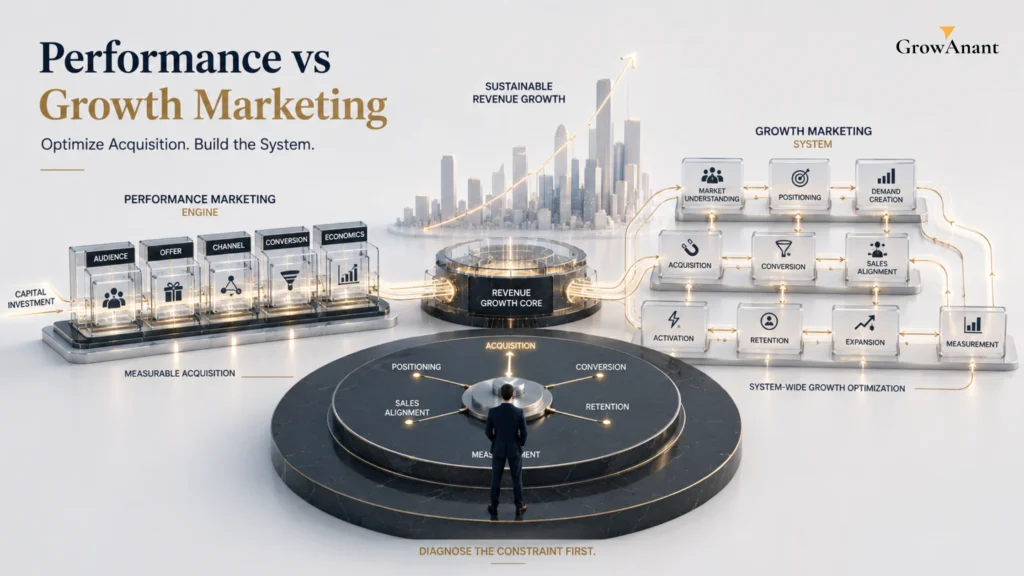
Choosing between performance marketing services USA and growth marketing services is not simply a channel decision. It is a strategic decision about how a company acquires customers, allocates capital, learns from the market, improves conversion, and builds sustainable revenue growth.
Performance marketing focuses primarily on measurable customer acquisition actions and the efficiency of paid media investments. Growth marketing takes a broader view of the customer journey, connecting acquisition, activation, conversion, retention, and expansion to the company’s overall growth strategy.
For founders and executives, the real question is not which approach is universally better. The question is which model addresses the company’s current growth constraint.
A company struggling to generate qualified opportunities may need stronger acquisition execution. A company generating traffic and leads but experiencing funnel leakage, weak retention, rising acquisition costs, or disconnected teams may need a broader growth system.
Understanding the strategic difference helps leadership allocate budgets more effectively, improve pipeline visibility, and build stronger foundations for sustainable business growth.
Understanding performance marketing
Performance marketing is a results-oriented approach in which marketing investments are evaluated against measurable actions such as clicks, leads, qualified opportunities, purchases, booked meetings, or customer acquisition.
Companies using performance marketing services USA typically focus on channels where spending and outcomes can be tracked with reasonable accuracy.
These channels may include paid search, paid social, display advertising, affiliate marketing, retargeting, and other measurable acquisition programs.
However, performance marketing should not be defined simply as running paid advertisements.
The strategic purpose is to deploy capital into measurable acquisition opportunities, evaluate performance, and improve efficiency based on business outcomes.
A strong performance marketing system connects five elements:
| Element | Strategic Question |
| Audience | Are we targeting customers with real buying potential? |
| Offer | Is the value proposition strong enough to create action? |
| Channel | Are we reaching buyers where intent or demand exists? |
| Conversion | Are landing pages and funnels turning attention into qualified opportunities? |
| Economics | Does acquisition performance support sustainable growth? |
For example, a U.S. professional services company may invest heavily in paid search to generate consultation requests.
The campaign can produce leads while still failing commercially if those leads are poorly qualified, conversion rates remain low, or the cost of acquiring customers exceeds acceptable economics.
This is why experienced digital marketing consulting services should connect advertising metrics to qualified pipeline, sales outcomes, customer acquisition cost, and revenue contribution.
Performance marketing becomes strategically valuable when measurement extends beyond clicks and form submissions.
The central executive question should be:
Are we acquiring the right customers at an economically sustainable cost?
Understanding growth marketing
Growth marketing is a broader operating approach focused on improving growth across the entire customer journey.
Instead of concentrating primarily on acquisition, growth marketing services evaluate how positioning, customer acquisition, activation, conversion, retention, expansion, and referrals contribute to company performance.
The objective is to identify constraints within the growth system and prioritize improvements that create the greatest business impact.
A practical growth marketing model includes:
- Market and customer understanding.
- Positioning and messaging.
- Demand generation.
- Customer acquisition.
- Conversion optimization.
- Sales alignment.
- Customer activation.
- Retention and expansion.
- Measurement and experimentation.
Consider a B2B SaaS company generating hundreds of leads every month.
Increasing advertising spend may produce more leads.
However, the company’s real growth problem may be that prospects do not understand the product’s differentiation, trial users fail to reach meaningful value quickly, sales teams receive low-intent opportunities, and customers leave before generating sufficient lifetime value.
A growth marketing agency USA or strategic growth partner would evaluate the complete system before recommending additional acquisition investment.
The objective is not to maximize marketing activity.
The objective is to identify where the company is losing growth potential and improve the system connecting marketing investment to revenue.
GrowAnant approaches growth marketing through this broader perspective, connecting strategy, positioning, demand generation, acquisition, conversion, sales alignment, and revenue measurement rather than treating individual campaigns as isolated activities.
Key differences
The primary difference between performance marketing and growth marketing is scope.
Performance marketing concentrates primarily on measurable acquisition efficiency.
Growth marketing evaluates the complete system responsible for creating and expanding customer value.
| Strategic Area | Performance Marketing | Growth Marketing |
| Primary focus | Measurable customer acquisition | Sustainable growth across the customer journey |
| Typical scope | Campaigns and acquisition channels | Market, funnel, customer lifecycle, and revenue systems |
| Core questions | Which campaigns and channels generate efficient results? | Where are the largest constraints preventing growth? |
| Time horizon | Often short to medium term | Medium to long term |
| Primary metrics | CPL, CAC, ROAS, CPA, conversion rate | Pipeline, CAC, activation, retention, LTV, expansion, revenue |
| Experimentation | Campaign and channel optimization | Cross-functional growth experimentation |
| Team involvement | Primarily marketing | Marketing, sales, product, customer success, and leadership |
| Strategic objective | Improve acquisition efficiency | Build scalable and repeatable growth systems |
Another important difference is how each approach responds to poor performance.
A performance marketing team may respond to declining results by changing targeting, creative, offers, landing pages, bidding strategies, or channel allocation.
A growth marketing team asks a broader set of questions.
Is the target market correct?
Is positioning sufficiently differentiated?
Is the offer aligned with customer priorities?
Are sales teams following up effectively?
Where does funnel leakage occur?
Are customers reaching value quickly enough?
Is retention strong enough to support additional acquisition spending?
These questions matter because growth problems rarely exist in isolation.
For example, a B2B growth marketing agency may discover that a client’s rising CAC is not primarily an advertising problem.
Weak positioning may reduce conversion.
Poor sales qualification may waste opportunities.
Limited customer retention may reduce lifetime value.
Inaccurate attribution may cause leadership to invest in the wrong channels.
In such situations, optimizing campaigns without improving the underlying system can create temporary efficiency gains without solving the larger business growth problem.
Which businesses need each
The right approach depends on the company’s stage, constraints, internal capabilities, and revenue model.
Performance marketing may be appropriate when:
- The company has validated product-market fit.
- Positioning and messaging are reasonably clear.
- Conversion infrastructure is established.
- Sales follow-up processes are reliable.
- Customer economics are understood.
- Leadership wants to test or scale measurable acquisition channels.
- The business needs specialized paid acquisition expertise.
A U.S. service company with proven demand, strong sales conversion, and clear customer economics may benefit from performance marketing services USA to expand qualified customer acquisition.
Growth marketing may be more appropriate when:
- Growth has plateaued.
- Customer acquisition is inconsistent.
- Marketing and sales operate separately.
- Lead quality is poor.
- CAC continues to rise.
- Funnel conversion is weak.
- Retention problems reduce customer lifetime value.
- Leadership lacks reliable attribution.
- The company is entering new markets.
- Teams execute activities without clear strategic priorities.
A funded SaaS company may already use paid media, outbound sales, content marketing, and B2B lead generation services.
If these activities fail to create a predictable pipeline, adding more campaigns may increase spending without improving growth.
The company may need growth strategy consulting, stronger positioning, improved sales alignment, better measurement, and a coordinated experimentation system.
The following decision framework can help leadership evaluate the right approach:
| Business Situation | Recommended Starting Focus |
| Acquisition channels are validated but need optimization | Performance marketing |
| Paid media efficiency is declining | Performance diagnosis followed by broader growth analysis |
| Lead volume is high but quality is poor | Growth marketing |
| Marketing generates leads but sales conversion is weak | Growth marketing |
| The company is entering the U.S. market | market entry strategy USA and go to market strategy consulting |
| Customer retention is limiting profitability | Growth marketing |
| The business needs rapid testing of measurable acquisition channels | Performance marketing |
| Teams lack strategic growth ownership | growth consulting services or fractional leadership |
| The company has no repeatable pipeline system | demand generation agency expertise combined with growth strategy |
The key principle is to diagnose before investing.
Companies should not choose performance marketing because paid acquisition is easy to launch.
They should not choose growth marketing because the term sounds more strategic.
Leadership should identify the most important constraint preventing sustainable growth and select the capabilities required to solve it.
Can they work together?
Yes.
Performance marketing and growth marketing are most effective when they operate as complementary capabilities within a coordinated growth system.
Performance marketing creates measurable acquisition opportunities and market feedback.
Growth marketing uses those insights alongside customer, sales, product, and revenue data to improve the broader growth system.
A practical integrated model works through six stages:
| Stage | Strategic Focus |
| 1. Strategy | Define market, ICP, positioning, economics, and growth priorities |
| 2. Demand | Build awareness, authority, and buyer interest |
| 3. Acquisition | Use measurable channels to generate qualified opportunities |
| 4. Conversion | Improve landing pages, funnels, sales processes, and buying experiences |
| 5. Retention | Increase customer value and reduce preventable churn |
| 6. Measurement | Connect investments and experiments to pipeline and revenue outcomes |
For example, a B2B software company may use paid search and LinkedIn campaigns to generate demand.
The performance marketing function measures acquisition costs, campaign conversion, and pipeline contribution.
The growth marketing function evaluates whether the right buyers are entering the funnel, whether messaging improves conversion, whether sales teams convert opportunities efficiently, whether customers activate successfully, and whether retention supports continued acquisition investment.
Together, these capabilities create a stronger decision-making system.
The same principle applies to professional service businesses.
A firm may use lead generation for B2B services, content, paid media, outbound prospecting, and referral programs.
Performance marketing can improve channel efficiency.
Growth marketing can connect those channels to positioning, sales processes, revenue attribution, and customer economics.
GrowAnant works as a growth partner by helping companies determine where performance execution fits within the larger growth system. This strategy-first approach helps leadership connect acquisition investment, demand generation leadership, conversion, revenue measurement, and scalable execution.
Before increasing investment, leadership teams should evaluate the following checklist:
- Is the ideal customer profile clearly defined?
- Does the company have meaningful differentiation?
- Are acquisition channels generating qualified opportunities?
- Can marketing investment be connected to pipeline?
- Are sales and marketing teams working from shared definitions and goals?
- Is customer acquisition cost understood?
- Are conversion bottlenecks measured?
- Does customer retention support continued acquisition investment?
- Is there clear ownership of the overall growth strategy?
- Can successful experiments be converted into repeatable processes?
If most problems exist at the acquisition channel level, performance marketing may be the immediate priority.
If problems exist across positioning, pipeline, conversion, sales alignment, retention, and measurement, the company likely needs a broader growth marketing approach.
The long-term objective should not be to choose one label.
It should be to build a growth system where customer acquisition investment produces useful market intelligence, teams learn from performance data, strategic decisions improve over time, and marketing activity contributes to sustainable revenue creation.
References
FAQs
Growth marketing is not universally better than performance marketing.
It is broader in scope because it evaluates acquisition, conversion, retention, and revenue systems. Performance marketing can be more appropriate when a company has strong fundamentals and needs specialized expertise to improve measurable customer acquisition.
The right approach depends on the company’s current growth constraint.
No.
Performance marketing is an outcome-focused approach to customer acquisition where investments are evaluated against measurable actions.
Paid search, paid social, affiliate programs, retargeting, and other measurable channels may be part of the strategy.
Effective performance marketing services USA should connect campaign performance to qualified opportunities, customer acquisition cost, pipeline contribution, and revenue.
The best approach depends on the SaaS company’s stage and growth constraints.
Early growth-stage SaaS companies may need broader SaaS growth consulting to validate positioning, improve activation, align acquisition with sales, and build stronger measurement systems.
More mature SaaS businesses with validated customer economics and repeatable conversion systems may use performance marketing to scale efficient acquisition channels.
Many SaaS companies benefit from combining both approaches.
Companies should reconsider their approach when acquisition costs continue rising, lead quality declines, conversion remains weak, marketing and sales become disconnected, retention limits customer value, or campaign optimization no longer improves business performance.
In these situations, the problem may extend beyond individual channels and require a broader growth marketing and growth strategy approach.