
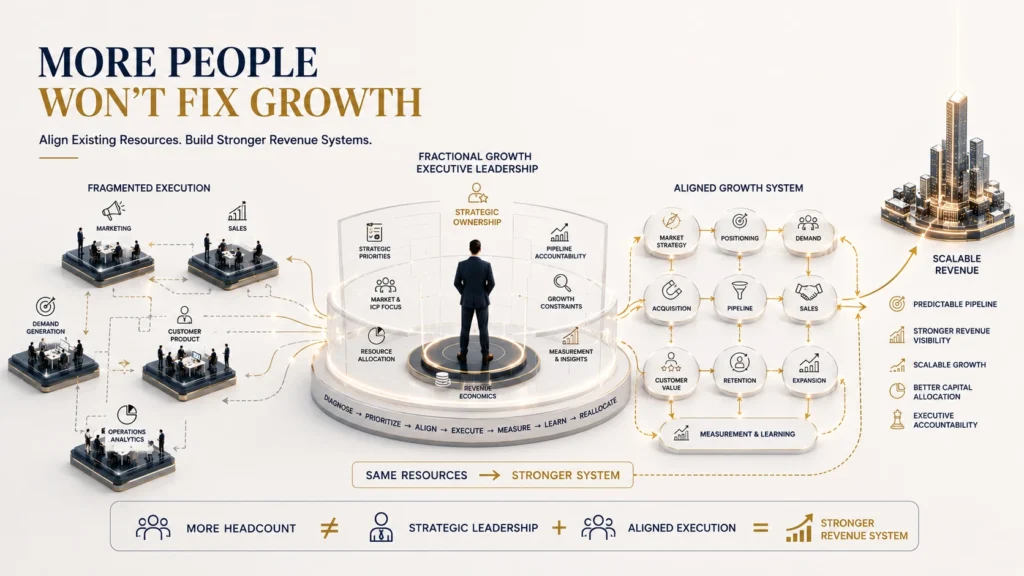
Hiring more people does not automatically solve growth problems. Many growth-stage businesses already have marketers, sales representatives, agencies, and operational teams executing campaigns and initiatives. What they often lack is senior growth leadership capable of connecting those activities to a clear revenue strategy.
A fractional growth executive provides experienced strategic leadership without requiring the company to immediately hire another full-time executive. The role focuses on identifying growth constraints, improving resource allocation, aligning teams, establishing accountability, and building growth systems that connect strategy to execution.
For founders and CEOs facing unpredictable pipeline, rising acquisition costs, disconnected teams, or stalled business growth, fractional leadership can provide strategic ownership while allowing existing teams to remain responsible for execution.
The objective is not simply to reduce headcount costs. It is to improve how the organization makes growth decisions, allocates capital, executes priorities, and measures progress toward revenue outcomes.
Leadership vs execution
One of the most common problems in growth-stage companies is confusing marketing execution with growth leadership.
Execution focuses on completing activities.
Teams launch campaigns, publish content, manage paid media, generate reports, contact prospects, update CRM systems, optimize websites, and create sales materials.
Leadership determines which activities should happen, why they matter, how resources should be allocated, who owns outcomes, and whether execution is improving the company’s commercial performance.
| Execution Responsibility | Leadership Responsibility |
| Launch campaigns | Determine strategic growth priorities |
| Generate leads | Define pipeline objectives and customer acquisition strategy |
| Create content | Align content with market positioning and buyer priorities |
| Manage advertising | Evaluate acquisition economics and investment allocation |
| Produce reports | Build decision-making systems around meaningful metrics |
| Run sales outreach | Align acquisition, qualification, and sales processes |
| Optimize conversion | Identify the most important constraint in the revenue system |
A company can have strong execution capacity and still experience stagnant growth.
For example, a U.S. B2B SaaS company may employ content marketers, performance marketers, sales development representatives, and account executives.
Each team is active.
Marketing generates leads.
Sales schedules meetings.
Content traffic increases.
Advertising campaigns produce conversions.
Yet leadership cannot clearly explain which customer segments are most profitable, which channels contribute to qualified pipeline, where prospects leave the funnel, or why customer acquisition costs continue increasing.
The problem is not necessarily a lack of execution.
The company lacks ownership of the overall growth strategy.
A fractional growth executive operates above individual channels and departments. The role identifies the company’s highest-priority growth constraints and aligns existing resources around solving them.
This distinction is why companies seeking growth consulting services should evaluate whether they need additional execution capacity or senior strategic ownership.
Revenue accountability
Growth leadership should create accountability for business outcomes rather than marketing activity.
Traffic, impressions, followers, leads, meetings, and campaign conversion rates can provide useful information.
However, these metrics become strategically meaningful only when connected to pipeline quality, customer acquisition cost, sales conversion, retention, customer lifetime value, and revenue growth.
A practical revenue accountability framework connects five layers:
| Layer | Executive Question |
| Market | Are we targeting customers with sufficient need, urgency, and economic value? |
| Demand | Are we creating awareness and interest among the right buyers? |
| Pipeline | Are marketing and sales generating qualified opportunities? |
| Conversion | Are opportunities becoming customers efficiently? |
| Economics | Does the revenue generated justify the resources invested? |
Consider a professional services company generating 300 leads each quarter.
Marketing reports strong campaign performance.
Sales argues that most leads are poorly qualified.
Leadership continues investing because lead volume is increasing.
A fractional growth consultant or executive-level growth leader would evaluate the complete system.
Which customer segments convert?
What percentage of leads become qualified opportunities?
How long does the sales cycle take?
Which channels produce the highest-value customers?
Where does funnel leakage occur?
What is the cost of acquiring customers?
Which services create the strongest retention or expansion potential?
This shifts the conversation from “How many leads did marketing generate?” to “How effectively does the company convert growth investment into sustainable revenue opportunities?”
Effective revenue growth consulting requires this level of accountability because companies cannot improve predictability without understanding how growth decisions affect commercial outcomes.
Team alignment
Growth slows when marketing, sales, product, and leadership operate from different definitions of success.
Marketing may optimize lead volume.
Sales may prioritize immediate opportunities.
Product teams may build features requested by individual customers.
Finance may reduce budgets based on short-term efficiency.
Leadership may expect revenue growth without defining the strategic priorities required to achieve it.
The result is organizational activity without coordinated direction.
A fractional growth executive creates alignment by establishing shared priorities, metrics, decision-making processes, and accountability.
A practical alignment system includes:
- A clearly defined ICP.
- Shared market positioning.
- Agreed pipeline stages.
- Consistent qualification criteria.
- Defined ownership across the customer journey.
- Shared revenue metrics.
- Regular growth reviews.
- Documented experiments and learnings.
- Clear resource allocation decisions.
- Executive visibility into performance.
For example, a SaaS company may discover that marketing is generating hundreds of trial users while sales focuses on enterprise opportunities.
Product teams prioritize self-service onboarding.
Leadership expects larger contracts.
Every department is executing against a different growth model.
Before investing in additional B2B lead generation services or growth marketing services, the company needs strategic alignment.
A fractional head of growth can help leadership decide whether the company should prioritize product-led acquisition, sales-led growth, enterprise expansion, a hybrid model, or another focused approach.
GrowAnant approaches fractional leadership by connecting company strategy, GTM leadership, marketing leadership, demand generation leadership, sales execution, and revenue measurement around shared business priorities.
The purpose is not to take over every team.
It is to ensure that existing teams work within a coordinated growth system.
Faster decision-making
Growth-stage companies frequently lose momentum because strategic decisions remain unresolved.
Should the company increase paid media investment?
Should it enter a new customer segment?
Should sales hire more representatives?
Should marketing prioritize inbound or outbound?
Should the company expand into the U.S. market?
Should pricing change?
Should the business launch another product?
Without clear growth ownership, these decisions may be driven by opinions, departmental incentives, or whichever problem feels most urgent.
A fractional growth executive improves decision-making by creating a structured process for prioritization.
A practical decision framework evaluates:
| Question | Strategic Purpose |
| What is the current growth constraint? | Prevents teams from solving secondary problems |
| What evidence supports the diagnosis? | Reduces opinion-driven decisions |
| What business outcome should improve? | Connects action to commercial impact |
| What resources are required? | Improves capital allocation |
| How quickly can the assumption be tested? | Accelerates organizational learning |
| What metric determines success or failure? | Creates accountability |
| What happens after the experiment? | Converts learning into future decisions |
Consider a founder-led B2B company experiencing declining pipeline.
The immediate reaction may be to hire more sales representatives or increase advertising.
However, the real problem may be weak positioning, declining conversion rates, poor qualification, limited market demand, or insufficient sales follow-up.
A senior growth consultant should diagnose the constraint before recommending additional spending.
This is where growth strategy consulting creates value.
Faster decision-making does not mean making more decisions.
It means identifying the decisions that matter most, testing assumptions efficiently, and reallocating resources based on evidence.
Growth systems
Sustainable growth requires systems that continue producing insight and improving execution beyond individual campaigns.
A fractional growth executive helps companies replace fragmented activities with connected growth systems.
A practical growth system includes:
Market Strategy → Positioning → Demand Creation → Customer Acquisition → Qualification → Sales Conversion → Customer Value → Retention → Expansion → Measurement → Learning
Each stage influences the next.
Weak positioning reduces demand quality.
Poor demand quality increases acquisition costs.
Weak qualification wastes sales capacity.
Poor sales processes reduce conversion.
Low customer value damages retention.
Weak measurement prevents leadership from identifying the actual problem.
This interconnected structure explains why hiring another marketer or launching another campaign rarely solves a company-wide growth challenge.
For example, a funded startup may use a growth marketing agency USA, outbound sales team, SEO partner, and internal marketing staff.
Each function may perform competently.
However, without strategic ownership, the company can still struggle to build a predictable pipeline.
A fractional growth executive can establish the operating system that connects these resources.
A practical implementation sequence includes:
- Diagnose the current revenue system.
- Identify the primary growth constraints.
- Define the ICP and strategic positioning.
- Establish measurable growth priorities.
- Align marketing and sales around pipeline objectives.
- Prioritize acquisition and demand generation channels.
- Build reporting around commercial outcomes.
- Create an experimentation process.
- Document learnings and repeatable processes.
- Transfer capabilities to internal teams.
GrowAnant supports companies that need this type of strategic ownership by operating as a long-term growth partner rather than a tactical digital marketing agency.
The focus is on connecting business growth consulting, demand generation, GTM planning, execution, and revenue accountability into a scalable operating system.
Measuring ROI
The ROI of fractional leadership should not be measured only by comparing compensation costs with the salary of a full-time executive.
The more important question is whether the engagement improves the company’s ability to allocate resources, generate qualified pipeline, convert opportunities, build internal capabilities, and make better growth decisions.
A practical ROI scorecard includes:
| Category | Metrics to Evaluate |
| Strategy | Clear ICP, positioning, growth priorities, roadmap |
| Acquisition | CAC, qualified pipeline, channel efficiency |
| Funnel | Conversion rates, leakage, opportunity progression |
| Sales | Win rate, sales cycle, pipeline velocity |
| Customer | Retention, expansion, lifetime value |
| Operations | Team alignment, decision speed, accountability |
| Economics | Revenue contribution, budget efficiency, resource allocation |
Leadership should establish baseline performance before the engagement begins.
The first phase should document current conditions:
- Pipeline generation.
- Lead-to-opportunity conversion.
- Opportunity-to-customer conversion.
- Customer acquisition cost.
- Sales cycle length.
- Channel contribution.
- Marketing efficiency.
- Retention and expansion.
- Team responsibilities.
- Reporting quality.
- Decision-making bottlenecks.
The next step is to identify the highest-priority constraints and define measurable improvement targets.
For example, the initial objective may not be immediate revenue acceleration.
The company may first need better ICP focus, improved attribution, stronger qualification, a clearer revenue strategy, or more reliable pipeline visibility.
These improvements create the conditions for better revenue performance.
Companies should also evaluate whether the engagement builds internal capability.
A strong fractional growth executive should create processes, frameworks, dashboards, documentation, and decision-making systems that remain useful to the company over time.
The most effective engagements therefore produce value at three levels.
Strategic value: Leadership gains clarity about markets, customers, priorities, and investment decisions.
Operational value: Teams gain better alignment, accountability, processes, and measurement.
Commercial value: The company improves its ability to generate qualified demand, manage pipeline, convert opportunities, retain customers, and allocate capital toward sustainable revenue growth.
For growth-stage businesses, the central question is not whether adding more employees creates more activity.
The question is whether the company has the leadership, systems, and accountability required to convert existing resources into stronger commercial performance.
References
FAQs
Fractional leadership can reduce the fixed cost and long-term commitment associated with immediately hiring a full-time executive.
However, the strategic value extends beyond compensation savings.
A fractional growth executive can help companies improve resource allocation, reduce inefficient marketing spending, strengthen team alignment, and build systems that support better growth decisions.
Fractional leadership improves the conditions that support revenue growth by connecting strategy, demand creation, customer acquisition, sales execution, retention, measurement, and accountability.
The role identifies growth constraints, prioritizes resources, aligns teams, and builds systems that help companies convert market opportunities into sustainable commercial performance.
Fractional leadership is typically designed to address a defined stage of organizational need.
Engagements may support companies during growth transitions, market expansion, leadership gaps, GTM development, team restructuring, or the process of building internal growth capabilities.
The duration should depend on the company’s objectives, complexity, and progress rather than an arbitrary timeline.
Growth-stage B2B SaaS companies, professional service firms, funded startups, founder-led businesses, SMBs, companies entering the U.S. market, and organizations with execution teams but limited senior growth leadership can benefit from fractional leadership.
The strongest fit is usually a company with real market traction and execution capacity that needs strategic direction, cross-functional alignment, stronger growth systems, and clearer accountability for revenue outcomes.