
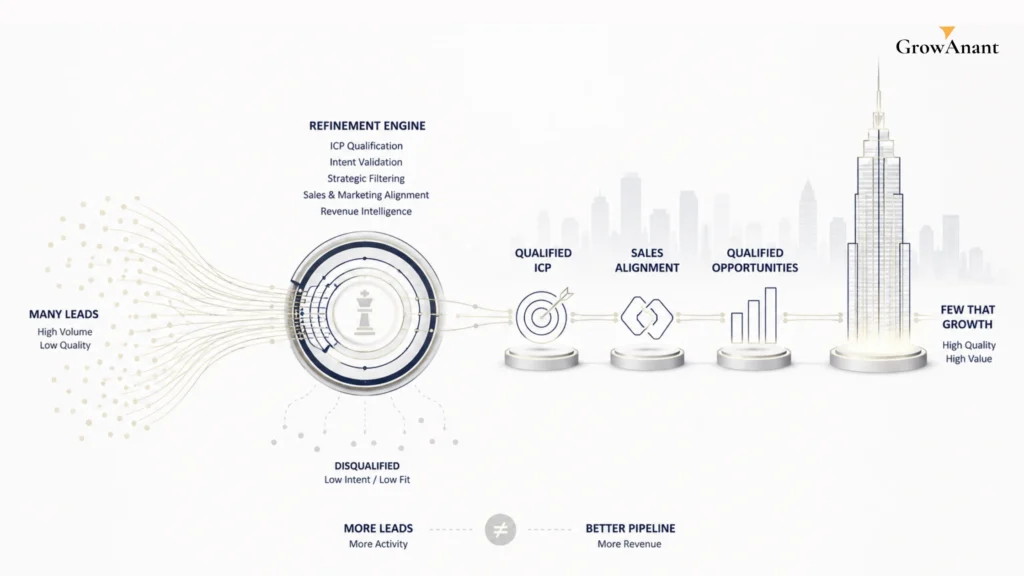
Many businesses celebrate generating hundreds or even thousands of leads each month. Dashboards fill with impressive numbers, marketing reports show increasing website traffic, and campaign metrics appear healthy. Yet revenue growth often remains inconsistent.
The reason is simple. Lead volume alone does not build predictable revenue. Sustainable growth depends on generating qualified opportunities that progress through the sales pipeline and convert into customers.
This is why modern Growth Marketing Services focus on improving pipeline quality instead of maximizing lead counts. Effective demand generation attracts businesses that match your ideal customer profile, while strong qualification processes ensure sales teams spend their time on opportunities with genuine buying intent.
Whether you are a B2B SaaS company, professional services firm, startup, or SMB expanding into the U.S. market, understanding the relationship between lead quality and revenue can significantly improve marketing efficiency, sales productivity, and long-term business performance.
Lead Volume vs Pipeline Quality
At first glance, generating more leads seems like the fastest path to growth. However, high lead volume often creates hidden operational problems when those contacts are poorly qualified.
A business receiving 2,000 low-intent leads each month may generate less revenue than a competitor producing only 300 highly qualified opportunities.
The objective of modern Growth Marketing Services is not simply to increase inquiries. It is to build a predictable pipeline filled with prospects that closely match your ideal customer profile, have genuine buying intent, and are likely to become long-term customers.
Understanding the Difference
| Lead Volume | Pipeline Quality |
| Measures quantity | Measures revenue potential |
| Focuses on marketing activity | Focuses on business outcomes |
| Often includes low-intent prospects | Prioritizes qualified buyers |
| Can overwhelm sales teams | Improves sales efficiency |
| Easy to increase through advertising | Requires strategic alignment |
Businesses relying only on lead volume frequently experience:
- Rising customer acquisition costs
- Low conversion rates
- Longer sales cycles
- Poor marketing ROI
- Sales frustration
- Inaccurate revenue forecasts
By contrast, organizations investing in B2B lead generation services emphasize quality at every stage of the customer journey.
Why Quality Produces Better Revenue Outcomes
Revenue is generated by customers, not leads.
For example, consider two B2B software companies.
Company A
- 3,000 monthly leads
- 2% qualified
- Low conversion
- High acquisition costs
Company B
- 500 monthly leads
- 30% qualified
- Higher close rates
- Better customer retention
Although Company A generates six times more leads, Company B often creates stronger business results because its pipeline contains higher-value opportunities.
This illustrates why experienced B2B growth marketing agency partners focus on improving qualification rather than maximizing marketing activity.
Instead of asking:
“How many leads did we generate?”
Executive teams should ask:
- How many qualified opportunities entered the pipeline?
- How many progressed to sales conversations?
- How much revenue did marketing influence?
- Which channels produce the highest-quality customers?
These questions connect marketing directly to commercial performance.
Revenue Metrics
One of the biggest mistakes businesses make is measuring marketing success using activity metrics instead of revenue metrics.
Website traffic, impressions, clicks, downloads, and form submissions provide useful operational data, but they rarely indicate whether the business is actually growing.
Executive teams should instead evaluate marketing using metrics that influence revenue generation.
Activity Metrics vs Revenue Metrics
| Activity Metrics | Revenue Metrics |
| Website visits | Pipeline value |
| Form submissions | Sales-qualified opportunities |
| Social engagement | Opportunity-to-customer conversion |
| Ad impressions | Customer acquisition cost |
| Email opens | Revenue influenced |
| Click-through rate | Customer lifetime value |
Organizations investing in digital marketing consulting services, growth consulting services, or business growth consulting increasingly shift reporting toward revenue contribution rather than marketing activity.
This change improves collaboration between marketing, sales, finance, and executive leadership.
Revenue Metrics Every Leadership Team Should Track
Rather than monitoring dozens of disconnected KPIs, focus on metrics that provide visibility into the health of your revenue engine.
Marketing Qualified Leads (MQLs)
Prospects who match your target audience and demonstrate meaningful engagement.
Sales Qualified Leads (SQLs)
Prospects validated by the sales team as genuine opportunities.
Pipeline Value
The total revenue potential of active sales opportunities.
Pipeline Velocity
The speed at which qualified opportunities move from first engagement to closed business.
Customer Acquisition Cost (CAC)
The total investment required to acquire each new customer.
Customer Lifetime Value (LTV)
The long-term revenue generated by each customer relationship.
Marketing-Sourced Revenue
Revenue directly influenced by marketing activities rather than simply lead generation.
Monitoring these metrics provides a much clearer picture of business performance than simply tracking lead counts.
Executive Revenue Framework
A practical way to evaluate marketing effectiveness is through the following framework:
Marketing Activity → Qualified Pipeline → Sales Opportunities → Closed Revenue → Customer Retention
Every stage should improve quality rather than simply increasing quantity.
Businesses that consistently optimize this framework typically achieve stronger forecasting, healthier sales pipelines, and more sustainable revenue growth.
For organizations pursuing growth strategy consulting, growth roadmap consulting, or revenue growth consulting, this shift from activity metrics to revenue metrics often becomes one of the highest-impact strategic improvements.
Sales Alignment
Even the highest-quality pipeline will struggle to generate revenue if marketing and sales operate independently. One of the biggest reasons businesses fail to convert qualified opportunities is poor alignment between these two functions.
Many organizations experience situations where marketing reports success because lead targets have been achieved, while sales teams complain that the leads are unqualified. This disconnect wastes budget, increases customer acquisition costs, and creates friction between departments.
Successful Growth Marketing Services establish shared ownership of revenue rather than separate ownership of marketing and sales activities.
How Sales and Marketing Should Work Together
| Marketing Responsibility | Sales Responsibility |
| Define the Ideal Customer Profile (ICP) | Validate lead quality |
| Create demand and educate prospects | Qualify buying intent |
| Generate marketing-qualified leads | Convert qualified opportunities |
| Track engagement signals | Provide feedback on lead quality |
| Optimize campaigns | Improve close rates |
Instead of measuring success independently, both teams should share metrics such as:
- Pipeline value
- Sales-qualified leads (SQLs)
- Opportunity conversion rate
- Revenue contribution
- Customer acquisition cost (CAC)
This shared accountability creates stronger collaboration and supports a healthier predictable pipeline.
For example, a professional services firm may generate hundreds of consultation requests through paid campaigns. However, if most inquiries come from businesses outside its target market, sales teams spend valuable time qualifying poor-fit prospects. Aligning marketing campaigns with sales feedback ensures future campaigns attract better opportunities instead of simply increasing lead volume.
Better Qualification
Pipeline quality depends on attracting the right prospects and qualifying them effectively before they enter the sales process.
Businesses that invest in B2B lead generation services and demand generation agency strategies prioritize qualification throughout the buyer journey instead of waiting until the sales conversation begins.
Characteristics of High-Quality Leads
Qualified opportunities generally share several characteristics:
- Match the company’s Ideal Customer Profile
- Have a genuine business challenge
- Demonstrate buying intent
- Fit the target industry or company size
- Have decision-making authority or influence
- Align with the company’s solution and pricing
When qualification standards are clear, marketing attracts better-fit prospects while sales teams spend more time closing deals instead of filtering leads.
Qualification Checklist
Use the following checklist before passing leads to sales.
✔ Matches your Ideal Customer Profile
✔ Demonstrates buying intent
✔ Fits target industry
✔ Meets company size requirements
✔ Has a clear business challenge
✔ Shows engagement across multiple touchpoints
✔ Is likely to become a long-term customer
Improving qualification often delivers greater business impact than simply increasing advertising budgets.
Businesses seeking growth consulting services, business growth consulting, or digital marketing consulting services frequently discover that refining qualification criteria improves conversion rates without increasing marketing spend.
Building Healthy Pipeline
A healthy pipeline is not measured by the number of contacts inside a CRM. It is measured by the likelihood that qualified opportunities will progress consistently toward closed revenue.
The strongest organizations build revenue systems rather than isolated campaigns.
Five-Step Healthy Pipeline Framework
| Stage | Primary Objective |
| Attract | Reach the right audience through targeted demand generation |
| Qualify | Identify high-fit prospects using clear ICP criteria |
| Nurture | Build trust through valuable educational content |
| Convert | Support sales with relevant messaging and enablement |
| Measure | Optimize using revenue-focused KPIs |
Each stage should reinforce the next, creating a repeatable process that supports sustainable business growth.
Best Practices for Long-Term Pipeline Health
To maintain a high-quality pipeline:
- Continuously refine your Ideal Customer Profile.
- Review lead sources regularly and prioritize channels producing the highest-quality opportunities.
- Align sales and marketing around shared revenue goals.
- Measure pipeline progression, not just lead generation.
- Invest in growth strategy consulting when revenue growth begins to plateau.
- Use customer feedback to improve messaging and positioning.
Many growth-stage companies also work with strategic partners such as GrowAnant to connect demand generation, sales alignment, and executive planning into one scalable revenue system rather than treating marketing as a standalone function.
Healthy pipelines are built through consistency, strategic leadership, and continuous optimization. As organizations scale, this approach creates stronger forecasting accuracy, more efficient customer acquisition, and sustainable revenue growth.
References
1. HubSpot
https://blog.hubspot.com/sales/sales-pipeline
FAQs
Many leads fail to convert because they are not qualified for your business. Common reasons include poor Ideal Customer Profile (ICP) targeting, weak messaging, limited buying intent, and misalignment between marketing and sales. Businesses using Growth Marketing Services should prioritize attracting qualified prospects who are more likely to progress through the sales pipeline instead of focusing only on lead volume.
Pipeline quality refers to the percentage of opportunities in your sales pipeline that closely match your target customer profile and have a realistic probability of becoming paying customers. A high-quality pipeline contains well-qualified prospects with genuine business needs, appropriate budgets, and decision-making authority, making it a stronger predictor of future revenue growth than lead quantity alone.
Marketing success should be measured by its contribution to business outcomes rather than activity metrics alone. In addition to website traffic or form submissions, leadership teams should evaluate pipeline value, sales-qualified leads (SQLs), conversion rates, customer acquisition cost (CAC), customer lifetime value (LTV), and marketing-sourced revenue. These metrics demonstrate how marketing contributes to sustainable business growth.