
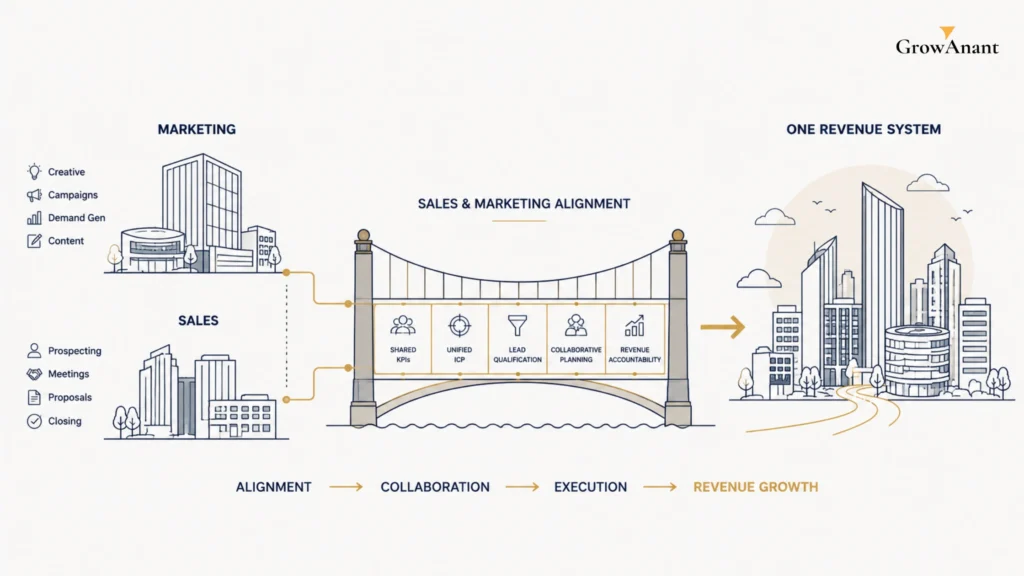
Many businesses invest heavily in marketing campaigns and sales teams yet continue to struggle with inconsistent pipeline, rising acquisition costs, and unpredictable revenue. The problem is often not a lack of effort but a lack of alignment. Digital Marketing Consulting Services help organizations connect strategy, execution, and measurement so marketing and sales operate as one revenue-focused system rather than two independent functions.
Whether a business is scaling a SaaS platform, expanding professional services, or entering new markets, aligning growth marketing services, B2B marketing, and sales activities creates a stronger foundation for sustainable revenue growth. Instead of measuring departmental success separately, high-performing organizations focus on shared business outcomes.
Why alignment matters
Sales and marketing alignment means both teams work toward the same revenue objectives using shared processes, customer definitions, and performance metrics. Rather than marketing focusing solely on lead generation and sales focusing only on closing deals, both functions collaborate throughout the customer journey.
Without alignment, businesses commonly experience:
- Poor lead quality
- Long sales cycles
- Rising customer acquisition costs
- Funnel leakage
- Low conversion rates
- Limited visibility into revenue performance
These issues become even more significant during business expansion or market entry, where every investment must contribute toward measurable outcomes.
Misaligned vs Aligned Revenue Teams
| Misaligned Teams | Aligned Teams |
| Marketing measures lead volume | Marketing measures qualified pipeline |
| Sales rejects large numbers of leads | Shared qualification process |
| Different customer definitions | Unified Ideal Customer Profile |
| Separate reporting systems | Shared revenue dashboards |
| Departmental goals | Revenue-focused business goals |
For example, a B2B software company may generate hundreds of monthly inquiries through content marketing while the sales team reports that few prospects are ready to purchase. Instead of increasing advertising spend, leadership should evaluate qualification criteria, messaging, and buyer targeting.
Organizations working with a demand generation agency or growth consulting services often discover that stronger alignment produces more predictable results than simply increasing marketing activity. Growth partners such as GrowAnant help businesses connect demand generation, sales execution, and revenue planning into scalable growth systems.
Shared KPIs
Shared KPIs ensure that marketing and sales evaluate success using the same business outcomes instead of competing departmental metrics. When both teams are accountable for revenue performance, collaboration naturally improves.
Recommended Shared Revenue KPIs
| KPI | Business Value |
| Qualified pipeline | Measures future revenue opportunities |
| Marketing Qualified Leads (MQLs) | Evaluates campaign quality |
| Sales Qualified Leads (SQLs) | Measures lead readiness |
| Opportunity-to-close rate | Indicates sales effectiveness |
| Customer Acquisition Cost (CAC) | Tracks acquisition efficiency |
| Revenue contribution | Connects activities to business outcomes |
KPI Alignment Checklist
✔ Agree on common revenue objectives.
✔ Define qualification criteria together.
✔ Review pipeline performance jointly.
✔ Measure conversion across every funnel stage.
✔ Use shared dashboards for reporting and forecasting.
For instance, a professional services firm may notice that marketing consistently achieves lead targets while sales struggles to convert opportunities. Shared KPIs help identify whether the issue lies in audience targeting, messaging, qualification standards, or follow-up processes rather than assigning blame to one department.
Businesses investing in revenue growth consulting, growth marketing services, and B2B lead generation services often see stronger decision-making because every performance discussion is linked directly to measurable revenue outcomes rather than isolated activity metrics.
Shared ICP
A shared Ideal Customer Profile (ICP) is the foundation of effective sales and marketing alignment. Without a common understanding of who the business should target, marketing may generate high volumes of leads while sales pursues a completely different audience. This disconnect increases acquisition costs, reduces conversion rates, and creates an unpredictable pipeline.
A shared ICP should be based on customer data rather than assumptions. It should define the industries, company sizes, decision-makers, business challenges, buying intent, and revenue potential that represent the best fit for the organization.
Shared ICP Framework
| Element | Questions to Define |
| Industry | Which industries generate the highest customer value? |
| Company Size | Which businesses benefit most from the solution? |
| Decision Makers | Who influences purchasing decisions? |
| Business Challenges | What problems create urgency? |
| Buying Signals | Which actions indicate purchase intent? |
| Revenue Potential | Which customers offer long-term value? |
For example, a SaaS company offering workflow automation may discover that mid-market healthcare providers convert faster than enterprise manufacturers. By refining the ICP, both marketing and sales focus on higher-quality opportunities instead of pursuing every inquiry.
Organizations using business growth consulting, growth strategy consulting, or go to market strategy consulting often improve pipeline quality simply by creating a shared understanding of their highest-value customers.
Better handoffs
Even when marketing generates qualified prospects, poor handoffs between marketing and sales can reduce conversion rates. Delayed follow-up, incomplete customer information, or unclear qualification standards frequently cause opportunities to stall before meaningful conversations begin.
A structured handoff process ensures that every qualified lead moves smoothly into the sales pipeline with the context needed for productive engagement.
Lead Handoff Checklist
✔ Establish clear MQL-to-SQL qualification criteria.
✔ Share complete customer interaction history.
✔ Define expected response times.
✔ Create a feedback process between marketing and sales.
✔ Review lost opportunities to improve future qualification.
For instance, a professional services firm may use webinars to generate executive-level interest. If sales receives attendee details without information about engagement, business challenges, or content consumed, follow-up conversations become less relevant. Sharing this information improves personalization and increases the likelihood of meaningful sales discussions.
Many businesses working with a B2B growth marketing agency or digital marketing consulting services strengthen revenue performance by standardizing lead management rather than simply increasing campaign activity.
Revenue accountability
True alignment exists when both sales and marketing are accountable for revenue instead of individual departmental metrics. Marketing contributes to pipeline generation, sales converts qualified opportunities, and leadership measures performance using shared business outcomes.
Revenue Accountability Framework
| Responsibility | Marketing | Sales | Leadership |
| Pipeline generation | ✔ | Shared | Oversight |
| Lead qualification | ✔ | ✔ | Governance |
| Revenue forecasting | Support | ✔ | Review |
| Customer insights | ✔ | ✔ | Strategic decisions |
| Revenue growth | Shared ownership | Shared ownership | Business accountability |
A founder-led business expanding into the U.S. market, for example, may initially track website traffic and lead volume. As the organization matures, leadership should prioritize qualified pipeline, conversion rates, customer acquisition costs, and revenue contribution to evaluate overall business performance.
Strategic growth partners such as GrowAnant help organizations align demand generation, sales execution, and growth strategy into integrated revenue systems. This creates stronger visibility across the customer journey and supports long-term business growth through coordinated decision-making rather than isolated departmental success.
References
FAQs
Sales and marketing often conflict because they measure success differently. Marketing may prioritize lead volume and campaign performance, while sales focuses on qualified opportunities and closed revenue. Without shared goals, qualification criteria, and communication processes, both teams develop different expectations of success. Aligning objectives and creating common KPIs helps eliminate these disconnects.
Companies align sales and marketing by establishing a shared Ideal Customer Profile (ICP), agreeing on lead qualification standards, tracking common revenue KPIs, creating structured lead handoff processes, and holding regular pipeline review meetings. These practices ensure both teams work toward the same business outcomes rather than separate departmental goals.
Both teams should share KPIs that directly influence revenue, including qualified pipeline, Marketing Qualified Leads (MQLs), Sales Qualified Leads (SQLs), opportunity-to-close rate, customer acquisition cost (CAC), conversion rates, revenue contribution, and forecast accuracy. Shared metrics improve collaboration and strengthen accountability across the customer journey.
Pipeline ownership should be shared. Marketing is responsible for generating qualified demand and attracting the right prospects, while sales is responsible for advancing and converting qualified opportunities. Leadership oversees the complete pipeline to ensure alignment, remove operational bottlenecks, and maintain predictable revenue performance.