
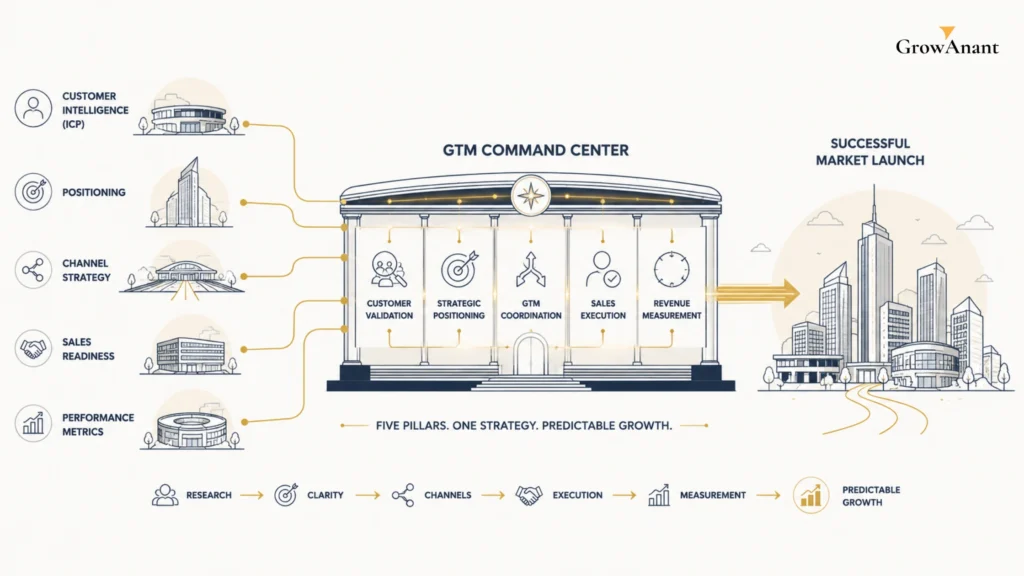
Launching a product or entering a new market requires more than a great idea. Many founders invest in marketing campaigns, sales hiring, or product development before validating whether every part of their go-to-market strategy is ready for execution. B2B Marketing Strategy Consulting helps businesses reduce this risk by creating structured plans that connect positioning, customer acquisition, sales execution, and revenue goals.
Whether you are launching a SaaS platform, expanding professional services, or executing a market entry strategy USA, a well-designed go to market strategy consulting framework ensures every business function works toward predictable business growth. Instead of relying on assumptions, successful organizations validate every stage before scaling investment.
ICP checklist
A clearly defined Ideal Customer Profile (ICP) is the starting point of every successful GTM strategy. Without a shared understanding of the right customer, marketing campaigns generate low-quality leads, sales cycles become longer, and acquisition costs increase.
An effective ICP should identify not only who the customer is but also why they are likely to buy, the challenges they face, and the value your solution delivers.
ICP Validation Checklist
| Area | Questions to Answer |
| Industry | Which industries gain the highest value? |
| Company Size | Which businesses are the best fit? |
| Decision Makers | Who approves purchasing decisions? |
| Business Challenges | What problems require immediate attention? |
| Buying Triggers | What events create purchasing urgency? |
| Revenue Potential | Which customers generate long-term value? |
For example, a B2B SaaS company may initially target all mid-sized businesses. After customer research, it may discover that logistics companies with 100 to 500 employees achieve faster implementation and higher retention than other industries. Refining the ICP enables both marketing and sales to focus on higher-value opportunities.
Many organizations investing in growth strategy consulting, business growth consulting, or startup growth strategy consulting improve pipeline quality by strengthening customer targeting before increasing marketing spend.
Positioning checklist
Even the strongest product struggles if customers cannot immediately understand its value. Effective positioning explains who the solution is for, the problem it solves, and why it is different from competing alternatives.
Strong positioning supports every GTM activity, including website messaging, sales conversations, advertising, and content marketing.
Positioning Framework
| Element | Strategic Question |
| Target Audience | Who benefits most from the solution? |
| Business Problem | What challenge is being solved? |
| Value Proposition | What measurable business outcome is delivered? |
| Differentiation | Why choose this solution over competitors? |
| Proof | What evidence supports the value proposition? |
Positioning Checklist
✔ Clearly define the primary business problem.
✔ Focus messaging on customer outcomes rather than product features.
✔ Differentiate from competitors using measurable business value.
✔ Validate messaging through customer interviews.
✔ Ensure marketing and sales communicate the same value proposition.
For instance, a professional services firm entering the U.S. market may discover that buyers respond more strongly to faster implementation and strategic guidance than to technical capabilities alone. Refining positioning before launch creates more relevant messaging and improves conversion across the customer journey.
Organizations working with B2B marketing strategy consulting, go to market strategy consulting, and experienced growth partners such as GrowAnant often validate positioning early because clear messaging strengthens every subsequent stage of demand generation and revenue execution.
Channel checklist
Selecting the right channels is a strategic decision, not simply a marketing preference. Every channel should support the buying behavior of your Ideal Customer Profile (ICP) and contribute to qualified pipeline generation. Expanding across too many channels too early often increases costs without improving revenue outcomes.
Instead of asking, “Which channel is most popular?” founders should ask, “Where do our ideal buyers research, evaluate, and purchase solutions?”
GTM Channel Evaluation Framework
| Channel | Best Used For |
| Organic Search | Long-term demand generation and buyer education |
| B2B decision-maker engagement and thought leadership | |
| Google Search Ads | High-intent buyer acquisition |
| Email Marketing | Lead nurturing and customer retention |
| Industry Events & Webinars | Relationship building and enterprise opportunities |
| Partner Programs | Referral-driven business growth |
Channel Selection Checklist
✔ Prioritize channels where decision-makers actively research solutions.
✔ Match channel investment to business objectives and budget.
✔ Test one or two acquisition channels before expanding.
✔ Measure pipeline contribution instead of traffic alone.
✔ Optimize channels based on qualified opportunities and revenue impact.
For example, a SaaS company targeting CFOs may achieve stronger results through LinkedIn thought leadership and Google Search than broad social media campaigns. Businesses investing in growth strategy consulting and growth marketing services often reduce customer acquisition costs by focusing on channels aligned with buyer intent rather than channel popularity.
Sales checklist
A successful GTM strategy extends beyond marketing. Sales processes must be prepared to convert demand into predictable revenue. Without structured sales execution, even high-quality marketing campaigns fail to deliver consistent business results.
Sales Readiness Checklist
✔ Define clear qualification criteria for every opportunity.
✔ Create a documented sales process with defined stages.
✔ Prepare messaging for common customer objections.
✔ Build standardized proposals and follow-up workflows.
✔ Align sales reporting with marketing performance metrics.
Sales Readiness Framework
| Sales Area | Key Objective |
| Lead Qualification | Prioritize high-fit opportunities |
| Discovery Process | Understand customer challenges |
| Proposal Process | Present measurable business value |
| Follow-up Strategy | Maintain buying momentum |
| Forecasting | Improve revenue predictability |
Consider a founder-led consulting business entering the U.S. market. Marketing may generate qualified executive inquiries, but without a repeatable sales process, response quality varies across prospects. Standardizing discovery calls, qualification criteria, and proposal development improves conversion rates and creates a more consistent customer experience.
Many organizations working with B2B lead generation services, digital marketing consulting services, or a professional services marketing agency discover that improving sales execution increases revenue more effectively than increasing lead volume.
Metrics checklist
Go-to-market success should be measured using metrics that reflect business performance rather than marketing activity. Traffic, impressions, and clicks provide useful context, but they should not become primary indicators of GTM effectiveness.
Essential GTM Metrics
| KPI | Why It Matters |
| Qualified Pipeline | Indicates future revenue potential |
| Customer Acquisition Cost (CAC) | Measures acquisition efficiency |
| Conversion Rate | Evaluates funnel performance |
| Sales Cycle Length | Tracks buying efficiency |
| Customer Lifetime Value (LTV) | Measures long-term customer value |
| Revenue Forecast Accuracy | Supports strategic planning |
GTM Measurement Checklist
✔ Define baseline metrics before launch.
✔ Monitor pipeline quality instead of lead quantity.
✔ Review marketing and sales metrics together.
✔ Identify funnel leakage at every stage.
✔ Continuously refine campaigns based on business outcomes.
Strategic advisors such as GrowAnant help businesses build reporting frameworks that connect business growth consulting, growth roadmap consulting, and demand generation into a single measurement system. This allows founders and leadership teams to make investment decisions based on predictable revenue performance instead of isolated marketing metrics.
Launch checklist
A successful launch is not defined by the day a product enters the market. It is measured by how effectively every component of the go-to-market strategy works together to generate qualified demand, support sales execution, and create sustainable revenue growth. Before increasing investment, founders should confirm that their GTM foundation is complete.
GTM Launch Checklist
✔ Validate the Ideal Customer Profile with real customer feedback.
✔ Confirm positioning is consistent across the website, sales materials, and marketing campaigns.
✔ Ensure marketing and sales share qualification criteria and revenue KPIs.
✔ Launch with clearly defined acquisition channels and budgets.
✔ Monitor pipeline, conversion rates, and customer feedback from the first day.
✔ Establish a regular review process to refine messaging, channels, and execution.
For example, a SaaS company launching into the U.S. market may begin with one industry segment, a focused Google Search campaign, and targeted LinkedIn outreach instead of attempting nationwide expansion immediately. Early performance data helps refine positioning, pricing, and sales execution before additional investment.
Similarly, a professional services firm expanding into a new vertical can validate messaging with a limited audience, improve proposals based on customer feedback, and scale only after demonstrating consistent demand and conversion.
Many growth-stage businesses discover that isolated marketing activities fail to produce sustainable results. Strategic partners such as GrowAnant help organizations combine go to market strategy consulting, growth consulting services, and growth strategy into repeatable systems that align marketing, sales, and leadership around measurable revenue outcomes.
References
FAQs
Every GTM strategy should include a clearly defined Ideal Customer Profile, differentiated positioning, selected acquisition channels, a structured sales process, measurable KPIs, and a launch plan with ongoing performance reviews. These elements work together to support scalable and predictable growth.
A GTM checklist is a structured framework that helps businesses prepare for product launches, market expansion, or new service offerings. It ensures that customer targeting, positioning, marketing, sales, and performance measurement are aligned before significant investment.
The timeline depends on business complexity, product maturity, and market readiness. For many B2B organizations, GTM planning takes several weeks to a few months, allowing time for customer research, positioning validation, channel selection, and sales preparation before launch.
Go-to-market strategy is a shared responsibility. Leadership establishes strategic direction, marketing generates demand, sales converts opportunities, and customer success supports retention and expansion. Cross-functional collaboration ensures every team contributes to revenue growth through a unified GTM approach.