
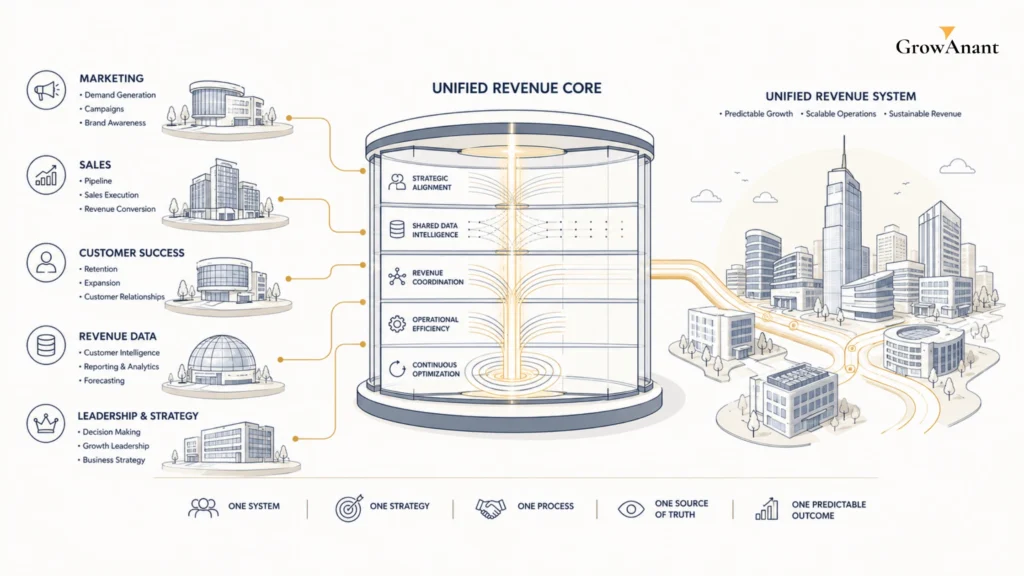
Growth rarely slows because businesses lack ambition. More often, revenue becomes unpredictable because marketing, sales, and customer success operate independently with different goals, metrics, and data. Revenue Growth Consulting addresses this challenge by helping organizations build Revenue Operations (RevOps), a framework that aligns teams, processes, and technology around sustainable revenue generation.
Whether a SaaS company is scaling, a professional services firm is expanding into new markets, or a startup is refining its growth strategy consulting approach, RevOps creates a single operating model that improves visibility, collaboration, and decision-making. Instead of optimizing individual departments, RevOps optimizes the entire customer journey to support long-term business growth.
What is Revenue Operations?
Revenue Operations, commonly known as RevOps, is a strategic business function that unifies marketing, sales, and customer success through shared processes, technology, data, and performance metrics. Its objective is to create a consistent revenue engine rather than isolated departmental success.
Unlike traditional organizational structures where each team operates independently, RevOps encourages cross-functional alignment that improves forecasting, customer experience, and operational efficiency.
Traditional Operations vs Revenue Operations
| Traditional Approach | Revenue Operations Approach |
| Separate departmental goals | Shared revenue objectives |
| Multiple reporting systems | Unified revenue dashboard |
| Siloed customer data | Centralized customer insights |
| Independent decision-making | Cross-functional collaboration |
| Limited revenue visibility | End-to-end pipeline visibility |
For example, a U.S.-based SaaS company may generate a large number of marketing-qualified leads, while the sales team struggles with low conversion rates and customer success experiences higher-than-expected churn. RevOps identifies these disconnects, allowing leadership to improve the entire revenue process rather than optimizing one department at a time.
Organizations investing in growth consulting services, business growth consulting, and growth strategy consulting frequently adopt RevOps because it strengthens strategic planning and improves coordination across revenue-generating functions.
Marketing, Sales & Customer Success alignment
Alignment between marketing, sales, and customer success is one of the defining characteristics of an effective Revenue Operations strategy. When these teams pursue different objectives, businesses often experience inconsistent lead quality, slower sales cycles, fragmented customer experiences, and limited revenue visibility.
A unified approach ensures that every team contributes to the same business outcomes instead of optimizing separate performance metrics.
Revenue Alignment Framework
| Team | Primary Responsibility | Shared Revenue Objective |
| Marketing | Generate qualified demand | Increase pipeline quality |
| Sales | Convert qualified opportunities | Improve revenue conversion |
| Customer Success | Retain and expand customers | Increase customer lifetime value |
Alignment Checklist
✔ Define shared revenue KPIs across all teams.
✔ Standardize lead qualification criteria.
✔ Maintain consistent customer messaging throughout the buying journey.
✔ Conduct regular cross-functional pipeline reviews.
✔ Use centralized reporting to evaluate marketing, sales, and customer success performance together.
Consider a founder-led technology company preparing for U.S. expansion. Marketing generates strong website traffic, sales focuses on closing enterprise accounts, and customer success prioritizes retention. Without aligned objectives, leadership struggles to identify which activities drive revenue. RevOps creates a common measurement framework that enables better investment decisions and improved execution.
Growth partners such as GrowAnant often help businesses integrate revenue growth consulting, growth consulting, and growth leadership into a unified operating model, enabling teams to focus on sustainable revenue outcomes instead of isolated departmental performance.
Revenue data
Accurate and accessible data is the foundation of every successful Revenue Operations strategy. Without a single source of truth, leadership teams struggle to understand pipeline health, customer behavior, marketing performance, and sales effectiveness. Different reports from different departments often result in conflicting decisions and missed growth opportunities.
RevOps centralizes revenue data so every team works from the same metrics and customer insights.
Revenue Data Framework
| Data Category | Business Value |
| Marketing Performance | Measure campaign contribution to pipeline |
| Sales Pipeline | Track opportunity progression and win rates |
| Customer Success | Monitor retention and expansion opportunities |
| Revenue Performance | Evaluate recurring and new revenue trends |
| Customer Journey | Identify friction across the buying lifecycle |
Revenue Data Checklist
✔ Create one centralized reporting system.
✔ Standardize KPI definitions across departments.
✔ Integrate CRM, marketing automation, and customer success platforms.
✔ Review revenue dashboards regularly with leadership.
✔ Use data to improve strategic decision-making rather than reporting activity alone.
For example, a professional services company may discover that most qualified opportunities originate from thought leadership content rather than paid advertising. Unified reporting helps leadership allocate resources more effectively and improve return on investment. Businesses adopting business growth consulting, growth roadmap consulting, and growth consulting services USA often prioritize centralized data before expanding demand generation efforts.
Forecasting
Reliable forecasting allows businesses to make informed decisions about hiring, marketing investment, expansion, and resource planning. Traditional forecasting often depends on sales intuition or historical trends, while RevOps uses real-time pipeline data and standardized processes to improve accuracy.
Revenue Forecasting Framework
| Forecasting Element | Strategic Purpose |
| Qualified Pipeline | Estimate future revenue potential |
| Opportunity Stages | Measure deal progression |
| Conversion Rates | Predict expected outcomes |
| Sales Cycle Length | Improve revenue timing |
| Customer Retention | Forecast recurring revenue |
Forecasting Checklist
✔ Establish consistent opportunity stages.
✔ Measure conversion rates at every funnel stage.
✔ Review forecasts using current pipeline data.
✔ Include customer retention alongside new business projections.
✔ Update forecasts regularly as market conditions change.
Consider a startup preparing to launch a new B2B software solution. Instead of forecasting revenue based solely on lead volume, the company analyzes qualified opportunities, average deal size, conversion rates, and implementation timelines. This approach provides a more realistic revenue outlook and supports better financial planning.
Organizations working with revenue growth consulting, startup growth strategy consulting, and go to market strategy consulting often strengthen forecasting before increasing sales and marketing investments, reducing uncertainty as they scale.
Operational efficiency
Operational efficiency is not simply about reducing costs. It is about removing friction that slows customer acquisition, delays decision-making, or creates inconsistent customer experiences. RevOps improves efficiency by standardizing workflows, automating repetitive processes, and aligning responsibilities across teams.
Operational Efficiency Checklist
✔ Document repeatable revenue processes.
✔ Automate routine reporting and lead routing.
✔ Reduce duplicate systems and manual data entry.
✔ Define ownership for every stage of the customer journey.
✔ Review operational performance continuously.
High-Impact Operational Improvements
| Improvement Area | Business Impact |
| Automated Lead Routing | Faster sales response |
| Standardized CRM Processes | Improved data quality |
| Unified Revenue Reporting | Better executive visibility |
| Workflow Automation | Higher team productivity |
| Cross-functional Reviews | Faster issue resolution |
For example, a SaaS company experiencing rapid growth may find that marketing generates qualified leads faster than sales can respond. Automating lead assignments and standardizing CRM workflows reduces response times and improves the overall buying experience.
Strategic growth partners such as GrowAnant help organizations connect growth consulting services, digital marketing consulting services, B2B lead generation services, and growth strategy into operational systems that support scalable, measurable revenue performance rather than isolated marketing activities.
Revenue systems
Revenue Operations delivers the greatest value when it evolves from a reporting function into a repeatable revenue system. Rather than relying on individual teams or one-time initiatives, businesses establish standardized processes that connect strategy, execution, measurement, and continuous improvement.
A strong revenue system creates accountability across every customer-facing function while enabling leadership to make faster, data-driven decisions. As markets change, these systems allow organizations to adapt without losing visibility into pipeline performance or operational efficiency.
Revenue System Framework
| Component | Strategic Purpose |
| Shared Revenue Goals | Align marketing, sales, and customer success |
| Unified Technology Stack | Enable consistent customer data |
| Standardized Processes | Improve execution across teams |
| Revenue Dashboards | Support executive decision-making |
| Continuous Optimization | Refine performance through ongoing analysis |
Revenue Systems Checklist
✔ Define shared revenue objectives across departments.
✔ Integrate technology platforms into a unified reporting ecosystem.
✔ Review pipeline performance using consistent KPIs.
✔ Optimize workflows based on customer and revenue data.
✔ Conduct regular cross-functional strategy reviews to identify improvement opportunities.
For example, a founder-led software company expanding into the U.S. market may initially rely on manual reporting across multiple tools. As customer acquisition grows, fragmented data makes forecasting and resource planning increasingly difficult. Implementing a structured RevOps system provides leadership with a single view of pipeline performance, customer retention, and revenue trends, supporting more confident strategic decisions.
Many growth-stage organizations discover that sustainable scaling depends on more than increasing marketing activity. Strategic growth partners such as GrowAnant help businesses combine Revenue Growth Consulting, growth consulting services, growth strategy consulting, and business growth consulting into integrated revenue systems that connect demand generation, sales execution, and customer success with measurable business outcomes.
References
- HubSpot
- Harvard Business Review
https://hbr.org
FAQs
Revenue Operations (RevOps) is a business function that aligns marketing, sales, and customer success through shared processes, technology, data, and performance metrics. Its goal is to improve revenue predictability, operational efficiency, and customer experience across the entire revenue lifecycle.
RevOps matters because it eliminates departmental silos, improves collaboration, increases visibility into the revenue pipeline, enhances forecasting accuracy, and helps leadership make data-driven decisions that support sustainable business growth.
Ownership varies by organization. In many companies, RevOps is led by a dedicated Revenue Operations leader, while growth-stage businesses may assign responsibility to a fractional growth executive, fractional head of growth, or leadership team that coordinates marketing, sales, and customer success around shared revenue objectives.
No. RevOps benefits businesses of all sizes. Startups, SaaS companies, professional service firms, and SMBs can use Revenue Operations to build scalable processes, improve cross-functional alignment, and create more predictable revenue as they grow.