
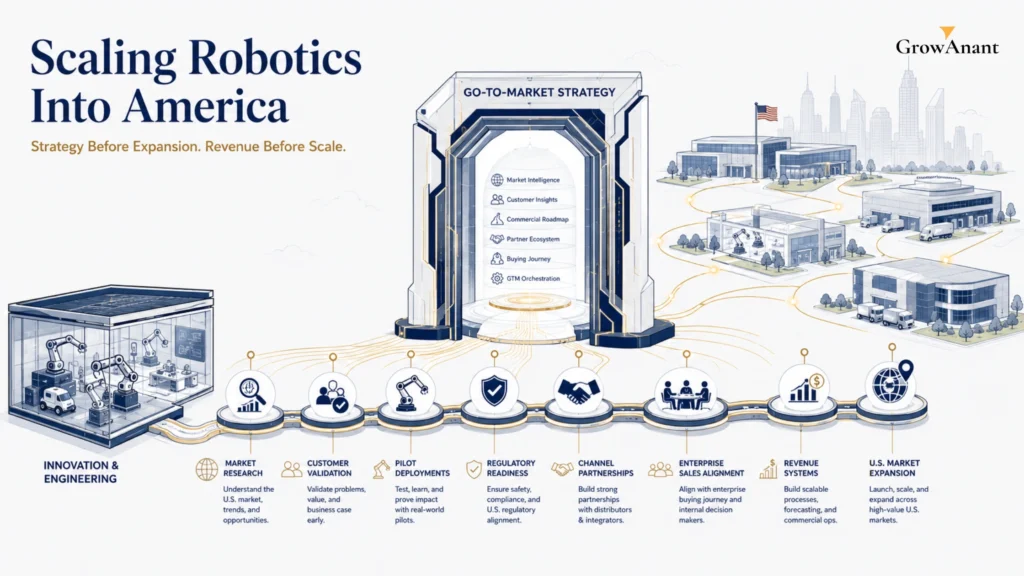
Expanding into the United States presents one of the largest commercial opportunities for robotics and hardware companies. However, unlike software businesses, physical products face longer sales cycles, certification requirements, channel complexity, and higher customer expectations. A successful gtm strategy for robotics startups us market requires much more than launching marketing campaigns. It demands a structured commercialization plan that aligns product readiness, distribution, customer validation, and revenue execution.
Many founders mistakenly apply SaaS playbooks to hardware businesses, resulting in delayed adoption and inefficient spending. Instead, combining go to market strategy consulting, market entry strategy USA, and growth strategy consulting helps organizations reduce uncertainty while building a scalable path toward commercial success.
Whether developing industrial robots, warehouse automation, medical devices, or manufacturing equipment, founders must understand how purchasing decisions differ across enterprise buyers. Decision-makers evaluate reliability, integration, compliance, total cost of ownership, and long-term support before approving purchases.
For companies entering the United States from overseas, particularly through us market entry consulting for indian companies, success often depends on combining local partnerships with a clear commercialization roadmap instead of relying solely on product innovation.
Why Hardware GTM Differs From SaaS
Although both SaaS and robotics businesses require customer acquisition, their commercial models differ significantly. Hardware companies manage manufacturing, logistics, installation, maintenance, and compliance alongside marketing and sales.
SaaS vs Hardware GTM Comparison
| Area | SaaS | Robotics & Hardware |
| Delivery | Instant deployment | Manufacturing and shipping |
| Sales Cycle | Weeks to months | Often several months |
| Buying Process | Department-level | Cross-functional procurement |
| Customer Validation | Product trials | Demonstrations and pilot programs |
| Implementation | Digital onboarding | Installation and integration |
| Revenue Model | Subscription | Equipment sales plus recurring services |
Because of these differences, founders benefit from combining business strategy consulting USA, startup growth strategy consulting, and business growth consulting before investing heavily in demand generation.
Why Traditional Marketing Is Not Enough
Hardware buyers typically evaluate vendors across multiple stages:
- Technical feasibility
- Operational compatibility
- Regulatory compliance
- Return on investment
- Long-term service capability
- Supply chain reliability
This means marketing must support engineering, sales, operations, and customer success rather than operate independently.
For example, a warehouse robotics startup selling automation solutions to U.S. logistics companies may generate qualified leads through content marketing, but purchase decisions often require facility visits, engineering reviews, pilot deployments, and executive approval before contracts are signed.
Many growth-stage companies work with strategic partners such as GrowAnant to connect growth consulting services, commercialization planning, and demand generation into a single growth system rather than treating each function separately.
Validating Product-Market Fit in the U.S.
Product-market fit achieved in one geography does not automatically translate to the U.S. market. Customer expectations, competitive landscapes, procurement processes, and regulatory requirements often differ significantly.
Instead of pursuing rapid expansion, founders should first validate demand through structured market testing.
Product-Market Validation Framework
| Stage | Objective |
| Market Research | Understand buyer priorities |
| Customer Discovery | Interview target users |
| Pilot Projects | Validate operational value |
| Feedback Collection | Improve product-market alignment |
| Commercial Scaling | Expand successful deployments |
Practical Validation Checklist
✔ Identify industries with the strongest automation demand.
✔ Interview operations leaders before building sales campaigns.
✔ Validate pricing assumptions against U.S. competitors.
✔ Run pilot installations with measurable business outcomes.
✔ Refine positioning based on customer feedback instead of internal assumptions.
For example, an industrial inspection robotics company may initially target manufacturing but discover stronger demand in utilities or energy infrastructure after conducting customer interviews. Early validation reduces wasted marketing spend while strengthening future sales conversations.
Distributor and Channel Partnerships
For many robotics and hardware companies, scaling through direct sales alone is expensive and slow. Strategic channel partners can accelerate market entry by providing local relationships, technical expertise, and implementation support.
Potential partners include:
- Industrial equipment distributors
- Value-added resellers (VARs)
- Systems integrators
- Manufacturing consultants
- Industry-specific technology partners
Rather than pursuing dozens of partnerships, prioritize organizations that already serve your ideal customer profile.
Channel Selection Framework
| Channel | Best For | Considerations |
| Direct Sales | Enterprise accounts | Greater control but higher acquisition costs |
| Distributors | Regional expansion | Faster market reach with lower control |
| System Integrators | Complex deployments | Strong technical credibility |
| OEM Partnerships | Product integration | Long sales cycles but scalable growth |
Combining strategic partnerships with startup consulting services USA, growth roadmap consulting, and digital growth agency expertise helps founders build a repeatable market entry model instead of relying on opportunistic sales.
Regulatory & Certification Considerations
Compliance is often a deciding factor in U.S. purchasing decisions. Enterprise buyers expect products to meet industry standards before considering large-scale deployment.
Depending on the product category, companies may need certifications such as:
- UL safety certification
- FCC compliance
- OSHA-related workplace requirements
- Industry-specific manufacturing standards
- Cybersecurity and data privacy compliance for connected devices
Founders should include certification planning in their commercialization roadmap rather than treating it as a post-launch activity. Delays in regulatory readiness can postpone customer deployments and slow revenue growth.
Building Early Customer Relationships
Enterprise hardware sales are built on trust as much as technology. Buyers want confidence that vendors can support implementation, training, maintenance, and long-term reliability.
A practical relationship-building framework includes:
- Publish educational thought leadership addressing industry challenges.
- Demonstrate the product through pilots or proof-of-concept projects.
- Develop customer success plans before contracts are signed.
- Gather measurable case studies from early adopters.
- Maintain regular executive communication throughout the buying journey.
For example, a warehouse automation startup may secure its first enterprise customer through a six-month pilot that demonstrates labor savings and operational efficiency before expanding into a multi-site deployment.
Organizations working with growth partners such as GrowAnant often integrate growth consulting services, business growth consulting, and commercialization planning to align sales, partnerships, and customer success around long-term revenue objectives rather than isolated campaigns.
Common Mistakes
Many robotics startups delay growth by making avoidable commercialization mistakes.
Common pitfalls include:
- Treating hardware GTM like a SaaS launch.
- Expanding nationally before validating regional demand.
- Ignoring certification and compliance timelines.
- Investing heavily in advertising before refining positioning.
- Building too many channel partnerships without clear accountability.
- Measuring marketing activity instead of qualified pipeline and revenue.
Avoiding these mistakes helps create a stronger foundation for sustainable expansion into the U.S. market.
References
Frequently Asked Questions
Hardware GTM involves manufacturing, logistics, certifications, installation, and long enterprise sales cycles in addition to marketing and sales. SaaS companies typically focus on software delivery and recurring subscriptions, while hardware businesses must coordinate physical operations, channel partners, and customer implementation. A successful gtm strategy for robotics startups us market addresses these additional complexities from the beginning.
Not every robotics startup requires distributors, but they can significantly accelerate expansion. Companies selling through regional manufacturing, industrial automation, or enterprise channels often benefit from distributors and system integrators that already have trusted customer relationships. The right partner depends on product complexity, target industry, and long-term commercialization goals.
Certification requirements vary by industry and product type. Common requirements include UL certification, FCC compliance, workplace safety standards, and industry-specific regulatory approvals. Founders should identify applicable certifications during product planning rather than after launch to avoid delays in customer deployment.
Market validation typically takes several months because enterprise buyers often evaluate products through discovery meetings, pilot projects, technical assessments, and procurement reviews before making purchasing decisions. Instead of rushing into full-scale expansion, founders should validate product-market fit with a focused group of target customers before investing in broader commercialization.