
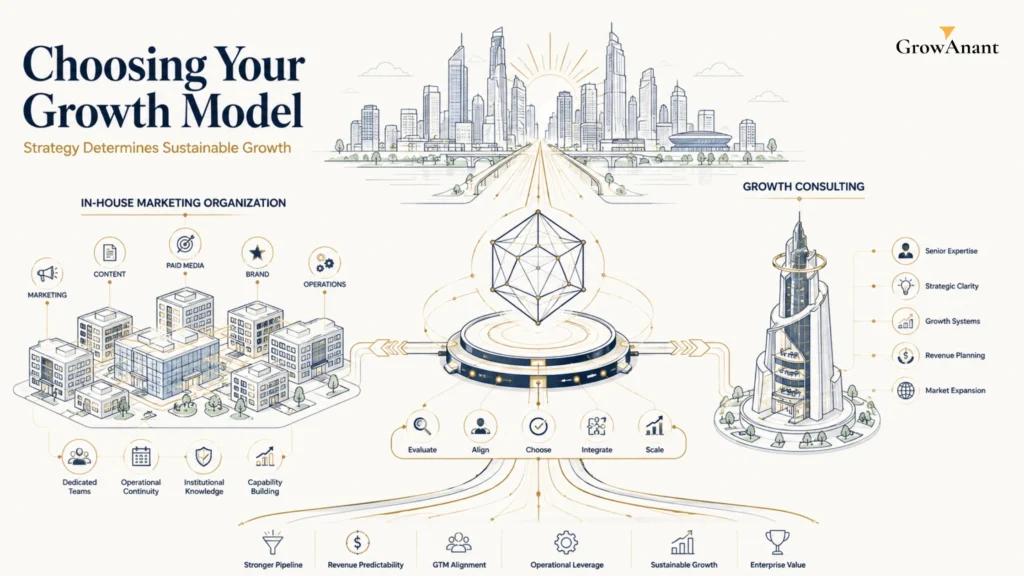
Choosing between growth consulting vs in-house marketing team is one of the most important strategic decisions for founders and executive teams. While both approaches can support expansion, they differ significantly in cost, execution speed, flexibility, expertise, and long-term scalability.
Many businesses assume hiring employees is the only sustainable option. Others rely entirely on consultants without developing internal capabilities. The most successful organizations evaluate their stage of growth, internal resources, and commercial objectives before deciding.
Whether you’re evaluating growth consulting services, business growth consulting, or planning to compare growth consulting vs hiring in-house growth team, the objective should always be the same: building a predictable revenue engine rather than simply expanding headcount.
For growth-stage SaaS companies, professional service firms, and organizations entering new markets, selecting the right operating model can significantly improve execution quality while reducing strategic risk.
Cost Comparison
Cost is often the first factor founders evaluate, but total business impact matters more than salary alone.
Building an internal growth function typically requires recruiting multiple specialists, investing in onboarding, purchasing technology, and allowing time for the team to develop institutional knowledge. In contrast, an experienced growth consultant or fractional growth consultant can provide immediate strategic expertise without requiring a full executive hiring cycle.
Cost Comparison Framework
| Category | In-House Team | Growth Consulting |
| Recruitment | High upfront investment | Minimal hiring effort |
| Salaries & Benefits | Ongoing fixed costs | Flexible engagement costs |
| Technology | Company-funded | Often integrated into engagement |
| Strategic Expertise | Depends on hires | Immediate senior-level experience |
| Scalability | Slower expansion | Easily adjusted as priorities change |
Although consulting engagements are not always less expensive, they often reduce hidden costs such as lengthy recruitment, management overhead, and delayed execution.
For example, an early-stage B2B SaaS company preparing for U.S. expansion may benefit more from growth strategy consulting and startup growth strategy consulting before investing in multiple full-time hires.
Speed to Results
Execution speed is another major differentiator.
An internal team requires time for hiring, onboarding, process development, and cross-functional alignment. Depending on the role, recruitment alone may take several months.
Experienced consultants typically begin with strategic assessments, growth diagnostics, and implementation planning immediately after engagement.
Typical Timeline Comparison
| Activity | In-House | Consulting |
| Recruitment | Several weeks or months | Immediate engagement |
| Strategic Assessment | After team formation | First weeks |
| GTM Planning | Gradual | Accelerated |
| Cross-functional Alignment | Internal development | Guided by experienced leadership |
| Optimization | Builds over time | Begins early through structured frameworks |
This does not mean consulting automatically produces faster revenue outcomes. Instead, it accelerates strategic clarity and reduces the time required to identify growth priorities.
Many organizations partner with firms such as GrowAnant because they need senior leadership capable of aligning revenue growth consulting, go to market strategy consulting, and execution without waiting for an entire internal leadership team to be assembled.
Flexibility & Risk
Business priorities rarely remain constant. New competitors emerge, budgets change, products evolve, and customer expectations shift. The ability to adapt quickly is often more valuable than maintaining a fixed organizational structure.
An in-house team offers continuity and deep company knowledge, but resizing teams or adding specialized expertise can be time-consuming and costly. A consulting engagement provides greater flexibility because businesses can scale support based on growth stages, product launches, or market expansion initiatives.
Flexibility Comparison
| Factor | In-House Team | Growth Consulting |
| Resource Scaling | Slower | Flexible and demand-driven |
| Specialized Expertise | Depends on hiring | Immediate access to specialists |
| Strategic Direction | Internal leadership dependent | Senior external guidance |
| Risk During Market Changes | Higher fixed cost | Lower long-term commitment |
| New Market Expansion | Requires new hiring | Rapid deployment of expertise |
For example, a manufacturing startup entering the U.S. market may require market entry strategy USA, business strategy consulting USA, and digital growth agency expertise for six to nine months rather than permanently expanding its payroll.
Institutional Knowledge Considerations
One concern founders often have is whether consultants leave with valuable knowledge once an engagement ends.
This risk can be minimized by designing engagements around documentation, process development, team enablement, and structured knowledge transfer rather than tactical execution alone.
A mature consulting engagement should produce:
- Growth playbooks
- GTM documentation
- Standard operating procedures
- KPI dashboards
- Customer journey frameworks
- Sales and marketing alignment processes
- Executive reporting templates
Instead of becoming dependent on external advisors, businesses should use consulting to strengthen internal capabilities.
Organizations that invest in growth consulting engagement structure, growth consulting business models, and documentation create long-term assets that remain valuable after the engagement concludes.
Hybrid Models
For many growth-stage businesses, the most effective approach is neither fully outsourced nor entirely in-house.
A hybrid model combines internal execution with external strategic leadership.
Typical Hybrid Growth Structure
| Responsibility | Internal Team | External Growth Partner |
| Daily Marketing Execution | ✔ | |
| Content & Campaign Management | ✔ | |
| Executive Growth Strategy | ✔ | |
| GTM Planning | ✔ | |
| Revenue Forecasting | ✔ | ✔ |
| KPI Reviews | ✔ | ✔ |
| Market Expansion Strategy | ✔ |
This model works particularly well for founder-led companies that already have marketing coordinators or specialists but lack senior strategic leadership.
Rather than replacing employees, a fractional growth consultant helps align marketing, sales, customer success, and executive decision-making around measurable business outcomes. This approach often provides the benefits of experienced leadership while allowing the internal team to continue executing day-to-day initiatives.
Decision Framework
There is no universal answer to growth consulting vs in-house marketing team. The right choice depends on your company’s growth stage, available resources, internal capabilities, and strategic priorities.
Executive Decision Matrix
| Business Situation | Recommended Approach |
| Early-stage startup validating GTM | Growth consulting with focused execution support |
| Scaling SaaS business entering new markets | Hybrid model combining internal execution and consulting |
| Established company with mature marketing operations | Strengthen internal team with specialized consulting when needed |
| Short-term transformation or product launch | Strategic consulting engagement |
| Long-term operational execution | Primarily in-house with periodic strategic reviews |
Before making a decision, founders should ask:
- Do we have experienced growth leadership?
- Are marketing and sales aligned around measurable revenue goals?
- Can our current team support expansion without additional strategic guidance?
- Are we investing in systems that scale or simply adding more people?
Many organizations discover that combining internal execution with experienced growth consulting services creates stronger long-term results than relying exclusively on one model. Growth partners such as GrowAnant help businesses connect strategy, growth systems, demand generation, and revenue execution while enabling internal teams to become more effective over time.
References
Frequently Asked Questions
Not always. While consulting engagements may reduce recruitment, onboarding, and management costs, the best option depends on business size, growth stage, and long-term resource requirements. Companies should compare total business value rather than salary costs alone.
An experienced consulting engagement often accelerates strategic planning because senior expertise is available immediately. However, sustainable business outcomes still depend on execution quality, market conditions, and organizational alignment.
Well-structured consulting engagements include documentation, processes, playbooks, KPI frameworks, and knowledge transfer. This ensures valuable expertise remains with the company after the engagement ends.
Yes. Many growth-stage businesses successfully combine an internal marketing team with external strategic leadership. This approach provides continuous execution while giving founders access to experienced guidance for growth strategy consulting, market expansion, and revenue planning without maintaining a large executive team.