
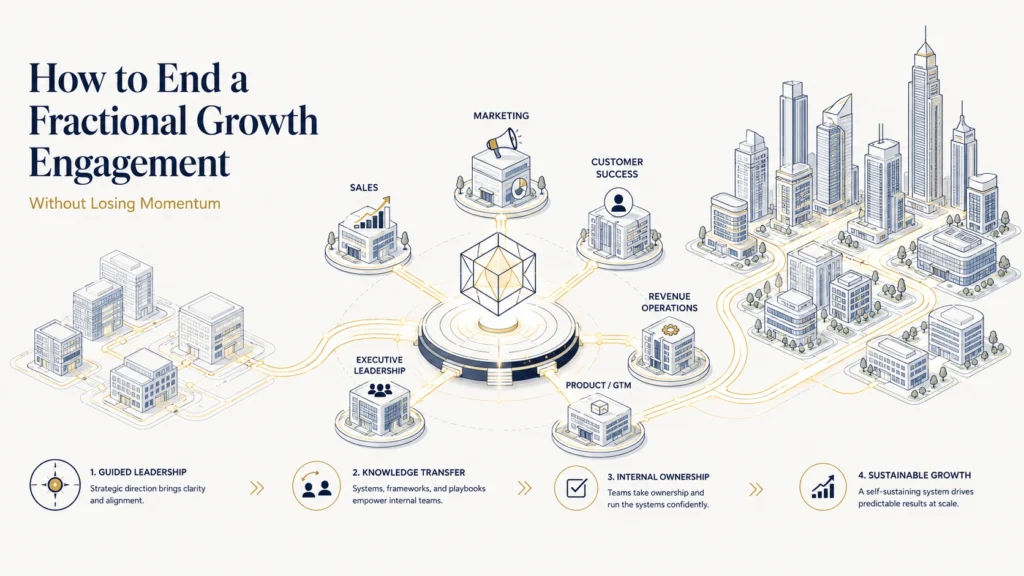
A successful ending a fractional growth engagement should never feel like the end of a growth strategy. Instead, it should represent the transition from externally guided leadership to an organization capable of executing predictable growth independently.
Many companies engage a fractional growth consultant to solve strategic challenges such as entering new markets, improving demand generation, aligning sales and marketing, or building scalable growth systems. Once these objectives are achieved, founders often ask an important question: how do we conclude the engagement without losing momentum?
Without a structured transition, businesses risk inconsistent execution, declining pipeline performance, and the gradual loss of strategic discipline. A well-planned exit preserves institutional knowledge while ensuring internal teams continue executing the roadmap effectively.
Whether supported through growth consulting services, growth strategy consulting, or business growth consulting, the goal should always be to leave the business stronger, more self-sufficient, and prepared for its next stage of growth.
When Engagements Naturally End
A fractional growth leadership engagement typically concludes when the organization has developed the internal capabilities needed to sustain execution.
Common milestones include:
- A repeatable demand generation process
- Clearly documented GTM strategy
- Established executive reporting and KPIs
- Strong alignment between marketing, sales, and customer success
- Internal ownership of strategic initiatives
- Leadership confidence in execution
Rather than measuring success by contract duration, founders should evaluate whether the business can consistently execute its commercial strategy without depending on external leadership.
Indicators That the Engagement Is Complete
| Business Indicator | Meaning |
| Leadership team owns strategic planning | Reduced dependence on external guidance |
| KPIs are consistently reviewed | Strong operational discipline |
| Growth roadmap is documented | Clear execution priorities |
| Cross-functional alignment exists | Marketing and sales operate together |
| Internal decision-making has improved | Sustainable leadership capability |
For example, a B2B SaaS company that initially hired a fractional chief growth officer to launch its U.S. expansion may conclude the engagement once internal marketing leadership, sales processes, and revenue reporting are operating independently.
Many organizations also use this stage to begin a fractional to full-time growth leader transition, replacing temporary executive support with a permanent internal leader while maintaining strategic continuity.
Planning the Transition
The transition process should begin well before the engagement officially ends. Waiting until the final week often creates knowledge gaps and execution risks.
An effective transition plan includes clearly defined responsibilities, timelines, documentation, and leadership ownership.
Transition Checklist
✔ Review strategic objectives achieved during the engagement.
✔ Identify remaining priorities and unresolved initiatives.
✔ Assign permanent owners for every growth process.
✔ Schedule knowledge transfer workshops.
✔ Confirm executive KPI reporting continues after transition.
Organizations that treat transition planning as part of the original engagement often experience smoother leadership changes and stronger long-term execution.
For many founder-led businesses, growth partners such as GrowAnant build transition plans into the engagement itself, ensuring that strategy, documentation, and internal capability development progress together rather than becoming separate activities.
Documenting the Playbook
One of the most valuable outcomes of a fractional growth leadership engagement is not the campaigns executed but the repeatable systems created.
A comprehensive growth playbook enables future leaders to understand how decisions were made and how growth activities should continue.
Essential Playbook Components
| Section | Purpose |
| Growth Strategy | Long-term business objectives and priorities |
| ICP & Positioning | Target markets, buyer personas, and messaging |
| GTM Framework | Customer acquisition and expansion approach |
| KPI Dashboard | Revenue, pipeline, CAC, conversion, and forecasting metrics |
| SOPs | Standard operating procedures for recurring activities |
| Quarterly Roadmap | Upcoming initiatives, milestones, and owners |
The documentation should be practical rather than theoretical. Internal teams should be able to use it immediately without relying on the departing consultant for clarification.
Handoff to the Internal Team
A successful handoff is a structured knowledge transfer, not a single meeting.
Founders should identify an internal owner for every critical function before the engagement concludes.
Handoff Framework
| Responsibility | New Internal Owner |
| Strategic Planning | CEO or Head of Growth |
| Marketing Execution | Marketing Manager |
| Sales Alignment | Sales Leader |
| KPI Reviews | Executive Team |
| GTM Roadmap | Growth Leadership |
To reinforce the transition:
- Conduct walkthrough sessions for key frameworks.
- Review current priorities and future milestones.
- Share reporting templates and decision-making processes.
- Clarify escalation paths for strategic decisions.
This approach ensures the internal team understands not only what to do but also why each growth decision supports broader business objectives.
Avoiding Strategy Drift
One of the biggest risks after ending a fractional growth engagement is strategy drift. Teams often become focused on short-term activities while gradually moving away from the original growth roadmap.
Warning Signs of Strategy Drift
- Marketing metrics replace revenue metrics.
- Teams launch campaigns without strategic alignment.
- Sales and marketing goals begin to diverge.
- Quarterly priorities change without supporting data.
- Executive KPI reviews become inconsistent.
Preventive Checklist
✔ Schedule quarterly strategy reviews.
✔ Continue tracking executive-level KPIs.
✔ Update the growth roadmap every quarter.
✔ Review positioning as markets evolve.
✔ Align marketing, sales, and customer success around shared revenue goals.
Organizations that periodically review their strategy are more likely to maintain momentum after the engagement ends. Some businesses also retain a fractional growth advisory board or occasional strategic reviews to provide objective guidance without maintaining a full-time consulting engagement.
Post-Engagement Support Options
Not every engagement needs to end completely. Many organizations transition from active execution to light-touch strategic guidance that supports long-term growth without creating dependency.
Common Post-Engagement Models
| Support Model | Best For |
| Quarterly Strategy Reviews | Businesses executing independently but needing periodic direction |
| Executive Advisory Retainer | CEOs seeking ongoing strategic input |
| Project-Based Support | Product launches or market expansion initiatives |
| Fractional to full-time growth leader transition | Companies hiring permanent growth leadership |
The right model depends on business maturity, internal capabilities, and future growth objectives. Many founder-led companies retain occasional access to a trusted advisor while their internal team manages day-to-day execution. This approach preserves strategic consistency while allowing the organization to operate independently.
References
Harvard Business Review
Frequently Asked Questions
A fractional growth leadership engagement should conclude when the business has documented processes, clear KPI ownership, aligned leadership, and an internal team capable of executing the growth strategy independently.
Preserve momentum by documenting the complete growth playbook, assigning ownership for every strategic initiative, maintaining executive KPI reviews, and scheduling regular roadmap updates. A structured handoff minimizes disruption and supports long-term execution.
Ownership should typically sit with the CEO, Head of Growth, or another senior leader responsible for commercial performance. While different departments execute individual initiatives, one executive should remain accountable for maintaining the overall growth strategy and ensuring cross-functional alignment.
Yes. Many companies shift from active execution to an advisory relationship that includes quarterly strategy sessions, executive coaching, or project-specific guidance. This model provides continued strategic perspective while allowing the internal team to lead day-to-day operations independently.