
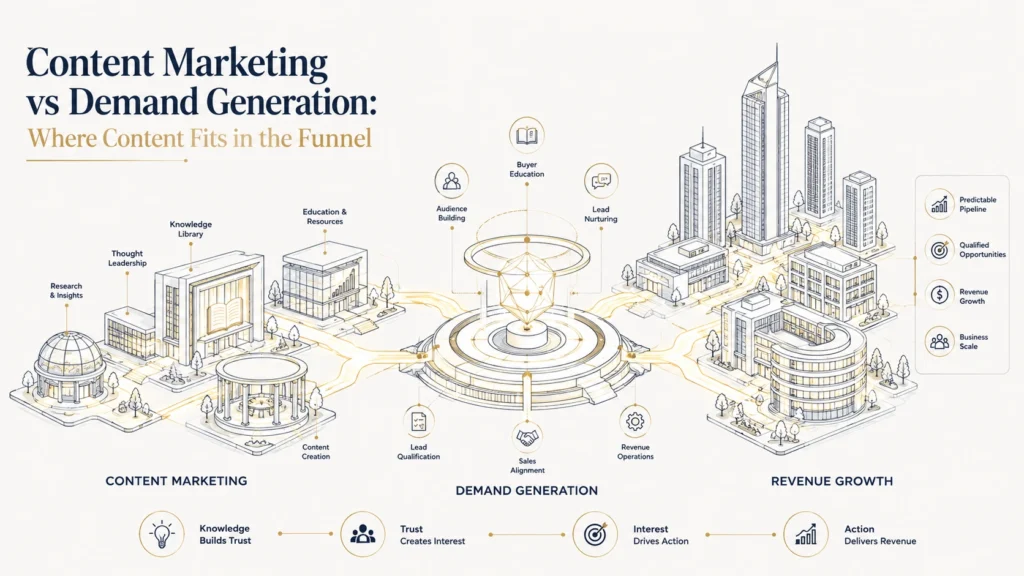
For many B2B companies, one of the biggest strategic questions is content marketing vs demand generation. The terms are often used interchangeably, yet they serve different purposes within a revenue-focused growth strategy.
High-performing organizations recognize that content marketing is one component of a broader demand generation system. While content educates and builds trust, demand generation connects marketing activities to qualified opportunities, pipeline creation, and measurable business outcomes.
Whether you’re leading a SaaS company, a professional services firm, or preparing for U.S. market expansion, understanding how content marketing vs demand generation works together helps allocate resources more effectively and improve marketing ROI.
A strategic demand generation agency or B2B growth marketing agency doesn’t simply create content. It builds integrated programs where growth marketing services, B2B lead generation services, and digital marketing consulting services work together to support sustainable revenue growth.
| Content Marketing | Demand Generation |
| Builds trust and authority | Creates and captures demand |
| Educates prospects | Converts interest into pipeline |
| Supports long-term visibility | Supports measurable revenue outcomes |
| Primarily attracts audiences | Aligns marketing, sales, and revenue |
What Content Marketing Does
Content marketing is the process of creating valuable educational resources that help prospective buyers solve problems before making purchasing decisions.
Instead of selling immediately, content builds credibility, answers questions, and establishes expertise over time.
Examples include:
- Educational blogs
- Industry reports
- Executive guides
- Webinars
- Case studies
- Research reports
- ROI calculators
- Video explainers
For a VP of Marketing, content serves several strategic objectives:
- Improve organic visibility
- Support thought leadership
- Increase buyer confidence
- Reduce friction during evaluation
- Educate multiple buying stakeholders
For example, a cybersecurity SaaS company entering the U.S. market may publish articles explaining compliance challenges, implementation best practices, and industry trends. These resources attract decision-makers long before they request a product demo.
Effective growth marketing services use content to build authority across every stage of the buying journey instead of treating blog publishing as an isolated marketing activity.
Executive Checklist: Strong Content Marketing
✔ Addresses buyer questions
✔ Supports SEO strategy
✔ Aligns with sales conversations
✔ Educates multiple stakeholders
✔ Reinforces brand credibility
✔ Contributes to long-term demand
Content alone, however, does not guarantee qualified pipeline. Without distribution, lead nurturing, attribution, and sales alignment, even exceptional content may generate traffic without meaningful business outcomes.
What Demand Generation Does
While content creates awareness, demand generation turns awareness into measurable business opportunities. It is the coordinated system that combines marketing, sales, data, and customer insights to generate qualified pipeline.
A modern demand generation agency focuses on creating predictable demand rather than simply increasing website visitors. This often includes paid campaigns, email nurturing, webinars, events, account targeting, lead scoring, and sales enablement.
For example, a B2B SaaS company launching in the U.S. might use educational content to attract prospects, LinkedIn campaigns to amplify reach, webinars to engage decision-makers, and lead nurturing to move qualified accounts toward sales conversations.
Many organizations also rely on performance marketing services USA, B2B lead generation services, and digital marketing consulting services to support this process. Together, these initiatives help convert marketing engagement into qualified pipeline.
Demand Generation Framework
| Stage | Primary Objective | Typical Activities |
| Awareness | Reach target buyers | SEO, content, social, PR |
| Engagement | Build trust | Webinars, guides, newsletters |
| Qualification | Identify buying intent | Lead scoring, forms, demos |
| Conversion | Generate opportunities | Sales outreach, meetings |
| Expansion | Support long-term growth | Customer marketing and referrals |
Overlap & Common Confusion
The debate around content marketing vs demand generation often exists because content is an important component of demand generation.
A simple way to understand the relationship is:
- Content marketing builds trust.
- Demand generation builds pipeline.
- Revenue requires both.
Content without demand generation can create readers but few qualified opportunities. Demand generation without quality content often increases acquisition costs because prospects lack the education needed to make informed buying decisions.
Organizations investing in B2B marketing generally achieve stronger results when content, paid acquisition, email nurturing, sales enablement, and attribution operate as one integrated system.
Content’s Role in the Demand Funnel
Content contributes differently at each stage of the buyer journey.
| Funnel Stage | Content Objective | Example Content |
| Awareness | Educate buyers | Blogs, videos, industry insights |
| Consideration | Build credibility | Case studies, comparison guides |
| Decision | Reduce risk | ROI calculators, customer stories |
| Expansion | Increase adoption | Product education, best practices |
This approach also improves demand generation analytics because marketers can connect content engagement to pipeline progression rather than evaluating success solely through page views or downloads.
Growth partners such as GrowAnant help organizations align strategy, content, and execution so every content asset supports measurable revenue objectives instead of existing as a standalone marketing activity.
Measuring Content’s Revenue Impact
One of the most common executive questions is whether content actually contributes to revenue. The answer depends on measuring business outcomes instead of traffic alone.
Content performance should be evaluated using metrics that demonstrate commercial impact, including influenced pipeline, qualified leads, opportunity creation, customer acquisition, and revenue contribution.
Organizations using a b2b marketing attribution model, lead scoring model b2b, and demand generation analytics gain much clearer visibility into which assets influence buying decisions.
Revenue Measurement Checklist
- Measure qualified leads, not only page views.
- Track marketing-qualified and sales-qualified leads.
- Attribute opportunities to content engagement.
- Monitor pipeline influenced by content.
- Compare customer acquisition cost across channels.
- Review conversion rates throughout the buyer journey.
Rather than publishing more content, successful B2B growth marketing agency teams focus on publishing content that directly supports sales conversations and business priorities.
Common Mistakes
Several recurring mistakes reduce the effectiveness of both content marketing and demand generation:
- Measuring success only through website traffic.
- Producing content without a documented buyer journey.
- Publishing inconsistent content that lacks strategic direction.
- Failing to align marketing with sales.
- Ignoring attribution and revenue reporting.
- Treating SEO, paid campaigns, and content as separate initiatives instead of an integrated growth strategy.
Businesses seeking sustainable growth often find that isolated marketing activities generate inconsistent outcomes. Strategic partners such as GrowAnant focus on connecting content, demand generation, pipeline development, and revenue execution into a unified growth system.
References
- HubSpot
- Gartner
FAQs
Yes. Content marketing supports demand generation by educating buyers, building trust, and creating engagement that ultimately contributes to qualified pipeline and revenue.
Content ROI should be measured through influenced pipeline, qualified leads, conversion rates, opportunity creation, customer acquisition, and revenue contribution rather than traffic alone.
Content typically forms the foundation of a demand generation strategy by attracting and educating buyers, while demand generation combines content with distribution, nurturing, and sales alignment.
Content can generate interest and organic visibility, but most B2B organizations achieve stronger pipeline growth when content is integrated with campaigns, sales enablement, lead nurturing, and broader growth marketing initiatives.