
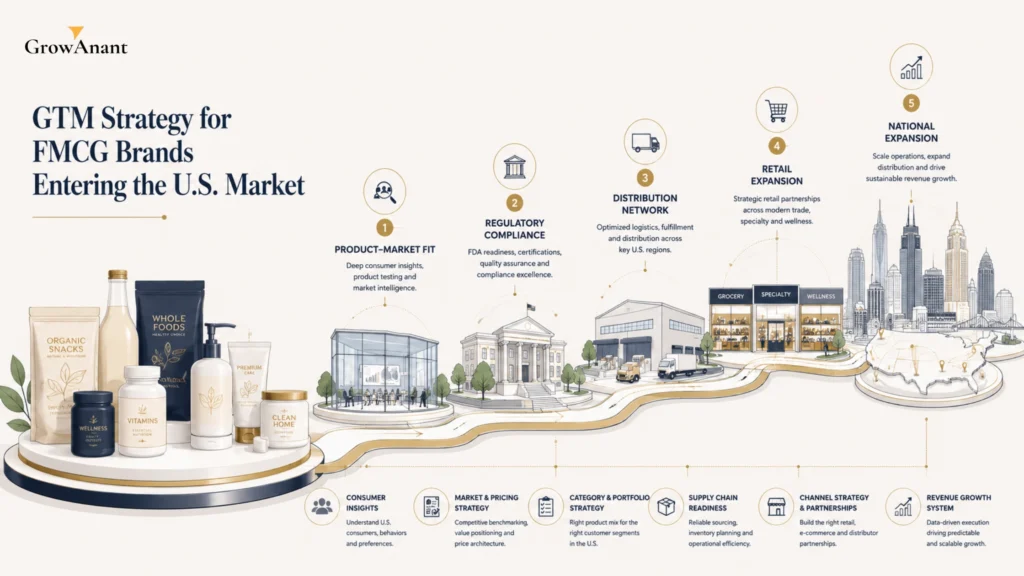
Expanding an FMCG brand into the United States presents significant opportunities, but success depends on much more than exporting products. A successful fmcg us market entry guide requires a structured commercialization strategy that aligns product positioning, regulatory compliance, retail partnerships, pricing, and consumer demand.
Unlike software businesses, FMCG brands operate in a physical retail ecosystem where shelf placement, distribution logistics, inventory management, and consumer purchasing behavior directly influence revenue growth. This makes market entry strategy USA a multidisciplinary business initiative rather than simply a marketing campaign.
Whether you’re an Indian food brand, personal care manufacturer, wellness company, or household products business, entering the U.S. market requires careful planning. Many companies work with experts in go to market strategy consulting, growth strategy consulting, and business strategy consulting USA to reduce execution risk and accelerate market readiness.
Executive Summary
| FMCG U.S. Expansion Success Factors | Why They Matter |
| Product-market fit | Matches local consumer preferences |
| Regulatory compliance | Enables legal market entry |
| Distribution strategy | Improves product availability |
| Brand positioning | Differentiates from competitors |
| Pilot market validation | Reduces expansion risk |
| Performance measurement | Supports sustainable scaling |
Why FMCG Entry Differs From B2B SaaS
Although both industries require structured growth planning, FMCG businesses face operational challenges that software companies rarely encounter.
A SaaS business can often launch digitally with relatively low distribution costs. FMCG companies, however, must manage manufacturing capacity, inventory forecasting, packaging requirements, shipping, retail negotiations, and ongoing supply chain coordination.
For example, an Indian healthy snacks company entering the United States must answer questions such as:
- Which regions should be targeted first?
- Which retailers best fit the product category?
- Are packaging labels compliant with U.S. regulations?
- Does pricing remain competitive after logistics costs?
- Can inventory support consistent retail demand?
These decisions directly affect profitability and long-term scalability.
FMCG vs SaaS Market Entry
| FMCG | SaaS |
| Physical inventory | Digital product |
| Retail distribution | Online distribution |
| Logistics intensive | Software deployment |
| Regulatory labeling | Software compliance |
| Shelf competition | Search and digital competition |
| Repeat consumer purchases | Subscription or contract revenue |
Because of these complexities, businesses frequently combine growth roadmap consulting, startup consulting services USA, and market entry strategy USA to build an execution plan before making major investments.
Rather than pursuing nationwide expansion immediately, experienced market entrants validate demand through smaller regional launches, optimize operations, and then scale with greater confidence.
Retail & Distribution Channels
Distribution is one of the most important strategic decisions for any FMCG brand entering the United States. Even exceptional products struggle if customers cannot easily find or purchase them.
Instead of attempting to reach every retailer simultaneously, successful brands prioritize channels that best match their target audience, pricing strategy, and operational capacity.
Common distribution options include:
- Regional grocery chains
- Specialty food retailers
- Health and wellness stores
- Ethnic supermarkets
- Club and warehouse retailers
- E-commerce marketplaces
- Direct-to-consumer websites
For example, a premium organic food brand may initially succeed through specialty retailers and online channels before expanding into national supermarket chains.
A structured channel strategy should evaluate:
- Target customer demographics
- Retail margins
- Inventory turnover
- Geographic demand
- Marketing support requirements
- Distribution partner capabilities
Companies working with specialists in business growth consulting and digital growth agency planning often evaluate each channel using commercial viability, operational readiness, and long-term profitability instead of focusing solely on distribution volume.
This phased approach helps founders reduce expansion costs while collecting valuable customer insights before investing in broader national distribution.
Regulatory Requirements
Before launching in the United States, FMCG brands must ensure products comply with applicable regulations. Failing to meet labeling or safety requirements can delay launches, increase costs, and damage retailer relationships.
Depending on the product category, founders should evaluate:
- FDA regulations for food, beverages, cosmetics, or supplements
- Ingredient and allergen disclosures
- Nutrition Facts labeling
- Packaging compliance
- Import and customs documentation
- Trademark protection
- Product testing and quality certifications
For example, a personal care brand entering the U.S. must verify ingredient compliance and labeling standards before approaching major retail buyers.
Regulatory Readiness Checklist
| Area | Key Focus |
| Product labeling | FDA-compliant information |
| Packaging | Required disclosures and warnings |
| Quality | Manufacturing and testing documentation |
| Intellectual Property | Trademark registration |
| Imports | Customs and logistics compliance |
Many founders combine business strategy consulting USA with legal and regulatory specialists to avoid costly delays and prepare for retailer due diligence.
Positioning for U.S. Consumers
Products that perform well in one country may not automatically succeed in another. Consumer preferences, purchasing behavior, and competitive expectations vary significantly across markets.
Strong positioning answers four questions:
- Why should customers choose this product?
- What problem does it solve?
- How is it different from competitors?
- Why is it worth the price?
For example, an Indian snack brand should not rely solely on its origin as a selling point. Instead, it might position itself around clean ingredients, healthier snacking, authentic flavors, or convenience, depending on its target audience.
Effective positioning also influences:
- Packaging design
- Messaging
- Retail merchandising
- Digital advertising
- Pricing strategy
Brands expanding internationally often combine growth strategy consulting, consumer research, and retailer feedback before investing heavily in marketing campaigns.
Pilot Market Strategy
Rather than launching nationwide, many successful FMCG companies begin with a focused regional rollout. This approach validates demand, improves operational efficiency, and reduces financial risk.
A pilot market typically includes:
- One metropolitan area or state.
- A limited group of retail partners.
- Local digital marketing campaigns.
- Sales and inventory monitoring.
- Customer feedback collection.
Pilot Market Framework
| Step | Objective |
| Select target region | Validate demand |
| Secure retail partners | Build initial distribution |
| Launch local campaigns | Generate awareness |
| Measure sales performance | Identify improvements |
| Refine expansion strategy | Prepare national rollout |
This staged approach enables businesses to improve pricing, packaging, logistics, and messaging before expanding into additional markets, creating a stronger foundation for long-term growth.
Common Mistakes
Many FMCG brands enter the U.S. market with strong products but weak execution strategies. Avoiding common mistakes can significantly improve the likelihood of sustainable growth.
The most frequent challenges include:
- Expanding nationally before validating regional demand.
- Underestimating regulatory and compliance requirements.
- Choosing too many retail channels at launch.
- Using messaging that does not resonate with U.S. consumers.
- Ignoring retailer margin expectations and supply chain readiness.
- Measuring success by distribution alone instead of sell-through and repeat purchases.
Many growth-stage businesses discover that expansion requires more than marketing. Strategic partners such as GrowAnant help connect go to market strategy consulting, commercialization planning, and execution into scalable growth systems that support long-term market success.
U.S. Market Entry Checklist
✔ Validate product-market fit in a pilot region.
✔ Complete regulatory and labeling requirements.
✔ Prioritize the right retail and e-commerce channels.
✔ Develop localized positioning and messaging.
✔ Measure sales, repeat purchases, and customer feedback before expanding nationally.
References
Frequently Asked Questions
Most brands should begin with channels that closely match their target audience and operational capacity, such as specialty retailers, regional grocery chains, ethnic supermarkets, or direct-to-consumer e-commerce before expanding nationally.
Requirements vary by product category but commonly include FDA regulations, product labeling, ingredient disclosures, packaging standards, import documentation, and applicable quality or safety certifications.
Choose a specific geographic market, partner with a limited number of retailers, support the launch with localized marketing, monitor sales and customer feedback, and refine operations before expanding into additional regions.
Successful positioning focuses on customer value, product differentiation, pricing, convenience, and trust rather than simply highlighting the product’s country of origin. Messaging should reflect the needs and expectations of the target U.S. audience.