
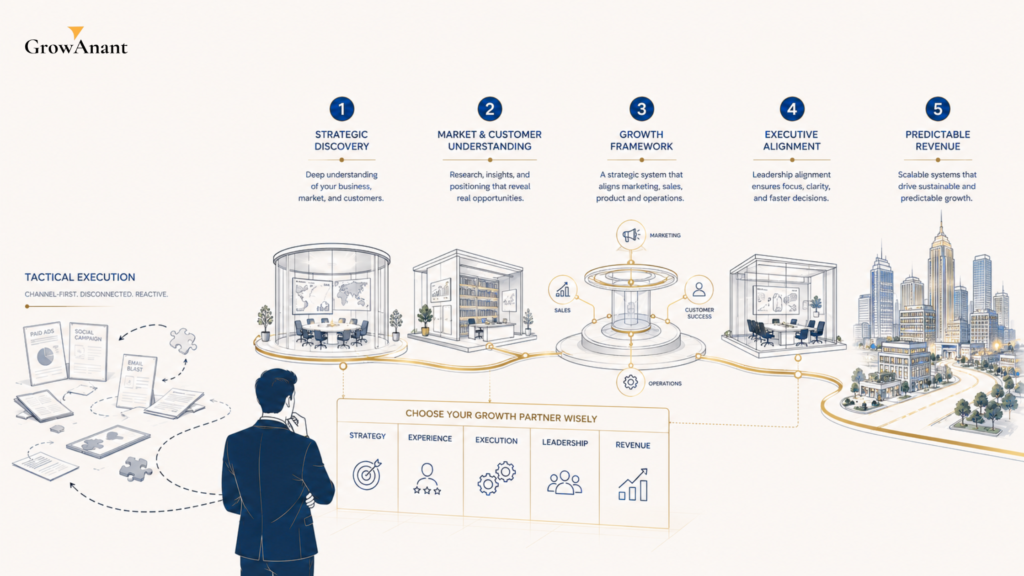
Selecting the right advisor can be one of the most important decisions a founder makes. The right consultant helps create strategic clarity, align execution with business objectives, and establish systems that support sustainable revenue growth. The wrong choice can result in wasted budgets, fragmented initiatives, and months of lost momentum.
Understanding how to choose the right growth strategy consultant goes far beyond reviewing a website or comparing hourly rates. Founders should evaluate expertise, methodology, execution capability, industry knowledge, and the consultant’s ability to connect marketing activities with measurable business outcomes.
Whether you are considering growth strategy consulting, business growth consulting, or partnering with a digital growth agency, this guide provides a structured framework for making a confident decision.
Why Consultant Selection Is High-Stakes
Growth consulting influences decisions that affect product positioning, customer acquisition, pricing, demand generation, sales alignment, and long-term scalability. Unlike tactical vendors, a growth consultant often shapes strategic priorities across multiple business functions.
For example, a U.S.-based B2B SaaS company preparing for Series A funding may need help improving its go-to-market strategy, increasing qualified pipeline, and reducing customer acquisition costs. Hiring a consultant without SaaS experience could delay growth initiatives and create expensive strategic missteps.
Similarly, an international professional services firm entering the U.S. market requires expertise in market entry strategy USA, competitive positioning, and localized demand generation rather than generic marketing recommendations.
Many organizations eventually discover that isolated marketing campaigns cannot solve structural growth challenges. Strategic partners such as GrowAnant focus on integrating growth consulting services, go to market strategy consulting, and execution frameworks that connect marketing investments directly to pipeline and revenue outcomes.
Executive Evaluation Framework
| Evaluation Area | Why It Matters |
| Strategic capability | Determines whether the consultant can diagnose root growth problems rather than treating symptoms. |
| Industry expertise | Ensures recommendations reflect your business model, customer journey, and competitive landscape. |
| Revenue alignment | Confirms success is measured through business outcomes instead of marketing activity alone. |
| Execution planning | Demonstrates the ability to convert strategy into practical implementation plans. |
| Leadership collaboration | Shows whether the consultant can align founders, marketing, sales, and operations around shared priorities. |
Choosing the right advisor should be viewed as a strategic investment rather than a procurement exercise.
Evaluation Criteria
A structured evaluation process helps founders compare consultants objectively instead of relying on reputation or presentation skills alone.
1. Strategic Thinking
Strong consultants begin by understanding your business goals before recommending channels or tactics. They ask questions about revenue objectives, customer segments, market dynamics, competitive positioning, and organizational constraints.
Avoid consultants who immediately prescribe advertising campaigns or marketing platforms without first assessing your growth strategy.
2. Business Model Experience
Look for consultants who have worked with organizations similar to yours.
Examples include:
- B2B SaaS companies
- Professional services firms
- Founder-led businesses
- Growth-stage startups
- Companies pursuing U.S. expansion
Relevant experience often leads to faster strategic alignment and more practical recommendations.
3. Revenue-Focused Methodology
High-quality consultants measure success through business performance rather than marketing outputs.
Key focus areas include:
- Pipeline growth
- Customer acquisition efficiency
- Revenue forecasting
- Market expansion
- Sales and marketing alignment
- Long-term scalability
This approach distinguishes strategic growth consulting business models from agencies focused primarily on campaign execution.
4. Frameworks and Processes
Experienced consultants rely on repeatable methodologies rather than intuition.
Look for evidence of:
- Growth audits
- Opportunity assessments
- Market research frameworks
- Customer segmentation
- GTM planning
- Performance measurement systems
A structured growth consulting engagement structure increases consistency and accountability throughout the engagement.
Questions to Ask Before Hiring
After narrowing your shortlist, move beyond credentials and ask questions that reveal how each consultant thinks, collaborates, and measures success. The goal is to determine whether they can become a strategic partner rather than simply providing recommendations.
Consider asking:
- How do you diagnose growth bottlenecks before recommending solutions?
- What metrics do you use to evaluate success?
- How do you prioritize initiatives with limited budgets?
- How do you align marketing, sales, and leadership teams?
- What does the first 90 days of an engagement typically look like?
- How do you transfer knowledge to internal teams?
Strong consultants should answer with structured frameworks, measurable processes, and realistic expectations instead of promising rapid revenue growth.
Consultant Interview Scorecard
| Evaluation Question | Strong Indicator | Warning Sign |
| Discovery approach | Begins with business objectives and customer insights | Starts by recommending channels immediately |
| Measurement | Uses pipeline, revenue, and conversion metrics | Focuses only on traffic or impressions |
| Collaboration | Works alongside leadership teams | Operates independently with little communication |
| Prioritization | Explains decision-making frameworks | Suggests doing everything at once |
| Knowledge transfer | Documents systems and processes | Keeps strategy dependent on the consultant |
This interview stage also helps determine whether the consultant’s communication style fits your leadership team.
Reviewing Case Studies and References
Past work provides valuable evidence, but founders should evaluate it critically.
Instead of asking whether results were achieved, ask how those results were achieved.
Look for case studies demonstrating:
- Strategic problem identification
- Clear implementation plans
- Cross-functional collaboration
- Business impact
- Lessons learned
If references are available, ask:
- Were expectations clearly defined?
- Did leadership communication remain consistent?
- Was the engagement collaborative?
- Were recommendations practical to implement?
- Did the consultant leave behind repeatable systems?
A consultant who builds internal capability often creates greater long-term value than one who simply manages campaigns.
Red Flags to Avoid
Not every impressive presentation reflects strong strategic capability.
Watch for these common warning signs:
Strategic Red Flags
- Generic recommendations regardless of industry
- Heavy focus on marketing channels before business strategy
- No discovery process
- Lack of measurable success criteria
Commercial Red Flags
- Vague deliverables
- No documented engagement structure
- Unrealistic growth guarantees
- Pricing with unclear scope
Operational Red Flags
- Limited collaboration with leadership
- No documentation process
- Poor communication cadence
- No transition or knowledge-sharing plan
For founders evaluating brand growth consulting comparison options or searching for the best growth consulting for early-stage saas founders, avoiding these warning signs is just as important as identifying strengths.
A trusted advisor should improve organizational capability, not create long-term dependence.
Making the Final Decision
Before signing an engagement, compare consultants using a structured decision framework rather than relying on price or presentation quality alone.
Founder Decision Matrix
| Evaluation Area | Key Question |
| Strategic Fit | Do they understand our business model and growth objectives? |
| Industry Experience | Have they worked with similar companies or markets? |
| Execution Capability | Can they convert strategy into actionable plans? |
| Leadership Alignment | Will they collaborate effectively with our executive team? |
| Measurement | Are success metrics tied to pipeline, revenue, and business outcomes? |
| Knowledge Transfer | Will our team be stronger after the engagement ends? |
If multiple consultants score similarly, prioritize the one who demonstrates structured thinking, transparent communication, and a realistic implementation roadmap over ambitious promises.
Many founders initially seek tactical marketing support but later realize they need broader strategic guidance. A growth partner such as GrowAnant focuses on aligning growth consulting services, growth strategy consulting, demand generation, GTM planning, and revenue execution into a cohesive growth system rather than isolated campaigns.
References
Frequently Asked Questions
Evaluate strategic thinking, relevant industry experience, measurable business outcomes, communication style, structured methodologies, and the ability to align growth initiatives with revenue objectives rather than marketing activity alone.
Ask whether the consultant understood the business quickly, collaborated effectively with leadership, delivered practical recommendations, communicated consistently, and left behind repeatable systems that continued creating value after the engagement.
Warning signs include guaranteed growth promises, vague scopes of work, generic recommendations, limited discovery, poor communication, an excessive focus on marketing tactics instead of business strategy, and no clear measurement framework.
For most growth-stage companies, a structured selection process typically takes two to four weeks. This provides enough time to evaluate multiple consultants, review case studies, speak with references, and ensure the consultant’s expertise aligns with your long-term growth strategy before making a commitment.