
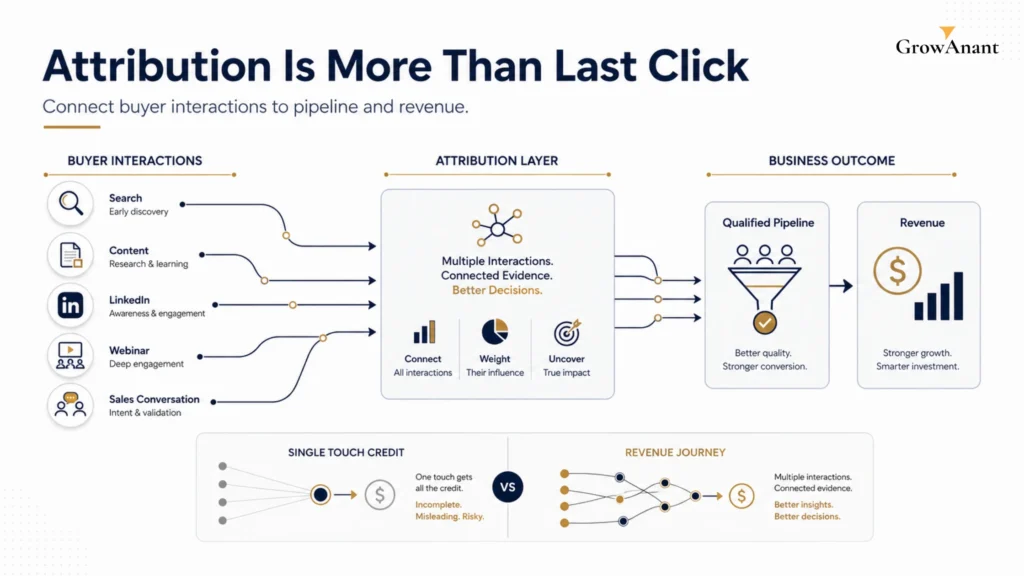
A b2b marketing attribution model helps businesses understand how marketing interactions contribute to leads, opportunities, and revenue. In B2B, this is difficult because buyers rarely move through a simple linear journey. A prospect might discover a company through search, read several articles, attend a webinar, engage with LinkedIn content, speak with sales, and return weeks later before becoming a customer.
That complexity makes demand generation analytics essential. The objective is not to claim that one channel “caused” a sale. It is to create a reliable framework for understanding which activities influence progression through the funnel and where marketing investment is contributing to business outcomes.
A strong attribution system therefore connects marketing data with CRM, sales activity, pipeline, and revenue instead of reporting isolated clicks or leads.
Why Attribution Is Hard in B2B
B2B buying journeys involve multiple people, channels, and interactions. A SaaS buyer may consume educational content before speaking with sales, while a professional services buyer may rely heavily on referrals, search, events, and direct conversations.
Three challenges make attribution particularly difficult:
- Long buying cycles: Several months may pass between the first interaction and closed revenue.
- Multiple stakeholders: One account can involve marketers, executives, procurement, operations, and technical evaluators.
- Offline activity: Meetings, events, referrals, and sales conversations may not be captured consistently.
This means a dashboard showing “last-click conversions” can create a misleading picture of performance.
For example, a U.S. B2B software company might see Google Search receiving most conversion credit because prospects search for the company shortly before booking a demo. But earlier content, webinars, and LinkedIn interactions may have created the awareness that made that search possible.
The purpose of attribution is therefore decision support, not perfect mathematical certainty.
First-Touch vs Last-Touch vs Multi-Touch
Different models answer different business questions. There is no universal model that is automatically correct.
| Model | What It Measures | Best Use |
| First-touch | First recorded marketing interaction | Understanding discovery and awareness |
| Last-touch | Interaction immediately before conversion | Understanding conversion activity |
| Linear | Distributes credit across interactions | Broad journey analysis |
| Time-decay | Gives greater weight to recent interactions | Longer buying cycles |
| Multi-touch | Assigns credit across multiple interactions | Complex B2B journeys |
Salesforce describes attribution as identifying the marketing activities, channels, and touchpoints that contribute to outcomes such as lead conversion, pipeline creation, or closed deals. Its tools support several models because different models answer different analytical questions.
For most growth-stage B2B companies, multi-touch analysis is more informative than relying exclusively on first or last touch.
However, avoid assuming that more sophisticated automatically means more accurate. A complex model built on incomplete CRM data can be less useful than a simple model based on reliable information.
Choosing the Right Model
Start with the business question, then select the model.
If your question is:
“Which channels introduce us to new buyers?”
Use first-touch attribution.
“Which activities help convert existing demand?”
Use last-touch attribution.
“How do multiple interactions contribute across the journey?”
Use multi-touch attribution.
“Which interactions appear most influential across complex journeys?”
Consider a data-driven model once sufficient historical data exists.
A practical framework is:
Business Question → Data Quality → Attribution Model → Reporting → Decision
Do not reverse this process by selecting software first.
For example, a B2B SaaS company investing in growth marketing services may discover that paid search creates many demo requests while thought leadership creates fewer direct conversions. A last-touch model may favor search, while a broader multi-touch view may reveal that content plays a significant role earlier in the buying journey.
This distinction matters when deciding whether to increase, reduce, or restructure marketing investment.
Tools & Data Requirements
An effective attribution system begins with clean data.
At minimum, companies should connect:
- CRM records
- Marketing campaigns
- Website interactions
- Lead source data
- Contact and account information
- Opportunity stages
- Revenue data
- Campaign costs
- Sales activities
The system should also establish consistent definitions for:
- Lead
- Marketing-qualified lead
- Sales-qualified opportunity
- Pipeline
- Closed-won revenue
- Marketing touchpoint
- Attribution window
HubSpot currently supports attribution reporting across contact creation, deal creation, and revenue, allowing businesses to analyze how sources, assets, and interactions influence different stages of the funnel.
A practical demand generation analytics stack does not necessarily require an expensive standalone platform. The priority is reliable data flow between marketing and revenue systems.
Attribution Data Checklist
| Requirement | Question |
| Source tracking | Can we identify where prospects originated? |
| Campaign tracking | Are campaigns consistently tagged? |
| CRM integration | Are marketing interactions connected to opportunities? |
| Revenue connection | Can we connect opportunities to closed revenue? |
| Cost data | Do we know what each channel costs? |
| Historical data | Is there enough information to identify patterns? |
Common Attribution Mistakes
The most common mistake is treating attribution as absolute truth.
Attribution models distribute credit based on defined rules. They do not perfectly observe every influence on a buyer.
Other common mistakes include:
1. Optimizing for leads instead of revenue
A channel generating many low-quality leads may appear successful while producing little pipeline.
2. Ignoring sales activity
Marketing attribution should be considered alongside sales progression, particularly in high-consideration B2B purchases.
3. Using inconsistent tracking
Missing campaign parameters, duplicate contacts, disconnected CRM records, or inconsistent lifecycle stages can distort reporting.
4. Changing models too frequently
If the model changes every month, leadership cannot establish meaningful trends.
5. Treating every touchpoint equally
A pricing-page visit and a five-minute blog view should not automatically be interpreted as having identical business significance.
6. Ignoring account-level behavior
B2B buying involves multiple stakeholders. Individual contact attribution may fail to represent the full account journey.
This is where a B2B growth marketing agency or strategic growth partner can add value by helping connect marketing measurement with broader revenue operations rather than treating attribution as a reporting-only exercise.
Reporting to Leadership
Executives rarely need a dashboard containing dozens of marketing metrics. They need a clear connection between investment, pipeline, and revenue.
A useful leadership dashboard can contain:
| Category | Core Metric |
| Investment | Marketing spend |
| Demand | Qualified leads |
| Pipeline | Marketing-influenced pipeline |
| Efficiency | Cost per qualified opportunity |
| Revenue | Marketing-influenced revenue |
| Conversion | Opportunity-to-customer rate |
| Forecast | Expected pipeline contribution |
The leadership conversation should move from:
“How many leads did marketing generate?”
to:
“Which marketing investments are contributing to qualified pipeline and revenue?”
For example, a U.S. B2B services company may discover that webinars produce fewer leads than paid campaigns but generate opportunities with larger deal sizes and stronger win rates. That insight could change budget allocation even if the webinar channel looks weaker under lead-volume reporting.
GrowAnant’s strategy-first approach similarly focuses on connecting B2B marketing, demand generation, and revenue execution so measurement supports business decisions rather than becoming another reporting exercise.
Attribution should be reviewed regularly, but not constantly changed. A monthly operating review can identify significant shifts, while quarterly analysis can evaluate whether the model, assumptions, and investment decisions remain appropriate.
References
- HubSpot: Attribution Reporting
HubSpot Attribution Reporting - Salesforce: Attribution in Marketing Intelligence
Salesforce Attribution in Marketing Intelligence
Frequently Asked Questions
There is no single best model for every B2B company. First-touch is useful for understanding acquisition, last-touch for conversion, and multi-touch for understanding broader customer journeys. The right model depends on the business question, buying cycle, and quality of available data.
Not necessarily. A reliable CRM, analytics platform, campaign tracking, and connected revenue data can provide a strong foundation. Specialized attribution software becomes more useful as the number of channels, stakeholders, and customer journeys increases.
Attribution can become highly useful, but it should not be treated as perfectly precise. Buyers interact with brands through channels that may not be tracked, and different models distribute credit differently. The goal is consistent, decision-useful measurement rather than claiming perfect causality.
Review performance monthly and evaluate the attribution framework quarterly or when major changes occur in the sales cycle, marketing mix, CRM structure, or business model. Avoid frequent model changes that make historical comparisons difficult.