
Choosing between competing consulting proposals is difficult because firms often use different language, methodologies, deliverables, and pricing structures. A proper brand growth consulting comparison should therefore evaluate more than presentation quality or monthly fees.
The real question is not simply which brand growth consulting is best for digital marketing. It is which partner can best connect positioning, growth strategy consulting, execution, customer acquisition, and measurable business outcomes.
For a founder or CEO, the evaluation should focus on five areas:
- Strategic clarity
- Relevant expertise
- Execution capability
- Commercial model
- Fit with the company’s growth stage
A strong proposal should make it clear what the firm will solve, how it will approach the problem, what will be delivered, and how progress will be evaluated.
What “Brand Growth Consulting” Actually Covers
Brand growth consulting should connect brand strategy with commercial growth rather than treating branding as a purely creative exercise.
Depending on the business, the work may include positioning, customer research, market analysis, messaging, demand generation, acquisition strategy, conversion optimization, and growth measurement.
A useful way to assess the scope is:
Market Understanding → Positioning → Acquisition → Conversion → Revenue → Measurement
For example, a B2B SaaS company may need sharper positioning before increasing paid acquisition. A professional services firm may need a stronger demand-generation system before investing heavily in growth marketing services.
A proposal that only lists activities such as content, campaigns, social media, or advertising may not address the underlying growth constraint.
McKinsey similarly frames effective growth around understanding where value exists, identifying growth opportunities, and building the capabilities required to execute the strategy.
The key evaluation question is:
Does the consultant address the business problem, or only the marketing activities surrounding it?
Comparing Strategic vs Execution-Heavy Firms
Not every consulting firm operates at the same level.
| Area | Strategic Growth Firm | Execution-Heavy Firm |
| Starting point | Business and growth problem | Marketing activity |
| Positioning | Core strategic input | Often predefined |
| Roadmap | Prioritized by business impact | Channel-based |
| Execution | Connected to strategy | Often activity-focused |
| Measurement | Pipeline and revenue relevance | Campaign metrics |
| Leadership involvement | High | Variable |
| Adaptability | Adjusts based on evidence | Often follows fixed scope |
An execution-heavy proposal is not automatically inferior. It may be appropriate when the company already has a clear strategy and simply lacks execution capacity.
For example, a funded SaaS company with validated positioning and strong internal leadership may need specialized B2B lead generation services. A founder-led business still trying to identify its strongest ICP may need business growth consulting before scaling acquisition.
The distinction is therefore not “strategy good, execution bad.”
It is:
What does the business need right now?
GrowAnant’s growth-partner model is designed around connecting strategy with revenue-focused execution rather than operating as a tactical digital marketing agency.
Evaluating Proposals Side-by-Side
Never compare proposals only by price.
Create a common scorecard so fundamentally different proposals can be evaluated against the same business requirements.
| Evaluation Area | Weight | What to Look For |
| Strategic understanding | 25% | Clear diagnosis of growth problem |
| Relevant experience | 20% | Similar business, market, or growth challenge |
| Execution model | 15% | Clear ownership and implementation |
| Measurement | 15% | Defined business and marketing KPIs |
| Team quality | 10% | Senior involvement and relevant expertise |
| Commercial structure | 10% | Transparent scope and pricing |
| Cultural fit | 5% | Communication and decision-making compatibility |
Proposal Evaluation Checklist
Before selecting a firm, ask:
- Does the proposal identify the actual growth constraint?
- Is the ICP clearly understood?
- Are priorities explained?
- Are deliverables specific?
- Are responsibilities defined?
- Are milestones measurable?
- Is senior expertise actually involved?
- Does the engagement structure fit the business?
- Are assumptions and exclusions visible?
- Is the pricing understandable?
This approach prevents a common mistake: selecting the most impressive-looking proposal rather than the most relevant one.
HubSpot’s proposal guidance similarly highlights the importance of clearly presenting areas such as goals, scope, success measures, fees, timing, and experience.
Pricing Models Compared
Different growth consulting business models can produce very different pricing structures. The right model depends on the complexity and duration of the growth problem.
| Pricing Model | Best Fit | Advantage | Watchout |
| Fixed project | Defined strategic problem | Clear scope | Limited flexibility |
| Monthly retainer | Ongoing growth leadership | Continuity | Scope must remain clear |
| Advisory | Leadership guidance | Lower execution burden | Requires internal capability |
| Project + retainer | Strategy followed by execution | Strong transition | Requires clear milestones |
| Fractional leadership | Need for senior ownership | Strategic continuity | Requires strong collaboration |
Do not assume the cheapest proposal offers the best value.
Instead, compare:
Expected business value + senior expertise + execution capacity + strategic relevance + organizational fit
A $5,000 proposal that solves the wrong problem can be more expensive than a larger engagement that addresses the actual growth constraint.
The opposite is also true. A highly sophisticated consulting engagement may be unnecessary if the company simply needs a clearly defined execution capability.
Questions to Ask References
References should validate how the consultant actually operates, not simply whether previous clients liked the experience.
Ask references:
- What problem did the consultant originally help solve?
- Did the scope change during the engagement?
- How involved was the senior consultant?
- Were recommendations practical to implement?
- How clearly were results measured?
- Did the consultant challenge internal assumptions when necessary?
- What happened when the initial strategy did not work?
- Would you hire the firm again?
The most valuable reference is often from a company with a similar growth challenge, not necessarily a company with the largest logo.
For example, a founder evaluating startup consulting services USA should prioritize references from companies that faced similar positioning, market-entry, or customer-acquisition challenges.
Decision Framework
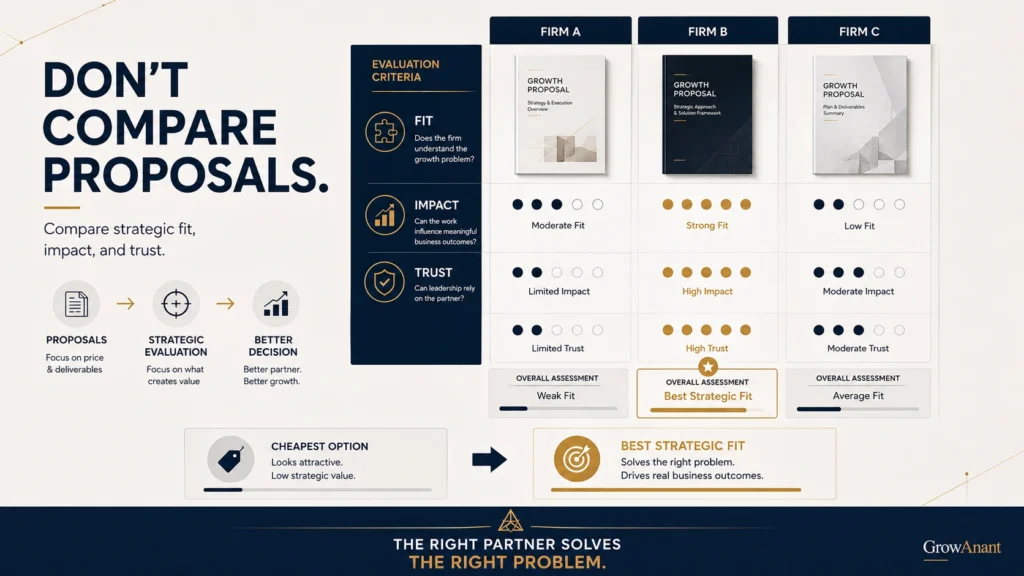
Use a simple FIT framework to make the final decision:
F: Fit
Does the firm understand your industry, growth stage, ICP, business model, and immediate constraint?
I: Impact
Can the proposed work reasonably influence pipeline, conversion, retention, positioning, or another meaningful business outcome?
T: Trust
Does the team demonstrate transparency about assumptions, limitations, risks, responsibilities, and measurement?
Score each shortlisted firm from 1 to 5 across these three dimensions.
| Decision Factor | Firm A | Firm B | Firm C |
| Strategic Fit | /5 | /5 | /5 |
| Business Impact | /5 | /5 | /5 |
| Trust | /5 | /5 | /5 |
| Relevant Experience | /5 | /5 | /5 |
| Execution Capability | /5 | /5 | /5 |
| Commercial Fit | /5 | /5 | /5 |
Then ask one final question:
Which firm gives leadership the clearest path from today’s growth problem to the capabilities required for sustainable growth?
For a growth-stage SaaS company, that may mean SaaS growth consulting. For a professional services business, it may involve marketing strategy for service businesses and lead generation. For a company entering a new market, it may require go to market strategy consulting and market-entry planning.
The strongest consulting relationship is not necessarily the firm with the biggest team, lowest price, or longest proposal. It is the partner whose strategy, capabilities, operating model, and level of involvement match the company’s actual growth challenge.
References
- HubSpot: Marketing Proposal Structure
HubSpot: Marketing Proposal Structure
Frequently Asked Questions
It can include positioning, customer and market analysis, brand strategy, acquisition strategy, demand generation, conversion improvement, measurement, and growth planning. The exact scope should depend on the company’s growth problem rather than a standard list of marketing activities.
Translate both proposals into the same evaluation framework. Compare strategic understanding, relevant experience, execution capability, measurement, team quality, commercial structure, and organizational fit rather than comparing deliverables line by line.
Common models include fixed projects, monthly retainers, advisory engagements, project-plus-retainer structures, and fractional leadership arrangements. The appropriate model depends on whether the business needs a defined project, ongoing execution, strategic guidance, or senior growth ownership.
Ask what problem the firm solved, how involved senior leadership was, whether recommendations were practical, how results were measured, how the firm handled setbacks or scope changes, and whether the reference would hire the firm again.