
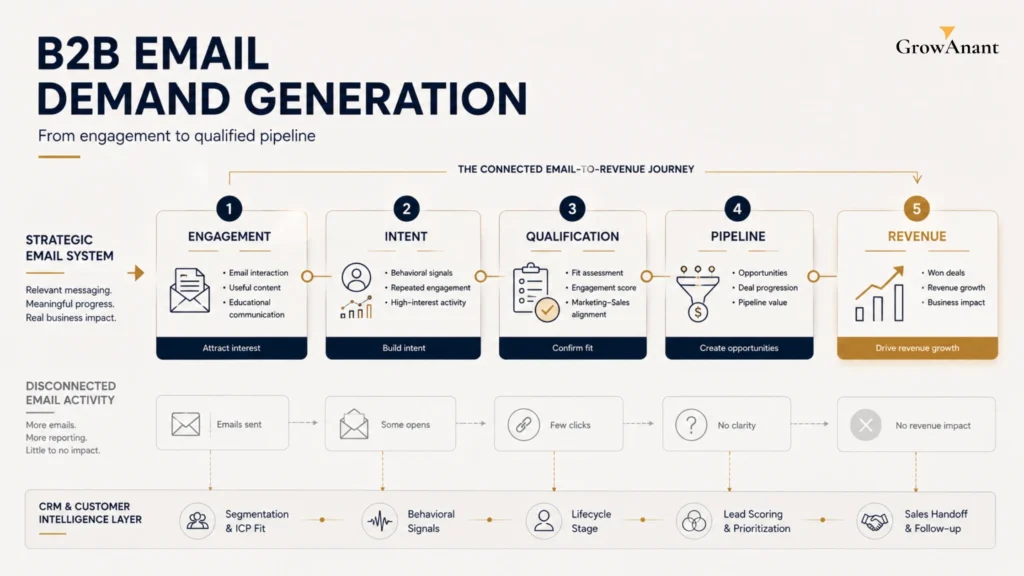
Email remains an important channel for b2b email marketing demand generation because B2B buying decisions rarely happen after one interaction. Buyers may download a resource, compare vendors, speak with colleagues, revisit pricing, and return weeks later before becoming sales-ready.
The role of email is therefore not simply to send promotions. Effective lead nurturing keeps relevant prospects engaged, builds trust, supports education, and helps move qualified accounts toward sales conversations.
For a B2B SaaS company, professional services firm, or growth-stage business, email should connect:
Audience → Engagement → Intent → Qualification → Pipeline → Revenue
The strongest programs combine useful content, segmentation, behavioral signals, and clear measurement rather than relying on email volume alone.
Why Email Still Works in B2B
B2B buying cycles are often longer and involve multiple stakeholders. This creates a gap between initial interest and commercial readiness.
Email can help maintain that relationship without forcing an immediate sales conversation.
For example, a U.S. SaaS company attracting operations leaders through educational content could use email to provide:
- Industry insights
- Problem-specific guides
- Customer examples
- Product education
- Comparison resources
- Implementation advice
- Relevant sales content
The objective is to increase buyer understanding and intent over time.
Email is particularly useful when integrated with growth marketing services, content, paid acquisition, events, and sales outreach. It should not operate as an isolated channel.
A practical B2B email model is:
| Stage | Email Objective | Example |
| Awareness | Educate | Industry insight |
| Consideration | Build confidence | Case study |
| Evaluation | Reduce uncertainty | Comparison guide |
| Intent | Encourage action | Consultation invitation |
| Sales-ready | Support conversion | Relevant proof or proposal content |
This makes email a supporting layer within a broader demand generation system.
Building Nurture Sequences
A nurture sequence should reflect the buyer’s decision process rather than simply delivering a fixed number of emails.
A practical framework is:
Problem → Insight → Evidence → Solution → Action
For example, a cybersecurity company targeting mid-market manufacturers might structure a sequence as:
- Explain the operational risk.
- Show how companies typically address it.
- Provide evidence or an example.
- Explain the strategic approach.
- Offer a relevant next step.
The sequence should also have an exit condition. If a prospect books a meeting, downloads a high-intent resource, or enters an active sales opportunity, the system should adapt rather than continuing the same generic nurture.
A useful starting structure is five to seven emails distributed according to buyer behavior rather than an arbitrary calendar.
Nurture Checklist
- Define the audience.
- Identify the buyer problem.
- Establish the sequence objective.
- Map content to buying stages.
- Create clear behavioral triggers.
- Define qualification signals.
- Establish sales handoff rules.
- Measure pipeline progression.
A demand generation agency or internal growth team should also coordinate email with CRM data, lead scoring, content, and sales activity.
Segmentation Strategies
Generic newsletters rarely provide enough relevance for complex B2B buying journeys.
Segmentation should reflect meaningful differences in buyer context.
Useful segmentation dimensions include:
| Segment | Possible Variable |
| Firmographic | Industry, company size, geography |
| Role | Founder, VP Marketing, CIO, Revenue Leader |
| Lifecycle | Subscriber, lead, opportunity, customer |
| Intent | Low, medium, high |
| Product interest | Service or product category |
| Engagement | Active, inactive, re-engaging |
A SaaS company could separate founders evaluating a new platform from enterprise buyers involved in a longer procurement process.
This also improves coordination between B2B lead generation services and sales teams because marketing can provide more context around why an account is being prioritized.
For companies using growth consulting services, segmentation should ultimately reflect the broader ICP and go-to-market strategy rather than being created only because the email platform allows multiple lists.
Deliverability Basics
Strong content cannot generate pipeline if emails do not reach the inbox.
Deliverability starts with technical authentication, list quality, sending behavior, and recipient engagement.
Google recommends authenticating sending domains using SPF and DKIM, with DMARC requirements applying to bulk senders. Google also recommends monitoring spam rates and domain or IP reputation through Postmaster Tools.
Deliverability Checklist
- Authenticate the sending domain.
- Configure SPF and DKIM.
- Implement DMARC appropriately.
- Use permission-based lists.
- Remove invalid or persistently bouncing contacts.
- Make unsubscribing easy.
- Avoid sudden sending-volume increases.
- Monitor spam complaints and delivery errors.
- Keep sender identity consistent.
Google also advises senders not to purchase email addresses and to send messages to recipients who have opted in to receive them.
For B2B teams, this matters because poor deliverability can undermine months of B2B marketing and demand-generation investment.
Measuring Email’s Pipeline Impact
Open rates and click rates can help diagnose engagement, but they should not be treated as the primary measure of commercial success.
The more important question is:
Did email contribute to qualified pipeline and revenue progression?
A practical measurement framework is:
Email Engagement → Qualified Response → Sales Activity → Opportunity → Pipeline → Revenue
Track metrics such as:
| Metric | Business Meaning |
| Delivery rate | Whether messages are reaching recipients |
| Click rate | Content engagement |
| Qualified response | Meaningful buyer action |
| Meetings influenced | Sales engagement |
| Opportunities influenced | Pipeline contribution |
| Pipeline value | Commercial potential |
| Revenue influenced | Relationship to closed business |
A b2b marketing attribution model can help connect email interactions with other channels, but attribution should be treated as directional evidence rather than perfect causality.
For example, a prospect may discover a company through search, read three emails, attend a webinar, speak with sales, and eventually purchase. Giving 100% credit to the final email would oversimplify the buyer journey.
A stronger demand generation analytics approach evaluates the complete sequence of interactions.
Common Mistakes
Several mistakes repeatedly weaken B2B email programs.
1. Measuring activity instead of business impact
A high click rate does not automatically mean strong pipeline.
2. Sending the same emails to everyone
Different industries, roles, buying stages, and intent levels require different messaging.
3. Over-automating communication
Automation should improve relevance, not remove judgment.
4. Ignoring sales alignment
Marketing and sales should agree on qualification signals, handoff rules, and follow-up expectations.
5. Treating email as a standalone channel
Email performs better when connected with content, CRM data, growth strategy, paid acquisition, and sales activity.
6. Increasing volume to compensate for weak relevance
More emails do not solve poor targeting or weak positioning.
7. Ignoring deliverability
Authentication, list quality, unsubscribe processes, and sender reputation are foundational.
GrowAnant approaches demand generation as a connected growth system, where email supports positioning, customer education, pipeline development, and revenue execution rather than functioning as a standalone marketing activity.
References
- Google: Email Sender Guidelines
Google Email Sender Guidelines - Google: Top Gmail Sender Issues
Google Top Gmail Sender Issues
Frequently Asked Questions
Yes. Email remains useful for educating prospects, maintaining engagement during longer buying cycles, supporting sales conversations, and nurturing accounts toward higher intent. Its effectiveness depends on relevance, segmentation, deliverability, and integration with the broader demand-generation system.
There is no universal ideal length. A sequence should contain enough communication to support the buyer journey without creating unnecessary volume. A practical starting point is five to seven emails, with progression based on engagement and buying signals.
Start with domain authentication, permission-based lists, clean contact data, consistent sending practices, clear unsubscribe options, and monitoring of spam complaints and delivery errors. SPF, DKIM, and appropriate DMARC configuration are important components of modern email authentication.
Track qualified responses, meetings influenced, opportunities influenced, pipeline value, and revenue influenced alongside delivery and engagement metrics. Email should ultimately be evaluated according to its contribution to the buyer journey and commercial outcomes.