
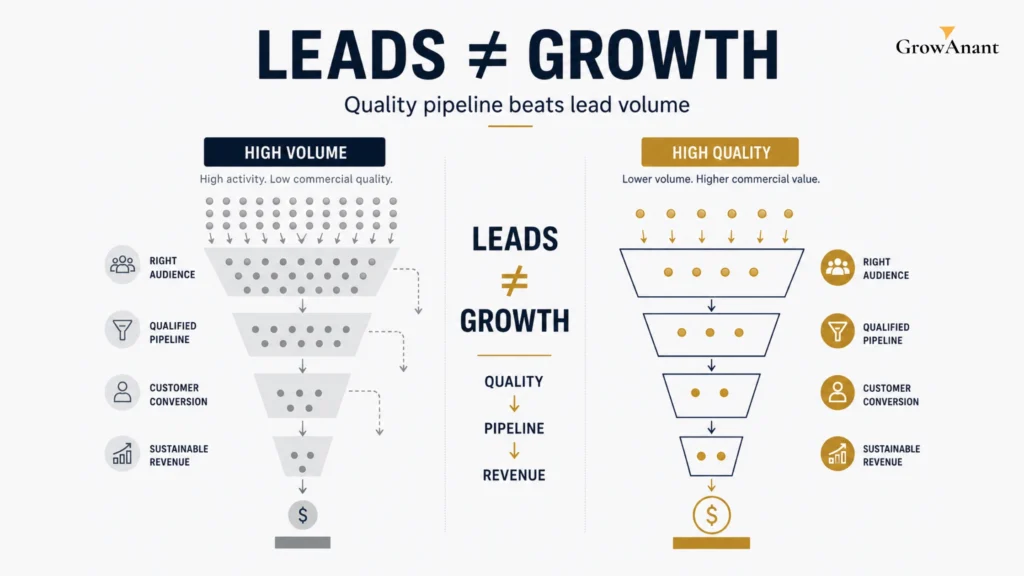
Choosing growth consultants that focus on sustainable revenue instead of just top of funnel leads requires looking beyond lead counts. A consultant can generate thousands of leads while leaving the sales team with poor-fit prospects, weak conversion rates, rising acquisition costs, and little predictable revenue.
Revenue-focused growth consulting takes a different approach. It connects market positioning, demand generation, customer acquisition, pipeline quality, conversion, retention, and commercial performance.
For a founder or CEO, the critical question is not, “How many leads did marketing generate?” It is, “Did the growth system create more qualified opportunities and improve the economics of acquiring and retaining customers?”
That distinction matters for SaaS companies, professional services firms, funded startups, and SMBs where marketing investment must ultimately support sustainable business growth.
The Problem With Lead-Volume-Only Consultants
Lead generation is important, but lead volume is an incomplete measure of growth.
A consultant focused primarily on top-of-funnel activity may optimize for:
- Website traffic
- Form submissions
- Marketing-qualified leads
- Social engagement
- Email subscribers
- Campaign response rates
These metrics can be useful leading indicators, but they do not necessarily demonstrate commercial impact.
Consider two B2B SaaS companies:
| Metric | Company A | Company B |
| Leads generated | 1,500 | 500 |
| Sales-qualified opportunities | 60 | 100 |
| Opportunity-to-customer rate | 10% | 25% |
| Customers won | 6 | 25 |
| Revenue quality | Low | High |
Company A appears stronger if leadership only reviews lead volume. Company B has a healthier growth system.
This is why revenue growth consulting should examine the entire path from demand creation to revenue realization.
A lead-volume-only approach can also create friction between marketing and sales. Marketing celebrates acquisition numbers while sales struggles with poor-fit prospects. Leadership then sees increasing activity without corresponding revenue visibility.
The problem is not lead generation itself. The problem is treating leads as the final outcome.
What Sustainable Revenue Focus Looks Like
Sustainable growth means building a system where acquisition activity contributes to qualified pipeline, customer conversion, retention, and commercially viable economics.
A revenue-oriented growth consultant typically connects five layers:
Market → Demand → Pipeline → Revenue → Retention
Each layer answers a different question:
| Layer | Leadership Question |
| Market | Are we targeting the right customers? |
| Demand | Are we creating interest in the right audience? |
| Pipeline | Are marketing efforts creating qualified opportunities? |
| Revenue | Are opportunities converting into valuable customers? |
| Retention | Are customers staying and expanding? |
For example, a U.S. professional services firm might discover that its marketing generates significant traffic but very few qualified conversations. A revenue-focused consultant would investigate positioning, ICP definition, lead qualification, conversion paths, sales follow-up, and offer-market alignment rather than simply increasing traffic.
This is consistent with broader evidence that sustainable growth requires coordinated commercial capabilities rather than isolated marketing activity. McKinsey describes growth as requiring clear strategy, resource allocation, leadership, and execution across commercial functions.
For a growth-stage company, the objective should therefore be a measurable growth system, not an ever-increasing marketing activity list.
Questions That Reveal a Consultant’s True Focus
The easiest way to determine whether a consultant is revenue-oriented is to examine the questions they ask before recommending tactics.
A strong consultant should want to understand:
- Who is the ideal customer?
- Which customer segments are most profitable?
- What is the current sales cycle?
- Where does the funnel lose prospects?
- What percentage of leads become qualified opportunities?
- Which channels generate actual pipeline?
- What is customer acquisition cost?
- What is customer retention like?
- Which offers convert best?
- How does marketing performance connect to revenue?
Compare that with a consultant who immediately asks for access to advertising accounts and promises to increase lead volume.
A practical consultant test
Ask:
“If lead volume increases by 50% but qualified pipeline does not improve, what would you investigate?”
A revenue-focused answer should involve ICP quality, channel mix, messaging, qualification, conversion rates, sales follow-up, attribution, and funnel leakage.
A weak answer may simply recommend generating more leads.
Another useful question is:
“Which metrics would you report to the CEO every month?”
The answer should extend beyond impressions, clicks, traffic, and leads.
For companies considering growth strategy consulting, the quality of the diagnostic process is often more important than the number of tactics included in a proposal.
Metrics That Signal Revenue Orientation
A revenue-focused scorecard should combine leading indicators with commercial outcomes.
| Category | Metrics |
| Demand | Qualified traffic, target-account engagement |
| Acquisition | Cost per qualified lead, CAC |
| Pipeline | Qualified pipeline, pipeline velocity |
| Conversion | Lead-to-opportunity, opportunity-to-customer |
| Revenue | New revenue, expansion revenue |
| Retention | Churn, retention, customer expansion |
| Efficiency | CAC payback, channel efficiency |
The exact metrics should depend on the business model.
A SaaS company may emphasize qualified pipeline, CAC payback, conversion, retention, and expansion. A professional services firm may emphasize qualified consultations, proposal conversion, average deal value, sales cycle, and client retention.
The important principle is metric hierarchy.
Activity metrics → quality metrics → pipeline metrics → revenue metrics
If a consultant reports only the first category, leadership has limited visibility into whether growth investments are actually working.
For organizations using growth consulting services, the monthly scorecard should also identify what changed, why it changed, and which actions should receive more or less investment.
A Comparison Scenario
Imagine a founder of a U.S. B2B services company evaluating two consultants.
Consultant A: Lead-volume model
The proposal focuses on:
- More website traffic
- More paid campaigns
- More landing pages
- More form submissions
- More monthly leads
Consultant B: Revenue-focused model
The proposal focuses on:
- ICP refinement
- Positioning
- Demand generation
- Lead qualification
- Sales and marketing alignment
- Pipeline measurement
- Conversion improvement
- Channel economics
- Revenue reporting
Neither model should automatically be accepted or rejected. The correct choice depends on the company’s actual constraint.
If the company has strong conversion and sales capacity but insufficient demand, additional lead generation may be appropriate.
If the company already generates substantial leads but revenue remains unpredictable, more leads may make the problem worse.
Decision framework
Use this simple diagnostic:
Low leads + strong conversion
→ Improve demand generation.
High leads + low qualification
→ Improve targeting and positioning.
High qualified leads + low opportunity conversion
→ Investigate sales process and offer-market fit.
Strong pipeline + low customer conversion
→ Investigate sales execution, pricing, objections, and product fit.
Strong acquisition + poor retention
→ Address onboarding, customer success, product value, or retention.
This is the difference between treating growth as a campaign and treating it as a business system.
For GrowAnant, this distinction is central to its positioning as a growth partner rather than a tactical marketing vendor. The role is to connect strategy, demand generation, execution, and revenue so leadership can make better growth decisions.
McKinsey’s recent B2B research similarly emphasizes that stronger performers differentiate themselves through coherent commercial architecture, data, technology, and accountability rather than simply adopting more channels or tools.
References
- McKinsey & Company: Mindset to Action: Imperatives for Growth
- McKinsey & Company: Seven Tests for B2B Growth
Frequently Asked Questions
Because lead volume measures activity rather than commercial value. If targeting, qualification, conversion, sales execution, or retention is weak, increasing leads may increase workload without proportionally increasing revenue.
Ask which business outcomes the consultant will be accountable for, how marketing will be connected to pipeline, which metrics will be reported to leadership, and what they would do if lead volume increased without improving qualified pipeline.
Look for qualified pipeline, conversion rates, customer acquisition cost, sales cycle, new revenue, retention, expansion, and channel efficiency. Lead volume can remain on the dashboard, but it should not be the primary measure of growth.
Yes. Effective revenue-focused growth still requires strong lead generation. The difference is that lead generation is treated as one component of a broader system connecting the right audience to qualified demand, pipeline, customers, and sustainable revenue.