
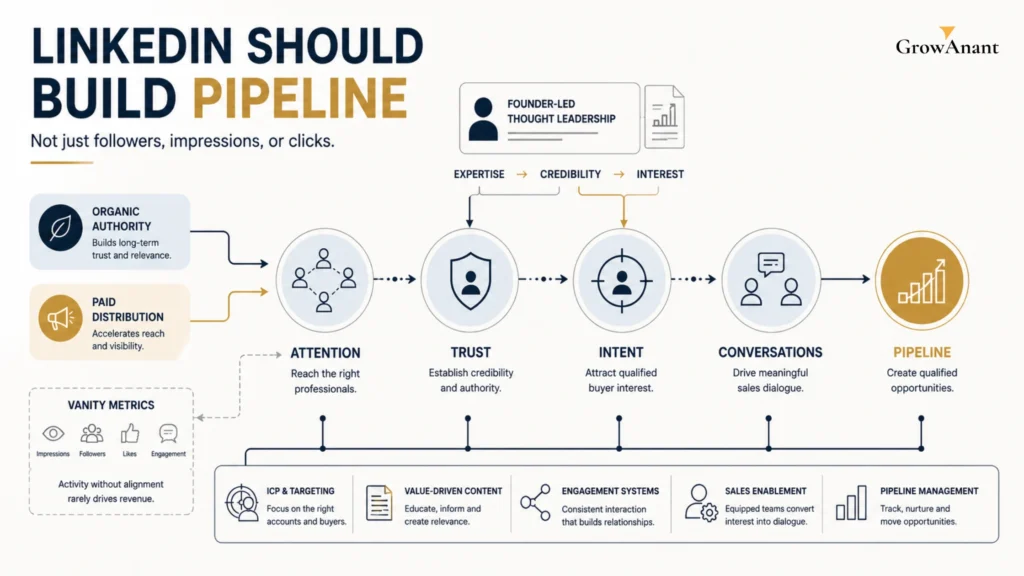
For B2B companies, linkedin growth marketing b2b works best when LinkedIn is treated as part of a broader revenue system, not simply a social media channel. The strongest programs combine growth marketing services, founder-led authority, targeted advertising, demand creation, and disciplined measurement.
LinkedIn can help a U.S. SaaS company reach buying committees, help a professional services firm establish expertise, or help a founder entering a new market build credibility before a sales conversation. But impressions and follower growth are not the objective. The objective is qualified demand that eventually contributes to pipeline and revenue.
Why LinkedIn Dominates B2B Demand Generation
LinkedIn is particularly valuable for B2B because professional identity, company information, seniority, industry, and business interests are closely connected to the platform.
That creates a useful environment for B2B marketing, particularly when the target audience is narrow.
A B2B cybersecurity company, for example, can build content specifically for CISOs and technology leaders rather than communicating with a broad consumer audience.
The strategic advantage is not simply targeting. It is the ability to combine:
- Professional audience targeting
- Founder and executive credibility
- Educational content
- Account-level targeting
- Paid distribution
- Retargeting
- Lead generation
- Sales enablement
LinkedIn’s B2B research has emphasized the importance of balancing brand building and lead generation rather than treating demand generation as a short-term lead-volume exercise.
A useful model is:
Attention → Trust → Engagement → Intent → Conversation → Pipeline
Skipping the trust and consideration stages often produces expensive clicks without meaningful commercial impact.
For a demand generation agency, this means LinkedIn should be evaluated by its contribution to the entire buying journey, not only by cost per lead.
Organic vs Paid LinkedIn Strategy
Organic and paid LinkedIn should perform different jobs.
| Organic LinkedIn | Paid LinkedIn |
| Builds authority | Expands targeted reach |
| Develops founder credibility | Accelerates distribution |
| Educates buyers | Targets specific audiences |
| Creates conversations | Supports account-based campaigns |
| Builds long-term visibility | Generates measurable engagement |
| Supports sales credibility | Retargets engaged audiences |
Organic content is particularly valuable when the company has a strong point of view.
Paid distribution becomes useful when a company already understands its ICP and has content or offers worth amplifying.
The mistake is to begin with advertising before establishing what message actually resonates.
A practical sequence is:
ICP → Positioning → Organic content → Engagement signals → Paid amplification → Sales follow-up
This is where growth marketing services and B2B lead generation services should connect rather than operate independently.
When should you prioritize organic?
Choose organic-first when:
- The founder has strong expertise
- The company is still refining positioning
- Budget is limited
- Trust is a major buying factor
- The sales cycle is consultative
When should paid become a priority?
Paid becomes more relevant when:
- ICP criteria are clear
- Conversion assets exist
- Sales follow-up is reliable
- The company wants to reach specific accounts
- Engagement data can inform targeting
Founder-Led Content on LinkedIn
Founder-led content can be one of the strongest assets in a B2B LinkedIn strategy because buyers often want to understand the thinking behind a company before engaging commercially.
The founder should not simply repost company announcements.
Instead, content should demonstrate how the founder thinks about problems buyers already care about.
A useful content framework is:
| Content Type | Example |
| Problem insight | Why B2B companies struggle with inconsistent pipeline |
| Contrarian view | Why more leads may not solve a revenue problem |
| Customer lesson | What changed after restructuring the buying journey |
| Industry observation | A shift affecting the target market |
| Framework | A practical approach to improving demand generation |
| Decision guidance | How founders should evaluate growth investments |
For a SaaS founder, this could mean explaining why activation rates are falling.
For a professional services founder, it could mean explaining why referrals alone create unpredictable growth.
For a U.S. market entrant, it could mean sharing lessons about positioning for American buyers.
The goal is not to make every post promotional. It is to build familiarity and credibility before the buyer is ready to speak with sales.
LinkedIn’s research also highlights thought leadership and brand investment as important components of B2B marketing rather than treating lead generation as the only objective.
LinkedIn Ads for Demand Generation
LinkedIn Ads become significantly more valuable when campaigns are structured around buying stages instead of one generic conversion campaign.
A practical full-funnel structure is:
Stage 1: Build awareness
Promote useful industry insights, research, videos, and thought leadership.
Stage 2: Build consideration
Target people who have engaged with content and introduce deeper resources such as guides, frameworks, or case-based content.
Stage 3: Capture intent
Use stronger conversion assets, consultation offers, demonstrations, or relevant lead-generation forms.
Stage 4: Support sales
Retarget engaged accounts and provide content that addresses objections, implementation concerns, or competitive differentiation.
This approach is closer to demand generation than simply buying leads.
For an enterprise SaaS company, an account-based campaign might target 100 priority companies with different messages for executives, users, and technical stakeholders.
For a B2B consulting company, the campaign could focus on a specific industry problem and drive senior decision-makers toward an executive-level resource.
The critical principle is relevance.
Broad targeting can create cheap engagement while producing little commercial value.
Measuring ROI
LinkedIn ROI should ultimately be connected to pipeline, not vanity metrics.
A basic measurement hierarchy is:
Reach → Engagement → Qualified Response → Opportunity → Pipeline → Revenue
Track three levels.
Level 1: Attention metrics
- Impressions
- Video views
- Engagement rate
- Follower growth
Level 2: Demand metrics
- Website engagement
- Content downloads
- Qualified leads
- Meeting requests
- Account engagement
- Marketing-qualified accounts
Level 3: Revenue metrics
- Opportunities created
- Pipeline influenced
- Pipeline sourced
- Win rate
- Customer acquisition cost
- Revenue generated
A b2b marketing attribution model should also account for LinkedIn’s role in longer buying journeys.
A prospect might first see a founder’s post, later search the company on Google, read a case study, attend a webinar, and eventually speak with sales.
Giving 100% credit to the final conversion channel can hide LinkedIn’s contribution.
For companies using demand generation analytics, the better question is:
“Did LinkedIn help move valuable accounts closer to a commercial decision?”
LinkedIn’s recent B2B research continues to emphasize measurement and the importance of evaluating marketing beyond immediate lead volume.
Common Mistakes
1. Measuring followers instead of pipeline
A growing audience is useful only when it supports awareness, trust, demand, or commercial conversations.
2. Making every post promotional
Constant product promotion reduces the value of founder-led content.
3. Targeting everyone
A B2B growth marketing agency should begin with a defined ICP, buying committee, industry, company size, geography, and business problem.
4. Running ads without a conversion system
Paid traffic cannot compensate for weak positioning, poor landing pages, or slow sales follow-up.
5. Treating LinkedIn as separate from sales
Marketing and sales should agree on target accounts, qualification criteria, messaging, follow-up, and pipeline definitions.
6. Optimizing for cheap leads
Low CPL does not necessarily mean efficient growth. A smaller number of high-fit opportunities can be more commercially valuable.
LinkedIn Growth Checklist
Before scaling your LinkedIn program, confirm:
- ICP is clearly defined
- Founder positioning is established
- Content pillars reflect buyer problems
- Organic content is consistent
- Paid campaigns have defined objectives
- Landing pages match campaign intent
- Lead qualification is documented
- Sales follow-up is aligned
- Attribution is configured
- Pipeline is tracked
- Monthly results are reviewed against revenue objectives
For a growth-stage company, this is where growth consulting services can add strategic value. The focus should be on connecting LinkedIn to positioning, demand generation, sales execution, and revenue rather than treating it as an isolated channel.
GrowAnant approaches LinkedIn as one component of a broader growth system, where strategy, demand generation, execution, and revenue measurement work together.
References
- LinkedIn, B2B Marketing Benchmark: LinkedIn B2B Marketing Benchmark
- LinkedIn, 6 B2B Marketing Insights for 2026: Marketers Are Raising Standards for Demand Gen Quality: LinkedIn B2B Demand Generation Insights
Frequently Asked Questions
Yes, particularly when the target audience consists of identifiable professional decision-makers. Its value depends on ICP quality, positioning, content, targeting, sales follow-up, and measurement rather than simply the amount spent.
Yes, when the founder has useful expertise and can consistently communicate meaningful insights. Founder-led content can build credibility and familiarity that company-only content may struggle to achieve.
LinkedIn can be particularly useful when precise professional and company-level targeting matters. However, it should be compared with search, outbound, partnerships, and other channels based on qualified pipeline and revenue contribution rather than CPC alone.
Measure LinkedIn across the complete journey from engagement to qualified demand, opportunities, pipeline, and revenue. Use attribution carefully because B2B buyers often interact with multiple channels before purchasing.