
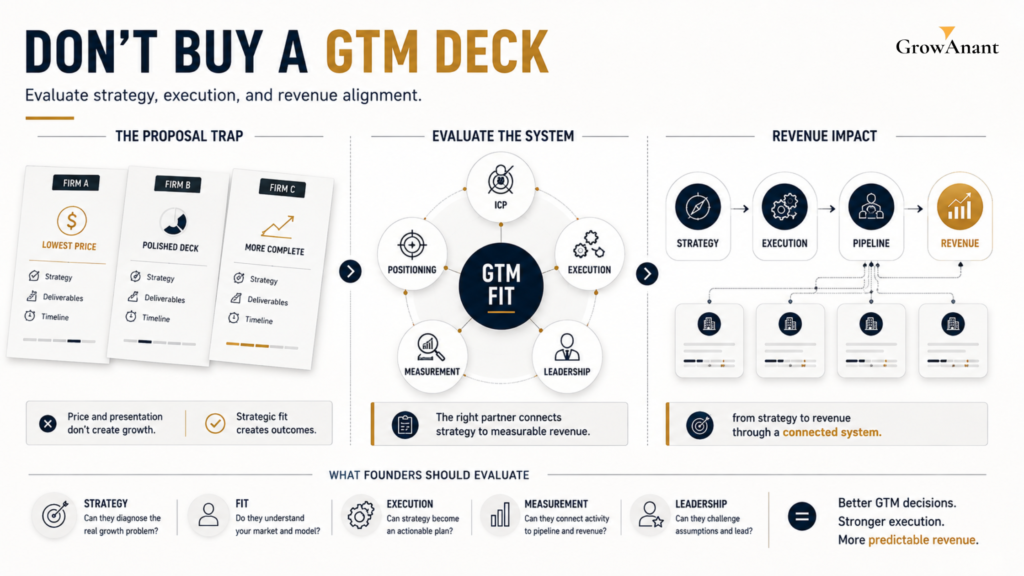
Choosing a go-to-market strategy consulting firm is a strategic decision, not simply a vendor selection exercise. The right partner can help clarify positioning, define target customers, build a go to market strategy consulting framework, align sales and marketing, and create a practical path toward scalable revenue.
The wrong partner can produce a polished strategy document that never influences pipeline, customer acquisition, or execution.
For founders evaluating go to market consulting firms, the central question should therefore be: Can this firm connect strategic decisions to commercial execution and measurable business outcomes?
This guide provides a practical framework for making that decision.
Why the Right GTM Partner Matters
A go-to-market strategy determines how a company approaches its market, customers, positioning, channels, sales motion, and growth priorities.
For a B2B SaaS startup, the challenge may be identifying the right ICP and building a repeatable acquisition model. For a professional services company, it may involve moving beyond referral-dependent growth. For a company entering the U.S., the challenge may include positioning, market segmentation, pricing, channels, and local buyer expectations.
The right growth strategy consulting partner should therefore look beyond individual marketing activities.
A useful GTM model is:
Market → ICP → Positioning → Offer → Channels → Sales Motion → Measurement
If a consulting proposal only addresses campaigns or lead generation, it may be solving an execution problem before establishing whether the underlying commercial model is sound.
McKinsey similarly describes effective B2B go-to-market transformation as a cross-functional discipline involving sales, marketing, customer understanding, channels, analytics, and leadership involvement.
What a Strong GTM Partner Should Connect
| Area | Strategic Question |
| Market | Where should we compete? |
| ICP | Which customers should we prioritize? |
| Positioning | Why should they choose us? |
| Offer | What value are we actually selling? |
| Channels | Where should buyers be reached? |
| Sales | How should opportunities convert? |
| Revenue | How will performance be measured? |
A strong partner does not necessarily need to own every activity internally. It does need to understand how the pieces connect.
Evaluation Criteria
When comparing a go-to-market strategy consulting firm, evaluate the partner across six dimensions.
1. Strategic Depth
Ask whether the firm can explain:
- Your market opportunity
- ICP segmentation
- Competitive positioning
- Buyer problems
- GTM risks
- Channel economics
- Sales motion
- Growth priorities
A firm providing business strategy consulting USA should be able to explain why a specific GTM approach makes sense, not simply recommend more marketing activity.
2. Relevant Experience
Look for evidence relevant to your business model.
A SaaS founder should examine experience with SaaS growth consulting. A professional services firm should look for experience with complex B2B sales and lead generation for B2B services. A company expanding into America may require market entry strategy USA expertise.
Do not evaluate experience purely by the number of logos shown on a website.
Ask:
“What was the commercial problem, what did you change, and how did you measure progress?”
3. Strategy-to-Execution Capability
A strategy is only useful when the organization can execute it.
Evaluate whether the firm can translate strategy into:
- Positioning
- Messaging
- Demand generation
- Sales enablement
- Content
- Channel plans
- CRM processes
- Measurement
- Testing priorities
This distinction separates strategic growth consulting services from purely execution-focused vendors.
4. Measurement Discipline
Ask what the firm considers success.
A mature partner should discuss metrics such as:
- Qualified pipeline
- Conversion rates
- Customer acquisition cost
- Sales cycle
- Pipeline velocity
- Revenue contribution
- Retention
- Channel efficiency
The exact KPI set should change according to the business model and growth stage.
5. Leadership Access
GTM decisions often affect multiple functions.
The consulting partner should be comfortable working with founders, CEOs, sales leaders, marketing leaders, and other stakeholders.
If the firm only communicates with a junior marketing team, strategic decisions may become disconnected from leadership priorities.
6. Ability to Challenge Assumptions
The best consultant is not necessarily the one who agrees with every request.
A strong partner should be willing to say:
- The ICP is too broad.
- The positioning is unclear.
- The offer needs refinement.
- The channel economics do not work.
- The sales process has a conversion problem.
- More leads will not solve the underlying issue.
That level of challenge can prevent companies from investing heavily in the wrong growth problem.
Questions to Ask Consulting Firms
Use the following questions during discovery calls.
Experience Questions
- Have you worked with companies at our stage?
- Have you worked with our business model?
- Have you handled similar GTM challenges?
- Can you explain a comparable engagement from problem to execution?
Strategy Questions
- How would you evaluate our ICP?
- How would you approach positioning?
- How do you determine which channels deserve investment?
- How would you identify GTM risks before execution?
Execution Questions
- What happens after the strategy is completed?
- Who owns implementation?
- How do you work with internal teams?
- How frequently will priorities be reviewed?
Measurement Questions
- Which KPIs would you track first?
- How do you connect marketing activity to pipeline?
- How do you handle attribution?
- What would make you recommend stopping an initiative?
Commercial Questions
- What is included in the engagement?
- Who will actually work on our account?
- How are strategic changes handled?
- What does success look like after 90 days?
The answers often reveal more than the proposal itself.
Comparing Proposals & Pricing
Comparing consulting proposals solely by price can be misleading.
One firm may offer a low-cost strategy document. Another may provide strategic planning, research, implementation support, measurement, and leadership advisory.
Those are fundamentally different engagements.
Proposal Comparison Framework
| Evaluation Area | Firm A | Firm B | Firm C |
| ICP clarity | |||
| Positioning strategy | |||
| GTM roadmap | |||
| Sales alignment | |||
| Demand generation | |||
| Measurement framework | |||
| Execution support | |||
| Leadership involvement | |||
| Reporting | |||
| Commercial model |
Common pricing structures can include project fees, monthly retainers, milestone-based engagements, or broader advisory arrangements.
The important question is not simply:
“Which proposal is cheapest?”
It is:
“Which engagement structure gives us the strategic capability and execution support required to solve our actual growth constraint?”
For some companies, growth roadmap consulting may be appropriate initially. Others may need ongoing business growth consulting because their GTM model is evolving continuously.
Also examine what happens when priorities change. A rigid engagement may become difficult when market feedback requires the strategy to adapt.
Red Flags
Several warning signs should cause founders to investigate further.
Red Flag 1: Guaranteed Growth Claims
Be cautious when a consulting firm guarantees specific revenue results without controlling the product, pricing, market, sales team, and execution environment.
Red Flag 2: Tactics Before Diagnosis
If the first recommendation is immediately “run ads,” “increase content,” or “generate more leads,” ask whether the firm has properly evaluated the underlying GTM system.
Red Flag 3: Vanity Metrics
A proposal centered almost entirely on impressions, traffic, followers, or lead volume may not provide enough visibility into commercial performance.
Red Flag 4: Generic Strategy
If the proposal could be copied and given to ten unrelated companies without major changes, it probably lacks strategic depth.
Red Flag 5: No Clear Ownership
Every major workstream should have a defined owner, decision-maker, and review process.
Red Flag 6: Strategy Ends With a Presentation
A strategy presentation is an output. It is not necessarily a growth system.
Red Flag 7: No Measurement Architecture
A serious GTM engagement should explain how the company will know whether strategic decisions are working.
For founders seeking startup growth strategy consulting, these distinctions are particularly important because limited resources make prioritization critical.
Onboarding a New Partner
Once you select a partner, the first objective should be alignment, not immediate campaign execution.
A practical onboarding sequence is:
Step 1: Business Context
Share financial priorities, growth objectives, product information, existing customers, competitive context, and current challenges.
Step 2: Performance Baseline
Review current acquisition, pipeline, conversion, sales cycle, retention, and channel performance.
Step 3: Customer Understanding
Analyze ICPs, existing customers, buyer objections, lost opportunities, and customer feedback.
Step 4: GTM Diagnosis
Identify the highest-impact constraints across market, positioning, acquisition, conversion, and sales execution.
Step 5: Prioritization
Create a roadmap separating immediate opportunities from longer-term growth infrastructure.
Step 6: Operating Rhythm
Establish recurring leadership reviews, KPI reporting, decision processes, and accountability.
Step 7: Test and Learn
Launch prioritized initiatives and use market feedback to refine the strategy.
This approach turns growth strategy consulting into an operating discipline rather than a one-time project.
For GrowAnant, this is the distinction between being a tactical marketing provider and acting as a growth partner. The focus is on connecting strategy, demand generation, GTM execution, and revenue measurement into one system.
Frequently Asked Questions
Look for strategic depth, relevant business-model experience, strong customer understanding, execution capability, measurable KPIs, leadership involvement, and the ability to connect GTM decisions with pipeline and revenue.
Ask the firm to explain comparable engagements, including the original business problem, strategic decisions, implementation process, challenges encountered, and measurement approach. Specific answers are more useful than general claims about expertise.
Fees can be structured around projects, monthly retainers, milestones, or ongoing advisory engagements. The appropriate model depends on the scope, complexity, implementation requirements, and level of leadership involvement required.
Common red flags include guaranteed revenue claims, generic recommendations, tactics presented before diagnosis, excessive focus on vanity metrics, unclear ownership, limited measurement, and a strategy that ends with a presentation rather than an implementation roadmap.