
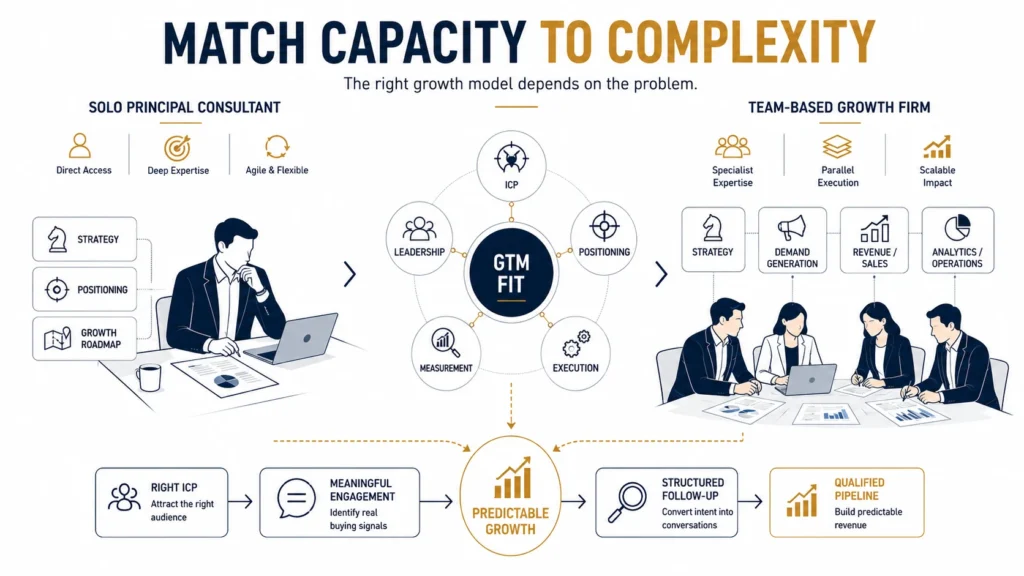
For many growth-stage businesses, hiring a founder and principal consultant can look attractive. A founder gets direct access to an experienced strategist, fewer layers of communication, and potentially a more focused engagement. A fractional growth consultant can also provide senior-level thinking without the commitment of hiring a full-time executive.
But the real question is not whether one consultant is capable. It is whether one person has enough bandwidth, expertise, execution capacity, and continuity to address the company’s current growth problem.
A solo consultant may be highly effective for a focused strategic challenge. A business managing multiple channels, markets, products, and execution teams may require broader support.
What a Solo Principal Consultant Offers
The biggest advantage of a solo principal consultant is direct access to senior expertise.
Instead of working through account managers or junior strategists, the founder may work directly with the person responsible for the strategy.
This can create several advantages:
| Advantage | Why It Matters |
| Direct access | Faster strategic communication |
| Senior expertise | Decisions are made by an experienced practitioner |
| Lower complexity | Fewer people and meetings |
| Flexibility | Scope can adapt quickly |
| Focused accountability | One person owns the strategic relationship |
For example, a B2B SaaS founder may need to clarify positioning before investing further in demand generation. A solo consultant with strong growth strategy consulting experience could conduct customer research, refine the ICP, evaluate competitors, develop positioning, and build a growth roadmap consulting framework.
That may be exactly what the business needs.
A solo model can also work well when the company already has capable internal execution resources. If a startup has marketers, designers, salespeople, and operations support, the consultant can act as the strategic layer connecting those resources.
The key question becomes:
Does the business need another executor, or does it need senior growth direction?
For a focused strategic engagement, direct principal involvement can be a significant advantage.
Limitations of a One-Person Engagement
The same characteristic that makes a solo consultant attractive can also create its biggest limitation: capacity.
One person cannot simultaneously provide deep strategy, conduct research, manage multiple campaigns, analyze performance, build content, coordinate sales, manage technology, and maintain executive advisory responsibilities at unlimited scale.
This matters when growth problems are interconnected.
Consider a U.S.-focused SaaS company experiencing:
- Weak positioning
- Low-quality leads
- Poor website conversion
- Underperforming paid acquisition
- Sales follow-up gaps
- Inconsistent content
- Weak CRM reporting
The business does not have one isolated problem. It has a growth system problem.
A solo consultant may diagnose the issues effectively, but execution capacity can become constrained.
Typical Capacity Risks
1. Single point of dependency
If the consultant becomes unavailable, strategic continuity can be disrupted.
2. Limited specialist coverage
One person may be strong in strategy but less experienced in paid acquisition, SEO, analytics, CRM operations, or content execution.
3. Execution bottlenecks
Recommendations may accumulate faster than they can be implemented.
4. Limited parallel work
Research, strategy, implementation, and optimization compete for the same person’s time.
5. Scaling constraints
As the business grows, the engagement may require capabilities that were not necessary at the beginning.
This does not make solo consulting inferior. It means the engagement structure needs to match the complexity of the growth challenge.
When a Team-Based Firm Is Better
A team-based model becomes more valuable when growth requires multiple capabilities operating simultaneously.
For example, a company entering a new U.S. market may need:
Market research → ICP definition → positioning → messaging → demand generation → sales enablement → analytics → optimization
A team can divide these responsibilities while maintaining a common strategic direction.
For companies seeking business growth consulting, the value of a team is therefore not simply having more people. It is having access to complementary expertise.
Solo vs Team-Based Model
| Factor | Solo Consultant | Team-Based Firm |
| Strategic access | Very high | High |
| Specialist coverage | Limited | Broader |
| Execution capacity | Limited | Higher |
| Parallel initiatives | Lower | Higher |
| Communication complexity | Low | Moderate |
| Continuity | Consultant-dependent | More distributed |
| Scalability | Moderate | Higher |
| Best fit | Focused challenges | Complex growth systems |
A team-based growth consulting services model can be particularly useful for businesses where marketing, sales, positioning, analytics, and operations must change together.
For instance, a professional services firm dependent on referrals may need positioning work, content development, B2B lead generation services, CRM improvements, sales enablement, and campaign execution. A broader team may be better equipped to coordinate those workstreams.
GrowAnant’s positioning as a growth partner reflects this distinction. The objective is not simply to provide a strategist or a collection of marketing services, but to connect strategy, demand generation, execution, and revenue priorities.
Evaluating Bandwidth and Bench Strength
Founders often ask about experience but overlook capacity.
A consultant may have excellent credentials but limited availability. A larger firm may have many employees but provide little access to senior expertise.
The solution is to evaluate both expertise and bench strength.
Ask these questions before signing an engagement:
Principal Consultant
- How much time will the principal personally spend on our account?
- Who makes strategic decisions?
- How many active clients does the consultant manage?
- What happens if the consultant is unavailable?
Team Capacity
- Who handles execution?
- Which specialists are available?
- Are those specialists employees or external contractors?
- How quickly can additional expertise be introduced?
- Who manages coordination across specialists?
Continuity
- Is there a documented strategy?
- Are decisions recorded?
- Is reporting standardized?
- Can another team member understand the account if responsibilities change?
A useful evaluation framework is:
Access × Expertise × Capacity × Continuity
A high score requires all four.
A solo consultant with exceptional expertise but limited capacity may still be the wrong fit for an organization that needs rapid execution across several functions.
Cost Differences
Cost should be evaluated against the scope of work, not simply the number of people involved.
A solo consultant may have lower overhead and provide senior expertise directly. A team-based firm may cost more because the engagement includes multiple specialists, project management, technology, research, and execution capabilities.
But a lower monthly fee does not automatically mean lower total cost.
Suppose a founder hires a solo consultant for strategy but then needs separate providers for:
- SEO
- Paid media
- Content
- Analytics
- CRM
- Design
The founder may end up managing several vendors independently.
A team-based engagement can consolidate those responsibilities.
Cost Evaluation Framework
Instead of asking:
“Which option costs less?”
Ask:
“What resources are required to solve the growth problem completely?”
| Cost Consideration | Solo Model | Team Model |
| Strategy | Usually included | Usually included |
| Specialist execution | May require external resources | Often available |
| Project management | Limited or founder-managed | Often included |
| Coordination | Lower internally | Managed by firm |
| Flexibility | High | Depends on engagement |
| Total management burden | Potentially higher | Potentially lower |
For early-stage businesses, a solo growth consultant may be appropriate when capital is limited and the immediate requirement is strategic clarity.
For a growth-stage company with multiple revenue initiatives, a team may provide better operating leverage.
The correct model depends on the business’s growth constraint, not simply its budget.
Decision Framework
Founders can use this simple decision framework before choosing between a solo consultant and a team-based firm.
Choose a Solo Consultant When:
- The growth challenge is clearly defined.
- You primarily need senior strategic guidance.
- Your internal team can execute recommendations.
- The number of active initiatives is limited.
- Direct principal access is a priority.
- You need flexibility rather than broad execution capacity.
Consider a Team-Based Firm When:
- Multiple growth problems are interconnected.
- Strategy and execution need to happen simultaneously.
- Several specialists are required.
- Sales and marketing need coordinated support.
- You are entering a new market.
- Your internal team lacks critical expertise.
- Growth initiatives need to run in parallel.
The Five-Question Test
Score each question from 1 to 5:
- Strategic complexity: How complex is the growth challenge?
- Execution volume: How much implementation is required?
- Specialist depth: How many different capabilities are needed?
- Internal capacity: How much can the existing team execute?
- Speed requirement: How quickly must multiple initiatives move?
If most scores are low, a solo consultant may be sufficient.
If several scores are high, a team-based engagement deserves serious consideration.
The most important principle is simple: match the engagement structure to the growth system you need to build.
A business does not necessarily need the largest consulting team. It needs enough strategic leadership and execution capacity to address its actual constraints.
Before selecting either model, founders should also clarify the expected growth consulting engagement structure, decision rights, KPIs, responsibilities, communication rhythm, and transition plan. These details often matter more than whether the provider describes itself as a consultant, agency, or growth partner.
References
Harvard Business Review: Why Teams Fail
McKinsey & Company: The future of B2B sales growth
Frequently Asked Questions
A solo consultant can be enough when the company has a focused strategic challenge, capable internal execution resources, and a limited number of simultaneous priorities. As complexity and execution requirements increase, additional specialist capacity may become necessary.
The primary limitations are bandwidth, specialist coverage, parallel execution, and continuity. One consultant may be highly capable but still unable to manage multiple complex workstreams simultaneously.
Ask who will actually work on the account, what specialist capabilities are available, how much time the principal will personally contribute, whether specialists are internal or external, and what happens if a key person becomes unavailable.
Not necessarily. A team-based firm may have a higher engagement fee, but it can also consolidate strategy, execution, coordination, and specialist expertise. The relevant comparison is the total cost and management burden required to solve the growth problem.