
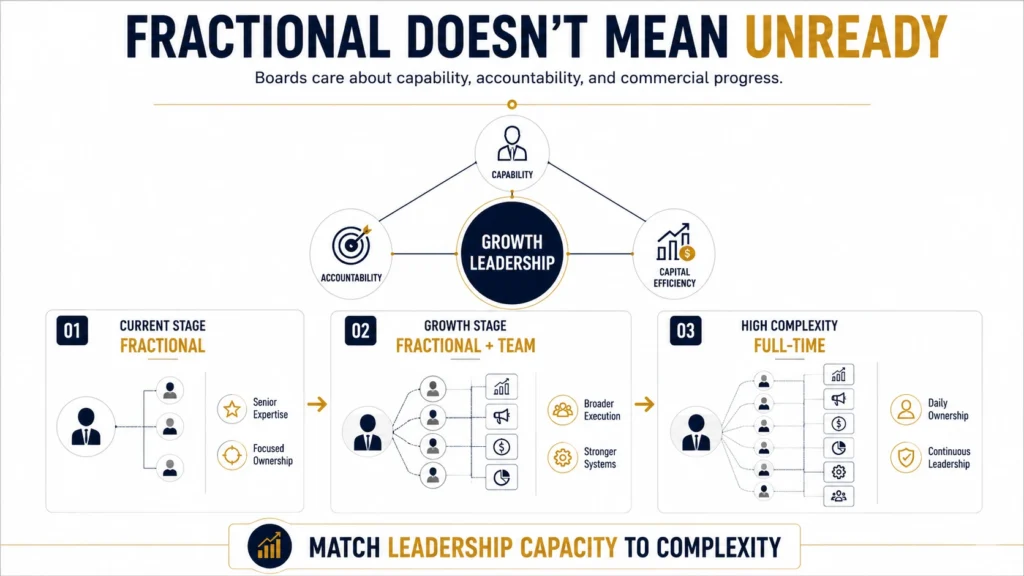
For founders, hiring a fractional growth leadership board perspective can raise an important question: will investors see fractional leadership as a smart use of capital or as a sign that the company is not ready for a full-time executive?
The answer depends largely on how the role is structured and reported.
A fractional growth leadership model can give a startup access to senior expertise before the business needs or can justify a full-time executive. Harvard Business Review notes that fractional leaders are increasingly used by startups and smaller businesses that need senior talent but may not yet have the resources or need for a full-time executive.
For boards, however, the important question is rarely whether the leader is fractional. It is whether the company has clear ownership, measurable progress, sound growth governance, and an appropriate leadership structure for its current stage.
Why Boards Increasingly Support Fractional Models
Boards and investors generally care about three things when evaluating leadership investments:
- Does the company have the capability required to execute its strategy?
- Is capital being allocated efficiently?
- Is there clear accountability for outcomes?
A fractional leader can make sense when the company needs experienced leadership but does not yet require that capability full-time.
For example, a Series A SaaS company may have:
- A strong product leader
- A capable sales founder
- Junior marketing resources
- Inconsistent pipeline
- No senior growth owner
Hiring a full-time executive may be premature if the company is still determining its repeatable growth model. A fractional growth consultant can provide strategic leadership while the company builds the internal capability required for the next stage.
Where Fractional Leadership Can Fit
| Business Situation | Potential Fractional Role |
| Early demand generation | fractional head of growth |
| GTM model development | fractional chief growth officer |
| Marketing and sales alignment | fractional growth executive |
| New market expansion | fractional growth leadership |
| Growth team development | fractional growth consultant |
The model is particularly relevant when the business needs expertise before it needs a permanent organizational layer.
However, boards should not interpret fractional leadership as a permanent substitute for every executive role. As the company scales, responsibilities, decision complexity, and operating requirements may change.
Board Reporting Expectations
Boards do not need a detailed activity report showing every marketing task completed.
They need visibility into whether the growth function is improving the company’s commercial position.
A strong monthly or quarterly update should connect:
Strategy → Actions → Leading indicators → Pipeline → Revenue implications
For example:
| Area | Board-Level Question |
| Strategy | What growth constraint are we solving? |
| ICP | Are we targeting the right customers? |
| Demand | Is qualified demand increasing? |
| Pipeline | Is marketing creating commercially relevant opportunities? |
| Conversion | Where is the funnel leaking? |
| Revenue | What is changing in bookings or revenue? |
| Efficiency | Are acquisition economics improving? |
| Risks | What assumptions may be wrong? |
| Next period | What decisions require leadership attention? |
This approach is consistent with broader board-management principles: boards need meaningful performance measures and clear accountability rather than an overwhelming volume of operational information. McKinsey research also emphasizes the importance of appropriate performance metrics as companies move through different stages of growth.
A Practical Fractional Growth Scorecard
A fractional growth leadership contract should ideally establish a scorecard containing:
Leading indicators
- Qualified website conversions
- Target-account engagement
- Sales-qualified opportunities
- Pipeline creation
- Conversion rates
- Sales activity quality
Lagging indicators
- New revenue
- Customer acquisition cost
- Pipeline-to-revenue conversion
- Retention
- Expansion revenue
- Gross margin contribution
The exact metrics should depend on the company’s business model.
A fintech startup, for example, may prioritize activation and qualified pipeline. A B2B SaaS company may focus heavily on pipeline velocity, win rate, CAC, and retention.
The key is to avoid presenting activity as progress.
Capital Efficiency Arguments
The strongest argument for fractional leadership is not simply that it costs less.
It is that the company can obtain senior capability at a level of commitment that matches its current needs.
Consider a company that needs senior growth leadership approximately two days per week while its internal team handles execution.
Hiring a full-time executive may create unnecessary fixed cost and organizational complexity.
A fractional model can instead provide:
- Senior strategic expertise
- Leadership decision support
- GTM direction
- Team management
- KPI accountability
- Executive-level communication
- Flexible capacity
Harvard Business Review specifically identifies access to senior expertise and the economics of hiring part-time leaders as important reasons organizations consider fractional leadership.
The Board-Level Capital Efficiency Test
Boards should ask:
What capability does the company need, how much of that capability is required today, and what evidence would justify expanding it?
This creates a more disciplined decision than simply comparing a fractional fee with an executive salary.
For example:
Stage 1: Fractional growth leadership establishes the GTM system.
Stage 2: Internal team execution increases.
Stage 3: Growth complexity increases.
Stage 4: Company evaluates whether a full-time executive is justified.
This creates a potential progression from external leadership to internal leadership rather than forcing the company to make the full-time decision too early.
Red Flags Boards Watch For
Fractional leadership becomes concerning when the structure creates ambiguity rather than capability.
1. No Clear Accountability
If nobody clearly owns growth decisions, the fractional role becomes advisory without meaningful leadership responsibility.
2. Activity Without Commercial Metrics
A report dominated by content published, campaigns launched, or meetings held does not demonstrate business progress.
3. Undefined Availability
Boards may question a role if leadership access is unclear.
The company should know when the fractional executive is available, what decisions they own, and how urgent issues are handled.
4. Dependency Without Knowledge Transfer
A fractional leader should not become the only person who understands the growth system.
Documentation, dashboards, processes, and internal capability should develop alongside the engagement.
5. No Transition Logic
The board should understand what happens if the company eventually requires a full-time executive.
6. Strategic Responsibility Without Authority
A fractional leader cannot reasonably be accountable for growth if the role has no influence over the resources, priorities, or teams required to execute the strategy.
A strong growth leadership team structure therefore defines decision rights as carefully as responsibilities.
Positioning Fractional Hires to Investors
Founders should avoid presenting fractional leadership as:
“We could not afford a full-time executive.”
That framing emphasizes limitation.
A stronger investor narrative is:
“We brought in senior growth leadership at the stage-appropriate level of commitment while building the internal capabilities required for our next growth phase.”
The distinction is important.
The investor should understand:
Why the role exists → What it owns → What has changed → What is being measured → What happens next
Investor Update Framework
1. Business problem
“We identified inconsistent pipeline generation as a major constraint.”
2. Leadership decision
“We added fractional growth leadership to establish senior ownership of the GTM function.”
3. Scope
“The role owns ICP refinement, positioning, demand generation priorities, funnel measurement, and growth operating cadence.”
4. Evidence
“Here are the changes in qualified pipeline, conversion, acquisition efficiency, and revenue indicators.”
5. Next stage
“Based on growth complexity and internal capability, we will evaluate whether the role should transition to a full-time executive position.”
This creates a clear story around strategic capability rather than employment structure.
Investors generally need a coherent connection between strategy, performance data, and the company’s long-term value creation narrative. McKinsey’s research on investor communications similarly emphasizes consistency and the importance of metrics that demonstrate growth and long-term performance.
For a company using growth consulting services or revenue growth consulting, this reporting discipline also helps ensure that growth work remains connected to the company’s broader financial objectives.
The strongest fractional model is therefore not “part-time marketing leadership.” It is accountable senior growth leadership designed around the company’s current stage.
Frequently Asked Questions
Not inherently. Fractional leadership can be a rational option when the company needs senior expertise but does not yet require a full-time executive. The concern arises when ownership, accountability, availability, or the path to future leadership needs are unclear.
Report it through business outcomes and strategic accountability. Explain why the role was created, what it owns, which KPIs are being tracked, what has changed, and how the leadership model may evolve as the company grows.
The strongest argument is matching leadership capacity to the company’s current requirements while accessing senior expertise. The goal should be efficient capability deployment, not simply reducing executive compensation.
Boards may favor a full-time hire when growth complexity becomes persistent, the leadership role requires continuous availability, multiple teams need ongoing coordination, or the company has reached a scale where permanent executive ownership is justified.