
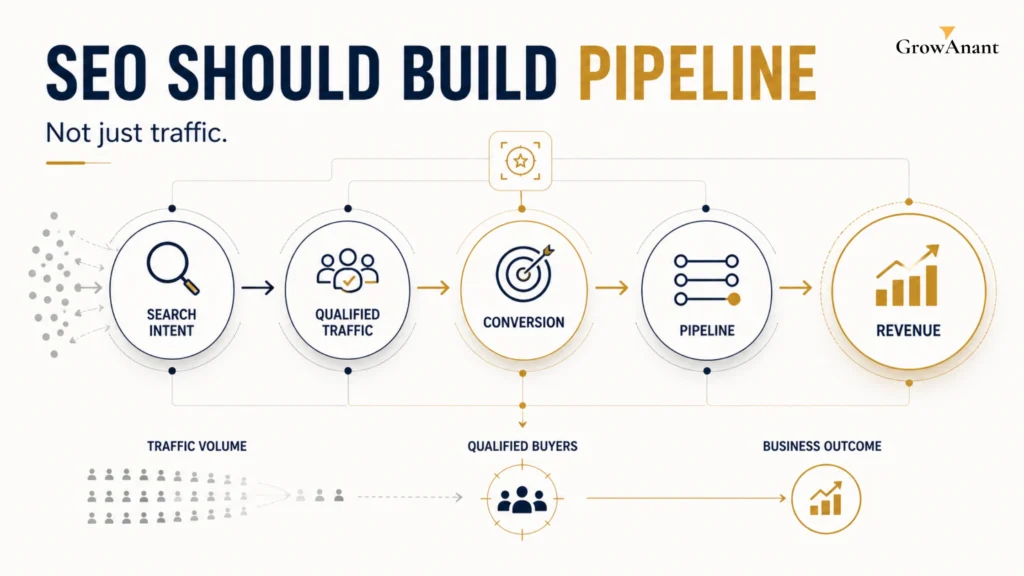
SEO for B2B demand generation is not simply about generating more website traffic. It is about creating organic visibility for the problems, solutions, comparisons, and decisions that matter to business buyers.
For a B2B SaaS company, professional services firm, or growth-stage business, this means connecting search intent to qualified demand, sales conversations, and pipeline. A well-designed SEO program can become a long-term demand engine, particularly when it targets high-intent queries instead of optimizing only for search volume.
Google recommends people-first content that provides useful, reliable information, while its SEO guidance emphasizes helping search engines understand content and helping users find relevant information.
Why SEO Is a Long-Term Demand Engine
SEO works differently from paid acquisition. Paid campaigns can create immediate visibility, while organic search compounds through content, authority, technical improvements, and accumulated search visibility.
The strategic objective of seo for b2b demand generation should therefore be:
Search visibility → Qualified traffic → Buyer engagement → Conversion → Pipeline → Revenue
This is why growth marketing services and demand generation agency strategies should not treat SEO as an isolated traffic channel.
A B2B buyer might search:
- “best CRM for healthcare companies”
- “B2B cybersecurity compliance software”
- “IT infrastructure consulting for manufacturers”
- “how to reduce SaaS customer acquisition costs”
These searches reveal different levels of commercial intent.
| Search Intent | Example | Business Value |
| Informational | What is demand generation? | Awareness |
| Problem-aware | How to reduce SaaS CAC | Consideration |
| Solution-aware | B2B demand generation software | Evaluation |
| Commercial | Best demand generation agencies | Vendor evaluation |
| Decision | GrowAnant alternatives | Purchase consideration |
A strong SEO strategy covers the buyer journey rather than producing disconnected blog posts.
For a B2B company, SEO should therefore be treated as an organic demand asset, not simply a publishing activity.
Keyword Strategy for B2B Buyers
Effective B2B lead generation services begin with understanding buyer intent before selecting keywords.
High-volume keywords are not automatically valuable. A low-volume keyword searched by a VP Marketing evaluating vendors may be more commercially important than a high-volume educational keyword attracting students or casual researchers.
A useful keyword prioritization framework is:
Business relevance × Buyer intent × Commercial value × Ranking feasibility
Keyword Categories
1. Problem keywords
These describe a business challenge.
Example:
“low B2B lead conversion rate”
2. Solution keywords
These indicate that the buyer is exploring potential solutions.
Example:
“B2B lead generation services”
3. Comparison keywords
These often indicate active evaluation.
Example:
“account based marketing vs demand generation”
4. Provider keywords
These signal strong commercial intent.
Example:
“demand generation agency”
5. Decision keywords
These relate directly to purchase or implementation.
Example:
“growth marketing agency USA”
This approach also creates a natural connection between demand generation analytics, content performance, CRM data, and sales outcomes.
Build a Keyword-to-Funnel Map
| Funnel Stage | Content Type | Example |
| TOFU | Educational guide | What is B2B demand generation? |
| TOFU/MOFU | Problem guide | Why B2B leads fail to convert |
| MOFU | Framework | Demand generation strategy framework |
| MOFU | Comparison | account based marketing vs demand generation |
| BOFU | Service page | B2B lead generation services |
| BOFU | Comparison | Agency vs internal growth team |
This is more valuable than publishing dozens of unrelated articles.
For example, a SaaS company offering revenue operations software should build content around the problems its ICP actively researches, then connect educational content to comparison pages, product pages, demos, and sales conversations.
Content That Converts Organic Traffic
Ranking is only the beginning.
The next question is:
What should a qualified visitor do after discovering the page?
Google’s current guidance emphasizes useful, people-first content rather than content created primarily to manipulate search rankings.
For B2B organizations, this means creating content that demonstrates expertise while helping buyers make decisions.
A strong content system should include:
Educational Content
Answers early-stage questions and establishes expertise.
Problem-Solving Content
Addresses operational or commercial challenges.
Comparison Content
Helps buyers evaluate alternatives.
Use-Case Content
Shows how a solution applies to a specific industry or business situation.
Decision Content
Supports vendor evaluation and implementation.
For example, a professional services company could create:
TOFU: “Why Referral-Dependent B2B Firms Struggle to Scale”
MOFU: “How to Build a Predictable B2B Lead Generation System”
BOFU: “Lead Generation for B2B Services: Internal Team vs External Partner”
Each page has a different role, but together they create a demand pathway.
The Organic Conversion Framework
Every important SEO page should answer:
- What problem does the buyer have?
- Why does it matter commercially?
- What options exist?
- How should the buyer evaluate those options?
- What evidence supports the recommendation?
- What is the appropriate next step?
This is where B2B growth marketing agency thinking differs from traffic-first SEO. The objective is to move the right buyer closer to a commercial decision.
GrowAnant, for example, can approach growth consulting services through this strategy-first lens by connecting organic content with growth strategy, demand generation, GTM planning, and revenue execution rather than treating SEO as a standalone activity.
Technical SEO Basics
Technical SEO is the infrastructure that allows search engines to crawl, understand, and index a website effectively.
Google’s SEO documentation specifically identifies crawlability, indexation, site structure, and page understanding as important parts of making a site discoverable in Search.
A B2B technical SEO checklist should include:
- Crawlability
- Indexation
- XML sitemap
- Robots.txt
- Canonical URLs
- Internal linking
- Mobile usability
- Page performance
- HTTPS
- Structured data where appropriate
- Broken-link monitoring
- Redirect management
- Duplicate-content control
- Search Console monitoring
However, technical optimization should support commercial content rather than become the entire SEO strategy.
A perfectly optimized website with weak positioning and irrelevant content will not create meaningful demand.
Technical SEO Priority Framework
| Priority | Question |
| Crawl | Can search engines access important pages? |
| Index | Are valuable pages actually indexed? |
| Structure | Can users and search engines understand the site hierarchy? |
| Performance | Is the experience technically usable? |
| Internal links | Are important commercial pages receiving contextual authority? |
| Conversion | Does traffic have a logical next step? |
For a growth-stage company, this prioritization helps prevent technical SEO work from consuming resources without improving business performance.
Measuring SEO’s Pipeline Contribution
The most important shift in B2B SEO measurement is moving beyond rankings and traffic.
A useful measurement framework is:
Visibility → Engagement → Conversion → Pipeline → Revenue
SEO KPI Framework
| Stage | Metrics |
| Visibility | Impressions, rankings, share of search |
| Traffic | Organic sessions, landing-page visits |
| Engagement | Engagement rate, return visits, content progression |
| Conversion | Form fills, demo requests, qualified conversions |
| Pipeline | SQLs, opportunities, influenced pipeline |
| Revenue | Closed-won revenue, customer acquisition cost |
A b2b marketing attribution model should also account for the reality that B2B buying journeys are rarely linear.
A prospect may:
- Read a blog post.
- Return through LinkedIn.
- Attend a webinar.
- Visit a service page.
- Speak with sales.
- Return through branded search.
- Become an opportunity.
SEO may influence the journey without being the final recorded conversion source.
That is why demand generation analytics should examine both direct and influenced pipeline.
A practical dashboard could track:
Organic traffic → ICP traffic → Qualified conversions → Opportunities → Pipeline influenced → Revenue
HubSpot’s current B2B SEO guidance similarly emphasizes qualified leads, conversion rates, influenced pipeline, and revenue rather than traffic alone.
Common Mistakes
1. Chasing Search Volume
High traffic does not necessarily mean high commercial value.
2. Publishing Without Buyer Intent
A large content library cannot compensate for weak alignment with ICP problems.
3. Ignoring BOFU Content
Companies often invest heavily in educational blogs while neglecting service, comparison, product, and decision-stage pages.
4. Treating Rankings as the Final KPI
A first-page ranking is useful only when it creates relevant visibility and contributes to business outcomes.
5. Creating Content Without Internal Linking
Strong content should form a connected topic architecture that guides buyers toward relevant commercial pages.
6. Ignoring Conversion Paths
Organic visitors need logical next steps such as a consultation, assessment, demo, resource, or other relevant action.
7. Separating SEO From Revenue Operations
SEO, CRM, sales, and marketing analytics should not operate as disconnected systems.
8. Optimizing Only for Search Engines
Search visibility should support buyer understanding. Google’s guidance explicitly favors helpful, reliable, people-first content over search-engine-first content.
A more effective approach is to build an integrated system where growth strategy consulting, growth marketing services, B2B marketing, and SEO work toward the same commercial objectives.
References
Google Search Central
SEO Starter Guide
Frequently Asked Questions
B2B SEO does not have a universal timeline. Some changes can appear relatively quickly, while competitive topics and new domains may require substantially longer. Google notes that changes can take anywhere from hours to several months to be reflected in Search.
The more useful question is whether qualified visibility, conversions, and pipeline are improving over time.
The most valuable keywords are usually those that combine strong business relevance with meaningful buyer intent. Problem, solution, comparison, provider, and decision-stage keywords can all matter, depending on the buying journey.
A low-volume keyword can be highly valuable if it is searched by the right decision-maker at the right stage.
Yes, but not all organic traffic should be expected to convert directly. SEO can influence pipeline through educational content, commercial pages, repeat visits, brand discovery, and assisted conversions.
The strongest measurement system connects organic search activity with CRM conversion, opportunity, pipeline, and revenue data.
Measure SEO through the progression from organic visibility to business outcomes:
Organic visibility → Qualified traffic → Conversions → Opportunities → Pipeline → Revenue
For B2B companies, this is more meaningful than evaluating SEO solely through rankings or traffic. A strong SEO program should demonstrate that it is helping the business reach relevant buyers and contribute to measurable commercial outcomes.