
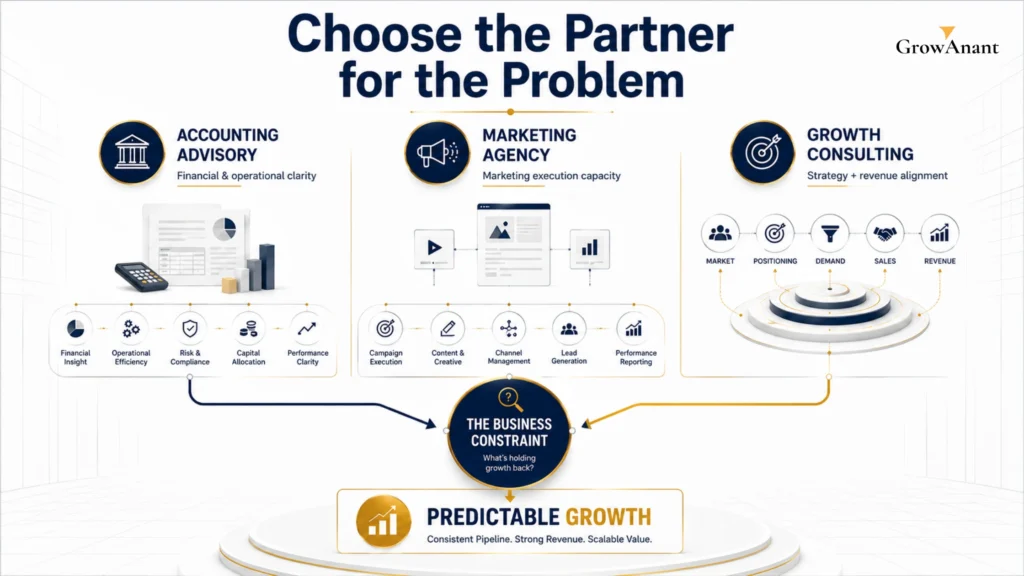
The choice between digital growth consulting vs general marketing agencies accounting firms is ultimately a question of what the business needs to solve. A company looking for execution may need an agency. A company looking for financial or operational guidance may benefit from an accounting firm’s advisory arm. A company facing fragmented marketing, weak demand generation, unclear positioning, or unpredictable pipeline may need specialized business growth consulting.
The distinction matters because growth is broader than marketing activity. A useful partner should connect market positioning, customer acquisition, demand generation, sales execution, measurement, and revenue priorities. McKinsey’s work with professional services firms similarly spans growth strategy, operating models, governance, and execution rather than treating growth as a single functional activity.
Why Accounting Firms Are Expanding Into Advisory
Accounting firms have traditionally been associated with audit, tax, compliance, and financial reporting. Many have expanded into advisory because clients increasingly want help interpreting financial information and making broader business decisions.
This can create substantial value.
An accounting advisory team may help a founder with:
- Financial planning
- Cash-flow management
- Business valuation
- Transaction preparation
- Risk management
- Operational improvement
- Financial controls
- Strategic planning
For a founder considering business growth consulting, however, the key question is scope.
If the central problem is:
“We do not understand our financial position.”
An accounting advisory team may be highly relevant.
If the problem is:
“We have a strong product, but our positioning, pipeline, demand generation, and acquisition model are not producing predictable growth.”
The required capabilities are different.
| Business Need | Likely Best-Fit Capability |
| Financial reporting | Accounting |
| Tax and compliance | Accounting |
| Cash-flow planning | Accounting advisory |
| M&A or transaction support | Financial advisory |
| Market positioning | Growth consulting |
| Demand generation | Growth consulting or specialized marketing |
| GTM strategy | Growth consulting |
| Marketing execution | Marketing agency |
| Revenue-system alignment | Growth consulting / RevOps |
| Growth leadership | Growth consultant or fractional leader |
The distinction is not that one provider is better than another. It is whether the provider’s core expertise matches the problem.
What General Marketing Agencies Offer
A general agency can be valuable when the company has a clear strategy and needs additional execution capacity.
Typical capabilities may include:
- Paid advertising
- SEO
- Social media
- Content production
- Website development
- Creative
- Email marketing
- Campaign management
- Marketing automation
For example, a SaaS company with a validated positioning strategy and defined ICP may benefit from a digital marketing agency executing paid campaigns, SEO, landing pages, and content.
The potential scope gap appears when the company expects the agency to determine the entire growth strategy.
A campaign can generate traffic without producing qualified pipeline. More content can increase website activity without improving conversion. More advertising can increase spend without solving rising CAC.
This is why the distinction between growth marketing services and broader growth leadership matters.
A general agency often asks:
“Which marketing activities should we execute?”
A growth-focused partner should also ask:
“Which market, buyer, problem, offer, channel, and commercial motion should we prioritize, and how will we know whether the system is working?”
HubSpot’s own partner ecosystem illustrates that providers can specialize across marketing, sales strategy, CRM, RevOps, implementation, and execution, reinforcing the importance of matching the provider to the specific business requirement.
What Specialized Growth Consultants Offer
A specialized growth consultant typically operates closer to the intersection of strategy, marketing, sales, and revenue.
The objective is not simply to increase marketing output. It is to identify the constraints preventing sustainable growth and establish priorities.
A typical growth strategy consulting engagement may examine:
- Market and ICP
- Positioning and differentiation
- Customer acquisition
- Demand generation
- Funnel performance
- Sales process
- Conversion points
- Revenue economics
- Measurement and attribution
- Growth leadership and execution
This makes specialized consulting particularly relevant when leadership says:
“We are doing a lot, but we are not sure which activities are actually driving growth.”
For a B2B SaaS company, this might mean diagnosing why qualified traffic is not becoming opportunities.
For a professional services firm, it might mean reducing dependence on partner referrals.
For a U.S.-focused startup, it could involve refining ICP, positioning, and GTM before scaling acquisition investment.
The engagement structure can also vary. growth consulting services may be delivered through a strategy project, advisory relationship, fractional leadership model, implementation program, or longer-term growth partnership.
The strongest model is the one aligned with the complexity of the problem.
Scope & Expertise Differences
The most useful way to compare providers is by looking at where responsibility begins and ends.
| Capability | Accounting Advisory | General Marketing Agency | Specialized Growth Consultant |
| Financial strategy | Strong | Limited | Supporting capability |
| Tax/compliance | Strong | No | No |
| Marketing execution | Limited | Strong | Selective |
| Positioning | Sometimes | Variable | Strong |
| GTM strategy | Variable | Variable | Strong |
| Demand generation | Limited | Strong | Strong |
| Sales alignment | Variable | Variable | Strong |
| Revenue strategy | Strong financially | Usually limited | Strong |
| Funnel diagnosis | Limited | Channel-focused | Cross-functional |
| Growth roadmap | Variable | Campaign-focused | Strong |
| Fractional leadership | Variable | Sometimes | Core capability |
| Cross-functional growth ownership | Limited | Variable | Strong |
The important issue is not the number of services listed on a website.
It is the level at which the provider operates.
A business can hire a B2B growth marketing agency to execute a defined acquisition strategy. It can hire a demand generation agency to build campaigns and pipeline programs. It can use revenue growth consulting when the problem spans marketing, sales, positioning, and commercial execution.
A specialized growth partner is especially relevant when those functions are currently disconnected.
McKinsey’s strategy work similarly emphasizes combining strategic decisions with resource allocation, implementation, capability building, and long-term value creation.
Choosing the Right Partner for Growth Specifically
The right provider should be selected based on the problem, not the provider category.
Use this decision framework.
Step 1: Define the primary constraint
Is the business primarily facing:
- Financial uncertainty?
- Marketing execution gaps?
- Weak positioning?
- Poor lead quality?
- Low conversion?
- Pipeline inconsistency?
- GTM uncertainty?
- Lack of senior growth leadership?
Step 2: Identify the required level of involvement
| Need | Appropriate Engagement |
| Defined execution | Specialist agency |
| Financial or operational guidance | Accounting advisory |
| Strategy diagnosis | Growth consultant |
| Strategy plus execution | Growth consulting partner |
| Senior growth ownership | Fractional growth leadership |
Step 3: Evaluate commercial accountability
Ask prospective partners:
- What business problem will you own?
- Which metrics will you influence?
- How will marketing connect to pipeline?
- Who makes strategic decisions?
- What happens when the original strategy does not work?
- How often will priorities be reassessed?
- What internal capabilities will be developed?
Step 4: Assess strategic depth
Look for evidence that the provider understands:
Market → ICP → Positioning → Demand → Pipeline → Sales → Revenue
A partner that focuses exclusively on one stage may be appropriate for a specific need. A partner responsible for growth strategy should understand the entire chain.
Strategic Selection Checklist
Before engaging a provider, confirm:
- The business problem is clearly defined.
- The provider has relevant industry or business-model experience.
- Strategy and execution responsibilities are explicit.
- Pipeline and revenue metrics are included.
- Reporting responsibilities are defined.
- Decision-making ownership is clear.
- The engagement has measurable priorities.
- The provider can work with existing internal teams.
- The commercial model matches the required level of involvement.
- There is a clear path from diagnosis to implementation.
For growth-stage businesses, GrowAnant approaches this gap as a growth consulting partner rather than a tactical vendor. Its role can span positioning, demand generation, GTM planning, revenue-focused execution, and scalable growth systems.
The objective is not to replace every specialist. It is to create strategic alignment so that specialists contribute toward the same growth priorities.
References
McKinsey & Company: Law Firms & Professional Services Consulting
HubSpot: Find the Perfect Service Provider With the HubSpot Partner Directory
Frequently Asked Questions
It can, particularly when growth decisions are closely connected to financial planning, capital allocation, transactions, or operational improvement. However, if the core challenge is positioning, demand generation, customer acquisition, GTM execution, or marketing-to-revenue alignment, a specialized growth partner may provide deeper functional expertise.
A general agency typically focuses on executing marketing activities across channels. A growth specialist looks more broadly at the commercial system, including ICP, positioning, acquisition, funnel performance, demand generation, sales alignment, and revenue outcomes. The distinction is primarily scope and strategic responsibility.
Scope gaps commonly appear between strategy and execution. An agency may execute campaigns without owning the broader GTM strategy. An accounting advisory team may understand financial performance without owning customer acquisition. A growth consultant may identify strategic priorities but require specialist teams for execution. Clear responsibilities should be established before engagement.
Start with the business constraint rather than the service category. If the problem is financial, consider financial advisory. If the strategy is clear and execution capacity is missing, consider a specialist agency. If positioning, demand generation, sales alignment, and revenue execution are interconnected problems, consider specialized growth consulting.