
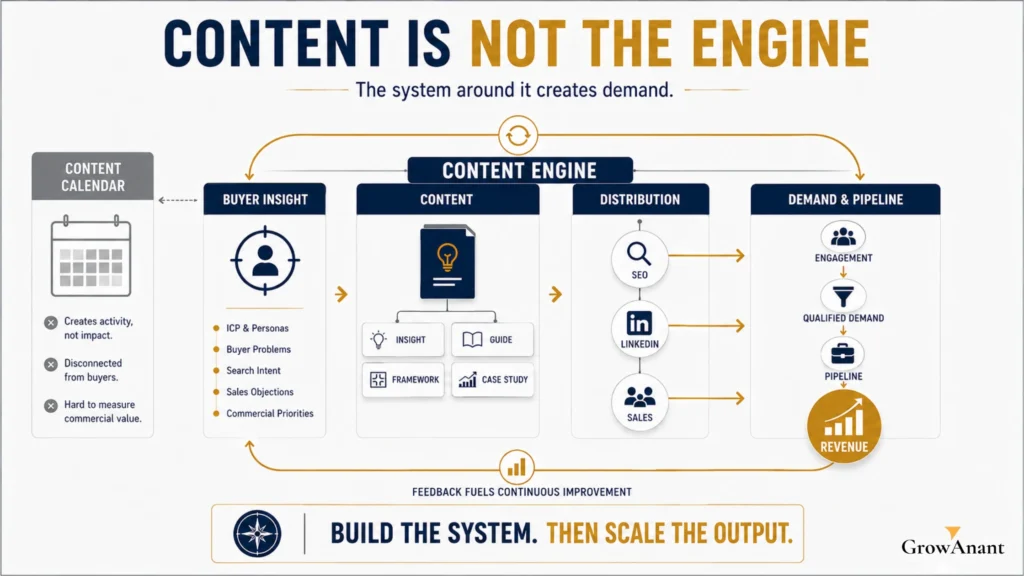
A b2b content engine is a structured system for consistently creating, distributing, and measuring content that supports buyer education, demand generation, pipeline creation, and revenue growth. Unlike an ad-hoc publishing approach, an effective content engine connects audience needs, search intent, commercial priorities, production workflows, and distribution.
For growth-stage B2B companies, content should do more than generate website traffic. It should help potential buyers understand problems, evaluate solutions, build trust, and move toward commercial conversations. This is where growth marketing services, demand generation agency capabilities, and B2B marketing strategy need to work together.
Why Ad-Hoc Content Fails
Ad-hoc content usually starts with a simple question:
“What should we publish this week?”
That approach can produce activity without creating a coherent growth asset.
Common problems include:
- Topics selected without reference to buyer priorities
- Content targeting keywords with little commercial relevance
- Repeated subjects without a clear content architecture
- Inconsistent publishing
- Limited subject-matter expertise
- No connection between content and sales conversations
- Weak distribution after publication
- Traffic measured without pipeline context
For example, a U.S. SaaS company might publish five articles about general industry trends while its sales team repeatedly hears questions about implementation costs, integration risks, security, and switching providers.
The content calendar is active, but the content system is disconnected from buyer friction.
A scalable engine instead begins with:
ICP → Buyer Problem → Search Intent → Content Asset → Distribution → Engagement → Pipeline → Revenue
This makes content a commercial system rather than a publishing schedule.
Content Engine Components
A scalable b2b content engine requires several connected components.
| Component | Purpose | Business Outcome |
| Audience strategy | Define priority buyers | Better relevance |
| Content strategy | Establish strategic themes | Consistent positioning |
| SEO strategy | Capture relevant search demand | Qualified organic discovery |
| Editorial calendar | Prioritize production | Predictable execution |
| Production workflow | Create content efficiently | Higher output quality |
| Distribution | Extend content reach | Greater buyer exposure |
| Sales enablement | Repurpose useful insights | Stronger sales conversations |
| Measurement | Track commercial impact | Better investment decisions |
The engine should also support different stages of the buyer journey.
Content by Funnel Stage
| Funnel Stage | Buyer Need | Content Examples |
| TOFU | Understand the problem | Educational guides, industry insights |
| MOFU | Evaluate approaches | Frameworks, comparisons, checklists |
| BOFU | Evaluate providers | Case studies, implementation guides |
| Customer | Maximize value | Education, adoption content |
A B2B growth marketing agency may help execute individual components, while a strategic growth consulting services approach can ensure the entire system supports business priorities.
Topic & Keyword Planning
Topic planning should begin with commercial relevance rather than keyword volume alone.
A strong framework is:
Business Priority → ICP → Pain Point → Search Intent → Keyword → Content Format → CTA
For example, consider a U.S. professional services firm that wants to reduce dependence on referrals.
Instead of publishing a generic article about marketing, its content system could address:
- Lead generation for professional services
- Building authority without relying exclusively on referrals
- Demand generation for consulting firms
- Creating a repeatable B2B sales process
- Measuring marketing contribution to pipeline
These subjects directly connect content to the firm’s growth challenge.
Keyword planning should also separate informational intent from commercial intent.
| Keyword Type | Example Intent | Content Role |
| Problem-based | “why B2B leads are low quality” | Education |
| Solution-based | “B2B demand generation strategy” | Consideration |
| Comparison | “agency vs consultant” | Decision support |
| Commercial | “B2B marketing consulting” | Conversion |
| Use-case | “lead generation for B2B services” | Qualified demand |
A content program can combine growth strategy consulting, demand generation, B2B lead generation services, and other relevant themes without forcing every article to sell a service.
The goal is to build topical authority around problems the business is qualified to solve.
Production Workflow
Scaling content does not mean producing content as quickly as possible. It means creating a repeatable workflow that protects quality while reducing operational friction.
A practical workflow is:
1. Prioritize
Rank topics by business relevance, buyer value, search opportunity, and strategic importance.
2. Research
Review search intent, customer questions, sales objections, competitive content, and internal expertise.
3. Brief
Define the target audience, primary keyword, supporting keywords, content objective, structure, and desired action.
4. Create
Develop the article, guide, comparison, case study, or other asset using subject-matter expertise.
5. Review
Check factual accuracy, positioning, SEO, clarity, internal links, and commercial relevance.
6. Publish
Ensure technical SEO, metadata, structured content, and conversion paths are in place.
7. Repurpose
Turn one high-value asset into LinkedIn posts, sales enablement material, email content, webinar topics, or executive insights.
Example Repurposing Model
One in-depth B2B article can become:
- 3 to 5 LinkedIn posts
- 1 sales enablement asset
- 1 email newsletter
- 1 webinar topic
- Multiple short-form educational insights
- Internal sales talking points
This increases the value of each research investment without requiring the company to create every asset from scratch.
A content marketing consultant vs agency decision should therefore consider not just writing capacity, but who can build the operating system, maintain strategic consistency, and coordinate content with broader growth priorities.
Distribution Strategy
Publishing is only one part of content marketing.
A useful distribution model separates owned, earned, and paid distribution.
| Distribution | Examples | Best Use |
| Owned | Website, email, newsletter | Long-term audience building |
| Organic | SEO, LinkedIn, communities | Sustainable discovery |
| Sales | Outreach, proposals, meetings | Commercial enablement |
| Earned | Partnerships, PR, expert mentions | Authority |
| Paid | Retargeting, sponsored content | Accelerating relevant reach |
For B2B companies, distribution should also reflect how buyers actually make decisions.
A founder evaluating a growth partner may discover an article through Google, read a LinkedIn post, discuss the topic internally, return through a branded search, and eventually book a consultation.
That means a single-touch attribution model can underestimate content’s influence.
For companies evaluating account based marketing vs demand generation, the answer may also be a combination. Content can support broad demand creation while highly relevant assets are distributed directly to priority accounts.
LinkedIn can play an important role in linkedin growth marketing b2b, particularly for founder-led thought leadership and executive audiences, but it should support the broader content architecture rather than become the entire strategy.
Measuring Impact
The biggest measurement mistake is treating content traffic as the final KPI.
A stronger measurement framework connects content activity to commercial outcomes.
Content Performance Framework
Level 1: Visibility
- Organic impressions
- Rankings
- Relevant traffic
- Branded search activity
Level 2: Engagement
- Engaged sessions
- Content depth
- Returning visitors
- Email engagement
Level 3: Demand
- Content-assisted conversions
- Qualified inquiries
- Demo or consultation requests
- Target-account engagement
Level 4: Pipeline
- Marketing-influenced opportunities
- Content-assisted opportunities
- Pipeline value
- Opportunity conversion
Level 5: Revenue
- Closed-won revenue influenced by content
- Customer acquisition efficiency
- Customer quality
- Revenue contribution
This requires a sensible b2b marketing attribution model rather than expecting every content interaction to receive direct credit.
A lead scoring model b2b can also help distinguish casual content engagement from meaningful buying signals. For example, repeated visits to solution pages, high-intent comparison content, webinar participation, and consultation requests may indicate stronger buying intent than a single blog visit.
Executive Content Dashboard
| Metric | Executive Question |
| Qualified organic traffic | Are we attracting the right audience? |
| Engaged accounts | Are priority buyers interacting with us? |
| Content-assisted leads | Is content generating demand? |
| Influenced opportunities | Is content entering active sales cycles? |
| Pipeline influenced | What commercial value is connected to content? |
| Conversion rate | Where does content create or lose momentum? |
| Cost per qualified opportunity | Is the content investment efficient? |
Demand generation analytics should therefore focus on relationships between content engagement, buyer progression, pipeline, and revenue rather than vanity metrics alone.
For GrowAnant, the strategic opportunity is to treat content as part of a broader growth system. A growth partner can connect business growth consulting, SEO, demand generation, positioning, sales enablement, and revenue measurement so content contributes to the commercial strategy rather than operating as a standalone marketing function.
Frequently Asked Questions
A content engine is a repeatable system for planning, creating, distributing, repurposing, and measuring content around defined audiences, business priorities, and buyer needs. Its purpose is to create consistent educational value while supporting demand generation, pipeline, and revenue objectives.
There is no universal publishing volume that guarantees results. A B2B company should publish enough high-quality content to cover its priority audiences, buyer questions, search opportunities, and commercial themes consistently. Quality, relevance, distribution, and business impact matter more than publishing frequency alone.
Marketing can own the content program, but effective production should involve subject-matter experts, sales, leadership, SEO, and demand generation stakeholders. Strategic ownership should remain clear so content does not become a collection of disconnected departmental requests.
Content engine ROI should be measured across the full journey from visibility to engagement, qualified demand, pipeline influence, and revenue contribution. A company should combine SEO and engagement metrics with CRM and revenue data to understand whether content is influencing commercially valuable buyer activity.