
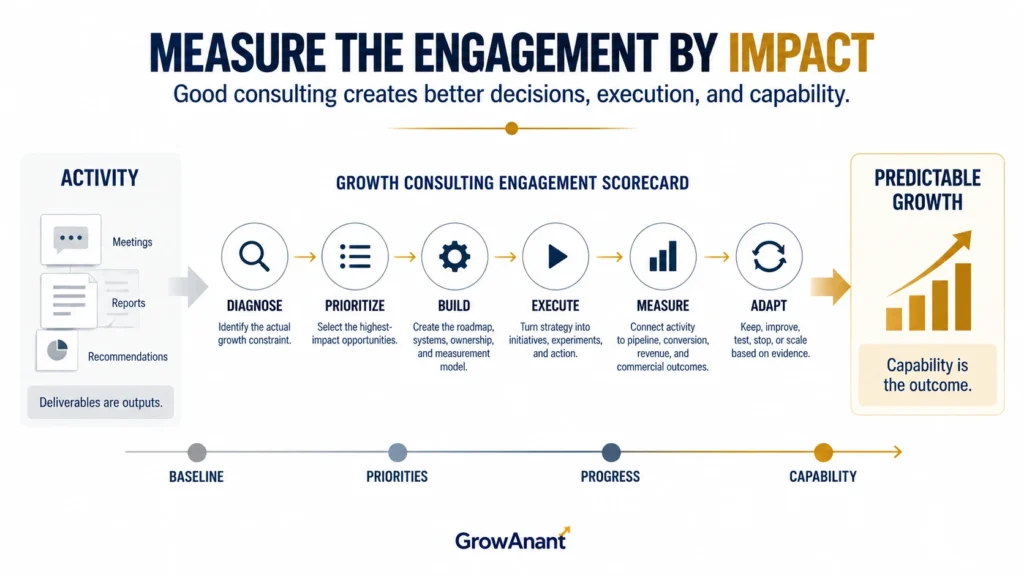
A strong growth consulting engagement structure benchmarks framework helps founders and CEOs evaluate whether a consulting relationship is producing meaningful strategic progress or simply generating meetings, reports, and recommendations.
The right growth consulting engagement structure should connect diagnosis, strategy, execution, measurement, and capability building. This matters because businesses rarely hire a growth consultant simply to receive advice. They need clearer priorities, stronger demand generation, better customer acquisition, improved pipeline visibility, and a practical path toward sustainable business growth.
For a B2B SaaS company, professional services firm, funded startup, or business entering the U.S. market, a good engagement should answer three questions:
- What is limiting growth right now?
- What should the company prioritize next?
- What evidence will demonstrate that those priorities are working?
A useful benchmark is therefore not “How many deliverables did the consultant provide?” but “Did the engagement improve the company’s ability to make and execute better growth decisions?”
What “Good” Looks Like in a Growth Engagement
A good growth consulting engagement structure moves through a logical sequence:
Diagnose → Prioritize → Build → Execute → Measure → Adapt
The sequence prevents a common problem in consulting engagements: producing a strategic document that never changes how the business operates.
McKinsey’s work on growth transformations emphasizes measurable objectives, specific milestones, execution discipline, and performance tracking rather than strategy in isolation.
The Five Characteristics of a Strong Engagement
| Dimension | What Good Looks Like | Weak Signal |
| Diagnosis | Clear growth constraint identified | Generic audit |
| Strategy | Prioritized choices | Long list of recommendations |
| Execution | Initiatives have owners and milestones | Advice without ownership |
| Measurement | KPIs connect to commercial outcomes | Vanity metrics |
| Capability | Internal team becomes more effective | Consultant dependency |
For example, a U.S. SaaS company may believe that its primary problem is insufficient leads. A proper diagnostic could reveal that the company generates enough leads but has weak ICP definition and poor sales qualification.
The engagement should then redirect resources toward the actual constraint.
That is the strategic value of growth strategy consulting.
What Founders Should Expect
A credible engagement should typically produce:
- a clearly defined growth problem
- prioritized opportunities
- measurable objectives
- a growth roadmap
- ownership across teams
- agreed KPIs
- recurring performance reviews
- documented decisions
- an evolving experimentation pipeline
This applies whether the company works with a traditional consultant, fractional growth consultant, or broader growth consulting services provider.
The best engagement creates increasing clarity over time.
Typical Timelines by Engagement Type
There is no universal engagement length. The right duration depends on the complexity of the growth problem, internal execution capability, and level of leadership involvement required.
However, founders can use the following as a practical planning benchmark.
| Engagement Type | Typical Focus | Indicative Timeline |
| Diagnostic | Identify growth constraints | 2 to 6 weeks |
| Strategy Sprint | Define priorities and roadmap | 4 to 8 weeks |
| Growth Advisory | Ongoing strategic guidance | 3 to 6+ months |
| Fractional Leadership | Strategy plus leadership and execution oversight | 6 to 12+ months |
| GTM Initiative | Launch or market expansion | 3 to 9 months |
| Growth Transformation | Multiple growth levers | 6 to 18+ months |
These are planning ranges, not promises or industry-wide standards.
A smaller founder-led company may need a focused diagnostic before committing to a longer engagement. A Series B SaaS company entering a new market may require sustained strategic leadership.
This is where different growth consulting business models become relevant.
Choosing the Right Engagement Model
Project-based: Best when the company has a clearly defined problem.
Advisory: Best when leadership needs recurring strategic perspective but has strong internal execution.
Fractional: Best when the company needs ongoing senior ownership without immediately creating a full-time executive role.
Hybrid: Best when strategy, leadership, and selected execution support need to work together.
A company should avoid choosing an engagement model simply because it is cheaper or more flexible. The model should match the complexity of the business problem.
Expected Deliverables at Each Stage
A good growth consulting engagement structure should make deliverables progressively more actionable.
Stage 1: Diagnose
Expected outputs may include:
- ICP assessment
- market and competitor analysis
- positioning review
- funnel analysis
- acquisition-channel assessment
- customer journey analysis
- growth constraint diagnosis
The output should not simply be a large audit.
It should answer:
“What is the most important growth problem we should solve first?”
Stage 2: Prioritize
The next stage converts findings into decisions.
A useful prioritization framework is:
Impact × Confidence × Feasibility
| Initiative | Impact | Confidence | Feasibility | Priority |
| ICP refinement | High | High | High | Immediate |
| New paid channel | Medium | Low | Medium | Test |
| Website redesign | Medium | Medium | Low | Later |
| Sales qualification | High | High | High | Immediate |
This prevents the organization from treating every recommendation as equally important.
Stage 3: Build
Expected outputs can include:
- growth roadmap
- GTM plan
- demand-generation framework
- funnel architecture
- measurement model
- experimentation backlog
- team responsibilities
- operating cadence
For a company entering the United States, this may include market entry strategy USA planning. For a SaaS company, it may involve SaaS growth consulting. For a service firm, it may involve marketing strategy for service businesses and lead-generation systems.
Stage 4: Execute and Measure
At this stage, the engagement should move from recommendations to operating rhythm.
A useful weekly or biweekly review should cover:
- initiatives completed
- experiments launched
- leading indicators
- pipeline movement
- conversion changes
- blockers
- decisions required
- resource allocation
McKinsey emphasizes the importance of connecting growth initiatives to financial and operational KPIs and using performance management to identify execution problems quickly.
Stage 5: Adapt
No growth plan should remain unchanged when market evidence contradicts its assumptions.
A strong engagement should identify:
Keep → Improve → Test → Stop → Scale
This is where the engagement becomes a growth system rather than a consulting project.
Benchmarking Results Against Peers
Benchmarking should be handled carefully.
A founder may ask, “Are our results normal compared with other SaaS companies?”
The problem is that growth metrics vary significantly by business model, market, pricing, sales cycle, customer segment, geography, and company stage.
Therefore, peer benchmarking should begin with comparable businesses rather than broad industry averages.
Benchmarking Framework
Compare across five dimensions:
| Dimension | Benchmark Question |
| Growth | Is revenue growth improving? |
| Pipeline | Is qualified pipeline becoming more predictable? |
| Acquisition | Is customer acquisition becoming more efficient? |
| Conversion | Are funnel stages improving? |
| Execution | Are strategic initiatives progressing on schedule? |
For example, comparing a self-serve SaaS company with a six-month enterprise sales cycle can produce misleading conclusions.
Instead, compare businesses with similar:
- ACV
- sales motion
- target market
- growth stage
- acquisition model
- geographic market
A brand growth consulting comparison should similarly examine the strategic context rather than relying on one headline metric.
The Better Benchmark
The strongest benchmark is often internal:
Where were we before the engagement, and what has materially changed?
Track:
- baseline
- target
- actual
- variance
- explanation
- next action
This makes the engagement accountable to progress rather than arbitrary external comparisons.
Red Flags in Underperforming Engagements
Not every engagement produces immediate revenue impact, but certain signals indicate that the relationship may not be functioning effectively.
Red Flag 1: Activity Without Prioritization
There are many campaigns, meetings, or recommendations, but no clear answer to what matters most.
Red Flag 2: Deliverables Without Decisions
The consultant provides reports, presentations, or analysis, but leadership still does not know what to do next.
Red Flag 3: Vanity Metrics Dominate
Traffic, impressions, followers, or lead volume are reported without connecting them to qualified pipeline or revenue.
Red Flag 4: No Operating Cadence
There is no consistent review of initiatives, KPIs, blockers, or decisions.
Red Flag 5: Strategy and Execution Are Disconnected
The roadmap says one thing while marketing, sales, and product teams execute something else.
Red Flag 6: No Learning Loop
Experiments continue, but the organization does not document what was learned or how the next decision changes.
Red Flag 7: Consultant Dependency
The business becomes increasingly dependent on the consultant instead of developing internal capabilities.
Harvard Business Review has argued that consulting value should be considered in terms of results rather than advice alone.
Engagement Health Checklist
A founder or CEO should be able to answer “yes” to most of these:
- We have a clearly defined growth constraint.
- Our strategic priorities are documented.
- Each major initiative has an owner.
- We know which KPIs matter.
- Marketing activity is connected to pipeline.
- We regularly review results and assumptions.
- Low-performing initiatives can be stopped.
- High-potential initiatives can receive more resources.
- Sales, marketing, and leadership share the same priorities.
- The engagement is improving internal decision-making.
- We understand what should happen next.
This is the practical distinction between growth consulting services that generate activity and an engagement that creates a functioning growth system.
For GrowAnant, the objective of a growth partnership is to connect strategy, demand generation, GTM execution, and revenue measurement into one operating model. The value is not simply another marketing plan. It is greater clarity around where the business should invest, what should be tested, and how leadership can measure progress.
A strong engagement should ultimately make growth decisions more disciplined, execution more coordinated, and resource allocation more evidence-based.
References
- McKinsey & Company: Eight lessons on how to get the growth you planned
- Harvard Business Review: Let’s Hold Consultants Accountable for Results
Frequently Asked Questions
Month one should typically establish the business baseline, diagnose the primary growth constraints, review the ICP and positioning, assess the funnel and acquisition channels, identify major opportunities, and establish initial priorities and KPIs. The exact deliverables depend on the engagement scope and business situation.
Engagement length varies by objective. A focused diagnostic or strategy project may take several weeks, while advisory, fractional leadership, GTM, and broader growth transformation engagements can continue for several months or longer. The appropriate duration should reflect the complexity of the growth problem rather than an arbitrary contract period.
Use comparable companies with similar business models, customer segments, sales cycles, pricing, growth stage, and acquisition models. Also benchmark internal performance by comparing the baseline before the engagement with current results across revenue, pipeline, acquisition, conversion, and execution metrics.
Common signals include activity without prioritization, deliverables without decisions, excessive focus on vanity metrics, weak communication, disconnected execution, unclear ownership, no learning loop, and increasing dependency on the consultant without corresponding improvement in internal capabilities.