
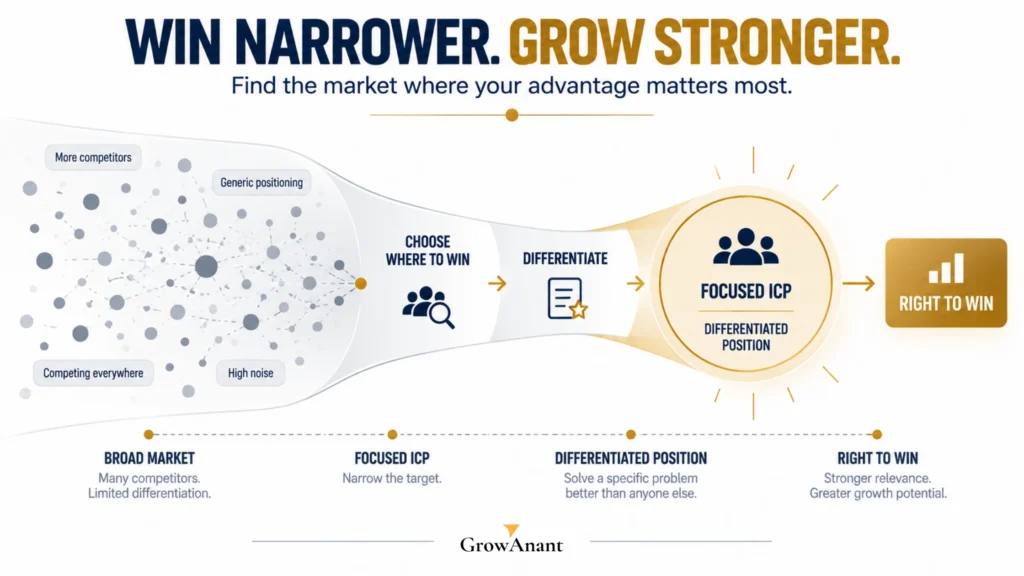
Competing in a crowded market rarely becomes easier by doing more of the same. More content, more advertising, more sales activity, or more channels cannot compensate for weak differentiation. growth strategy consulting for competitive markets focuses on identifying where a business can create a defensible reason to be chosen, then translating that advantage into positioning, channels, customer experience, and revenue execution.
This is the core role of growth strategy consulting: connect competitive insight with practical decisions about where to compete and how to win.
For a B2B SaaS company, professional services firm, or growth-stage business, the objective is not to become visible to everyone. It is to become significantly more relevant to the right customers.
Why Competitive Markets Need Different Growth Playbooks
In an emerging market, demand can sometimes compensate for imperfect positioning. In a mature or saturated market, customers already have alternatives, established suppliers, familiar categories, and competing messages.
That changes the growth problem.
A company must answer:
Why should a customer choose us instead of an established alternative, a cheaper provider, an internal solution, or doing nothing?
McKinsey identifies competitive advantage as a prerequisite for value-creating growth and emphasizes that companies need a clear, scalable reason to win before simply investing more resources into growth.
A competitive growth strategy therefore starts with five questions:
| Strategic question | What it reveals |
| Where can we win? | Attractive segments |
| Who values our advantage most? | Priority ICP |
| Why would they switch? | Demand trigger |
| What can competitors struggle to replicate? | Defensibility |
| How do we reach buyers efficiently? | Channel strategy |
For example, a SaaS company competing against several established workflow platforms might not win by claiming to be “another all-in-one solution.” It may instead focus on a specific industry, workflow, integration, implementation model, or customer outcome.
That is the difference between competing broadly and competing strategically.
Differentiation Through Positioning
Positioning is not simply a tagline. It is the strategic decision about who the business is for, what problem it owns, and why its solution deserves consideration.
Strong positioning usually combines:
Specific customer + important problem + differentiated approach + meaningful outcome
Consider a hypothetical U.S. SaaS market.
A generic positioning statement might say:
“Powerful analytics for growing businesses.”
A more differentiated position might focus on a particular type of revenue team and a specific forecasting problem.
The second approach gives marketing and sales a narrower but potentially more valuable battlefield.
Positioning differentiation framework
| Dimension | Weak approach | Stronger approach |
| Audience | Everyone | Specific ICP |
| Problem | Broad business challenge | High-priority pain |
| Value | Feature-focused | Outcome-focused |
| Category | Generic | Deliberately defined |
| Proof | General claims | Relevant evidence |
| Message | Similar to competitors | Distinctive and specific |
This is particularly important for business growth consulting because positioning influences downstream acquisition economics. If the message attracts the wrong audience, marketing may generate traffic and leads while sales struggles with qualification and conversion.
A practical positioning checklist:
- Define the highest-value customer segment
- Identify the customer’s most expensive problem
- Understand existing alternatives
- Identify the company’s strongest capability
- Define a credible point of difference
- Connect differentiation to business value
- Test the message with real buyers
- Align website, sales, content, and campaigns
This does not mean differentiation must always come from the product itself. Harvard Business Review has highlighted how businesses can differentiate across the broader customer experience rather than relying exclusively on product characteristics.
Differentiation Through Channel Strategy
A differentiated offer can still struggle if it reaches buyers through the same channels, messages, and buying experiences as every competitor.
Channel strategy should therefore answer a different question:
Where can we create an advantage in reaching and influencing the right customers?
For example, a B2B software company targeting CFOs might rely on:
- Executive thought leadership
- Account-based programs
- Industry-specific events
- Partner ecosystems
- High-intent search
- Customer referrals
- Sales-led education
Meanwhile, a product targeting technical users may depend more heavily on product-led discovery, technical content, communities, integrations, and peer recommendations.
This is where growth marketing services, demand generation, and B2B marketing need to operate from the same strategic foundation.
Channel differentiation framework
| Situation | Potential strategic response |
| Paid advertising is expensive | Build owned demand and partnerships |
| Competitors dominate generic search | Target high-intent niche searches |
| Buyers distrust vendor claims | Use customer evidence and education |
| Market is crowded on LinkedIn | Develop a distinctive executive point of view |
| Sales cycles are long | Build multi-stage demand programs |
| ICP is concentrated | Use targeted account engagement |
| Referrals drive quality leads | Systematize referral and partner channels |
A digital growth agency can execute across channels, but channel volume alone is not the strategy. The strategic question is whether the channel creates access, credibility, efficiency, or reach that competitors cannot easily reproduce.
For a U.S. company competing nationally, this may mean prioritizing a specific vertical before expanding horizontally. For an international SaaS company entering the U.S., go to market strategy consulting may identify a narrow market wedge where the company has a stronger initial right to win.
Differentiation Through Customer Experience
Customer experience becomes a growth lever when it influences acquisition, conversion, retention, expansion, or advocacy.
A company can differentiate through:
- Faster onboarding
- Better implementation
- More useful education
- More responsive support
- Simpler buying processes
- Better integration
- Greater transparency
- Stronger executive communication
- More relevant personalization
McKinsey’s 2026 B2B research indicates that seamless experiences across channels have increasingly become a baseline expectation, while leaders differentiate through more sophisticated personalization and coordinated commercial execution.
The implication is important: customer experience should be designed as part of the growth system, not treated as a post-sale function.
Customer experience growth test
Ask:
- Where do prospects experience friction?
- Where do customers wait unnecessarily?
- Which buying questions remain unanswered?
- What causes prospects to delay decisions?
- Where do customers need human support?
- Which experience could become a competitive advantage?
For example, a professional services firm competing against larger consulting companies may not be able to match their scale. It could instead differentiate through founder-level access, faster decision-making, industry specialization, and a more direct path from strategy to implementation.
The objective is not to provide “better service” as a vague claim. It is to identify a specific experience that customers value and that competitors struggle to replicate consistently.
A Differentiation Scenario
Consider a hypothetical B2B SaaS company offering workflow automation to U.S. professional services firms.
Its competitors already offer:
- Workflow management
- Reporting
- Integrations
- Automation
- Dashboards
- Customer support
Launching another broad “all-in-one platform” message would create little separation.
A growth strategy consulting approach could identify a narrower opportunity.
Before
Target: All professional services businesses
Message: Automate your business workflows
Channels: Paid search and generic LinkedIn
Competitive position: Feature comparison
Growth problem: High acquisition costs and weak differentiation
After
Target: Growing professional services firms with complex client workflows
Problem: Manual coordination creates delivery delays and management visibility gaps
Position: Specialized workflow infrastructure for scaling service operations
Channels: Industry content, targeted account programs, partnerships, executive education
Sales motion: Problem-led discovery followed by use-case demonstration
Measurement: Qualified accounts, opportunities, pipeline, conversion, retention
The strategy does not guarantee growth. It creates a more coherent hypothesis about where the company can win and why customers should care.
A similar approach could apply to a startup, professional services business, or SaaS company entering the U.S. market. The important principle is to establish a clear right to compete before scaling acquisition.
Common Mistakes
Competitive markets create predictable strategic mistakes.
1. Competing on generic claims
“Best service,” “innovative technology,” and “customer-focused” rarely provide meaningful differentiation because competitors can make the same claims.
2. Expanding the target market too early
Trying to serve everyone can weaken relevance. A narrower ICP can create stronger positioning and more efficient demand generation.
3. Copying competitor channels
Using the same channels as competitors without a distinct message often produces higher costs without creating strategic advantage.
4. Treating price as the primary differentiator
Price can attract customers, but sustained competitive advantage usually requires more than being cheaper.
5. Over-investing before proving the strategy
Increasing performance marketing services USA spend before validating positioning can amplify inefficient acquisition rather than solve it.
6. Ignoring customer experience
A strong acquisition engine cannot compensate indefinitely for poor onboarding, weak support, or a difficult buying process.
7. Measuring activity instead of commercial outcomes
Traffic, impressions, clicks, and content volume are useful indicators, but leadership also needs visibility into qualified demand, pipeline, conversion, CAC, retention, and revenue contribution.
Competitive differentiation checklist
Before scaling, leadership should be able to answer:
- Which customer segment matters most?
- Which problem do we solve better?
- Why would a buyer switch?
- What makes our position credible?
- Which channels reinforce our advantage?
- What part of the customer experience strengthens differentiation?
- Which competitors are we deliberately not trying to beat?
- Which metrics demonstrate commercial progress?
GrowAnant approaches differentiation as a strategic growth problem rather than a campaign problem. Its role as a growth consulting partner is to connect market positioning, demand generation, go-to-market decisions, and execution into a system that supports scalable, predictable revenue growth.
The most effective growth consulting services therefore do not begin with “Which marketing channel should we use?” They begin with “Where can this business create a defensible right to win?”
References
- McKinsey & Company: The 10 rules for a winning company growth strategy
- Harvard Business Review: Discovering New Points of Differentiation
Frequently Asked Questions
Grow by becoming more relevant, not simply more visible. Identify a high-value customer segment, understand its unmet needs, create differentiated positioning, select channels that efficiently reach that segment, and build customer experiences that reinforce the reason to choose you.
Positioning should generally come first because channels amplify a message. If the positioning is unclear, increasing channel activity can increase traffic without improving qualified demand. Once the strategic position is clear, channel selection determines how efficiently that position reaches the market.
Yes. Customer experience can influence conversion, retention, expansion, referrals, and competitive perception. It becomes a meaningful growth lever when the experience addresses something customers genuinely value and the business can deliver consistently.
The most common mistake is trying to compete everywhere using generic positioning. Businesses often respond to competitive pressure by adding channels, increasing marketing activity, or lowering prices instead of identifying a specific segment where they have a credible advantage.