
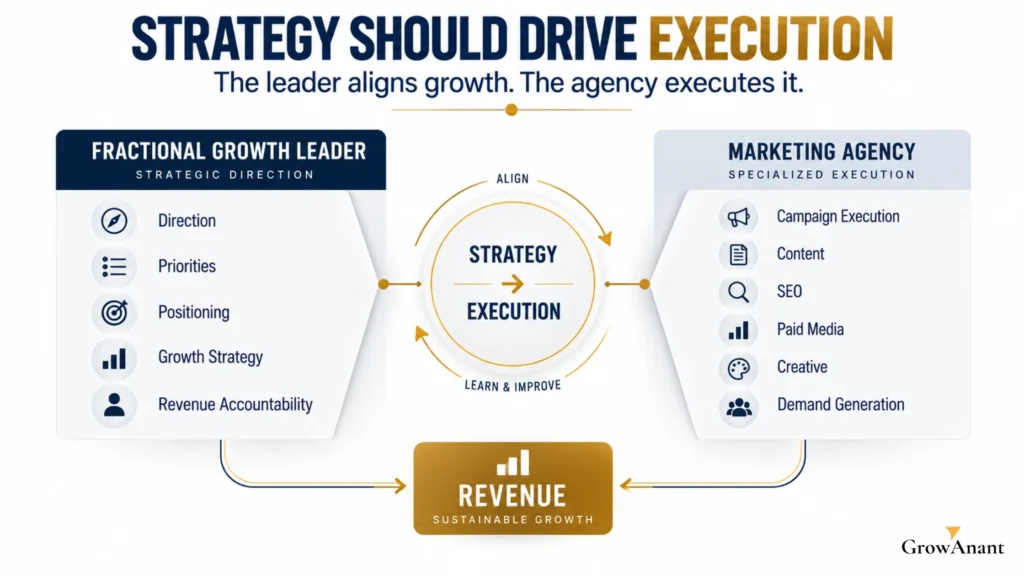
A fractional growth leader with marketing agency model can give growth-stage companies something neither function provides alone: strategic ownership combined with specialized execution capacity. A fractional growth consultant can define priorities, connect marketing activity to pipeline, and coordinate the broader growth system, while an agency executes specialized work.
This is particularly useful for B2B SaaS companies, funded startups, professional services firms, and businesses entering the U.S. market. The objective is not to add another layer of management. It is to create clearer accountability between strategy, execution, measurement, and revenue.
A practical growth consultant vs digital marketing agency comparison starts with one question: who owns the growth problem?
The agency may own execution quality. The fractional leader should own the growth direction and ensure that execution supports business priorities.
Why Companies Keep Both
A marketing agency and a fractional growth leader solve different problems.
A fractional growth leadership role typically focuses on:
- Growth priorities and strategic direction
- Go-to-market decisions
- Positioning and market opportunities
- Demand generation strategy
- Funnel performance
- Revenue alignment
- Marketing and sales coordination
- Measurement and accountability
An agency typically contributes specialist execution such as paid media, SEO, creative, content, web development, or campaign management.
| Area | Fractional Growth Leader | Marketing Agency |
| Growth strategy | Owns direction | Supports execution |
| Positioning | Guides decisions | Executes messaging |
| Campaigns | Prioritizes | Builds and manages |
| Demand generation | Designs system | Executes programs |
| Analytics | Defines business questions | Reports channel data |
| Sales alignment | Coordinates | Supports |
| Revenue accountability | Strategic owner | Contributes |
| Specialist capacity | Directs requirements | Provides expertise |
This distinction becomes important when companies have activity but lack progress. A business may be publishing content, running paid campaigns, improving SEO, and posting on LinkedIn while still experiencing weak pipeline.
The issue may not be execution capacity. It may be the absence of strategic ownership.
McKinsey’s research on marketing operating models similarly emphasizes connecting teams, governance, capabilities, and partners around a clear growth strategy.
For example, a SaaS company might already have an agency managing growth marketing services, but still lack a clear ICP, channel priorities, funnel definitions, or revenue attribution. Adding more campaigns does not necessarily solve that problem.
A fractional leader can create the operating structure that allows the agency to perform better.
Dividing Strategy From Execution
The strongest model creates explicit boundaries without creating silos.
A useful framework is:
Strategy → Prioritization → Brief → Execution → Measurement → Learning
The fractional leader generally owns the first two stages and coordinates the final two. The agency owns execution within the agreed strategic direction.
For example:
Fractional leader
- Defines ICP
- Establishes positioning
- Selects priority segments
- Sets quarterly growth objectives
- Defines channel priorities
- Establishes funnel metrics
- Reviews pipeline contribution
Agency
- Produces campaigns
- Creates content
- Manages advertising
- Implements SEO initiatives
- Develops creative assets
- Optimizes campaigns
- Provides channel-level reporting
This structure works across growth strategy consulting, business growth consulting, revenue growth consulting, and SaaS growth consulting engagements.
It also prevents a common problem: the agency becoming responsible for strategic decisions it does not control, while internal leadership assumes the agency owns business outcomes.
For companies considering growth consulting services, the key question should therefore be less “Who can execute more?” and more “Who owns the decisions that determine what gets executed?”
A simple responsibility matrix can help:
| Decision | Growth Leader | Agency | CEO/VP Marketing |
| ICP | A | C | A |
| Positioning | A | C | A |
| Channel strategy | A | C | C |
| Campaign execution | C | A | I |
| Budget allocation | A | C | A |
| Creative production | C | A | I |
| Pipeline reporting | A | C | A |
| Strategic pivots | A | C | A |
A = Accountable, C = Consulted, I = Informed.
Avoiding Role Conflict
Role conflict usually appears when responsibilities are defined around activities rather than decisions.
For example, both the agency and fractional chief growth officer may believe they own paid acquisition strategy. Or both may attempt to determine positioning. This creates duplicated work, competing priorities, and slower decisions.
The solution is a written operating agreement.
The 5-part role clarity framework
- Decision rights
Define who makes each major growth decision. - Success metrics
Establish shared metrics such as qualified pipeline, conversion rate, CAC efficiency, and revenue contribution. - Strategic priorities
Limit the number of major initiatives being pursued simultaneously. - Escalation rules
Define when the agency should challenge a strategy and when the growth leader makes the final call. - Review rhythm
Create a consistent process for reviewing results and changing priorities.
This matters especially for companies using a fractional head of growth, internal marketing team, and external specialists simultaneously.
The objective is not to make the agency subordinate. It is to create a system where specialists have enough strategic context to execute effectively.
Communication Structures That Work
The communication model should be simple enough to maintain and rigorous enough to prevent drift.
A practical structure is:
| Cadence | Participants | Primary Purpose |
| Weekly | Growth leader + agency lead | Priorities, blockers, performance |
| Biweekly | Growth, marketing, sales | Funnel and pipeline alignment |
| Monthly | CEO/VP + growth leader + agency | Business outcomes and strategic decisions |
| Quarterly | Leadership team | Strategy, budget, market priorities |
The weekly meeting should not become a channel-by-channel reporting session.
Instead, use four questions:
- What changed?
- Why did it change?
- What does it mean for pipeline?
- What should we do differently?
This moves the conversation from activity reporting to decision-making.
For example, instead of discussing how many leads an agency generated, the team should examine whether lead quality improved, whether sales accepted those leads, whether opportunities progressed, and where funnel leakage remains.
This is particularly relevant when building B2B marketing, demand generation, or B2B lead generation services around revenue outcomes.
McKinsey also highlights the importance of clear governance, decision rights, and coordinated external partnerships within modern marketing operating models.
A Working Scenario
Consider a U.S. B2B SaaS company with an established marketing agency.
The agency is producing content, managing paid campaigns, and supporting SEO. Traffic is increasing, but qualified pipeline remains inconsistent.
The CEO brings in a fractional growth executive.
The first step is not to replace the agency.
Instead, the growth leader reviews:
- ICP and segmentation
- Positioning
- Funnel stages
- Lead qualification
- Channel economics
- Sales follow-up
- Attribution
- Pipeline conversion
- Existing campaign performance
The analysis identifies that the agency is optimizing campaign metrics while the business has not clearly defined which customer segment should receive the majority of acquisition investment.
The growth leader establishes a narrower segment, updates the demand generation priorities, clarifies qualification criteria, and gives the agency a revised execution brief.
The agency then continues doing what it does best: execution.
This is where a growth partner such as GrowAnant can operate differently from a traditional execution-only provider. The role is to connect growth strategy, demand generation, go-to-market priorities, and execution into one operating system.
The same principle can apply to fintech, healthtech, professional services, and founder-led businesses where specialized agencies already exist but strategic growth ownership is limited.
Common Pitfalls
The most common mistakes are operational rather than technical.
1. Hiring a leader without giving decision authority
A fractional growth consultant cannot meaningfully influence growth if every strategic decision requires multiple approvals.
2. Keeping separate goals
If the agency measures campaign performance while leadership measures revenue, both sides can appear successful while the business remains stagnant.
3. Overlapping responsibilities
When the growth leader and agency both own strategy, disagreements become inevitable.
4. Excessive meetings
More communication does not automatically create alignment. Meetings should exist to make decisions, resolve blockers, and review business outcomes.
5. Treating the growth leader as another vendor
A fractional leader should function as part of the leadership system, not simply another external supplier.
6. Changing strategy too frequently
Growth requires learning, but constant strategic changes prevent execution teams from accumulating meaningful data.
7. Measuring only marketing metrics
Clicks, impressions, traffic, and leads can provide useful signals, but executives ultimately need visibility into qualified opportunities, pipeline movement, acquisition efficiency, and revenue contribution.
Implementation Checklist
Before combining a fractional leader with an agency, leadership should confirm:
- One clearly defined growth owner
- Written decision rights
- Shared business objectives
- Defined ICP and positioning
- Agreed channel priorities
- Common funnel definitions
- Consistent pipeline reporting
- Weekly execution rhythm
- Monthly strategic review
- Quarterly growth planning
The underlying principle is straightforward: strategy should determine execution, and execution should continuously inform strategy.
For growth-stage companies, this creates a more coherent growth leadership team structure without requiring every strategic capability to be built internally.
References
- McKinsey & Company: Connecting for growth: A makeover for your marketing operating model
- McKinsey & Company: When agile marketing breaks the agency model
Frequently Asked Questions
Yes. A fractional growth leadership model can work alongside an agency when responsibilities are clearly separated. The fractional leader typically provides strategic direction, prioritization, measurement, and cross-functional alignment, while the agency provides specialist execution.
The exact structure depends on the organization, but the fractional leader should generally own growth direction, priorities, and strategic decisions. The agency should own execution against the approved strategy and provide specialist recommendations based on performance data.
Role conflict is avoided through explicit decision rights, shared objectives, defined responsibilities, and a consistent review cadence. A written responsibility matrix can clarify which decisions belong to the growth leader, agency, CEO, and internal marketing team.
A weekly operating meeting between the growth leader and agency lead, a biweekly cross-functional review, and a monthly executive review is a practical starting point. The focus should remain on decisions, performance, pipeline, and strategic priorities rather than activity reporting.