
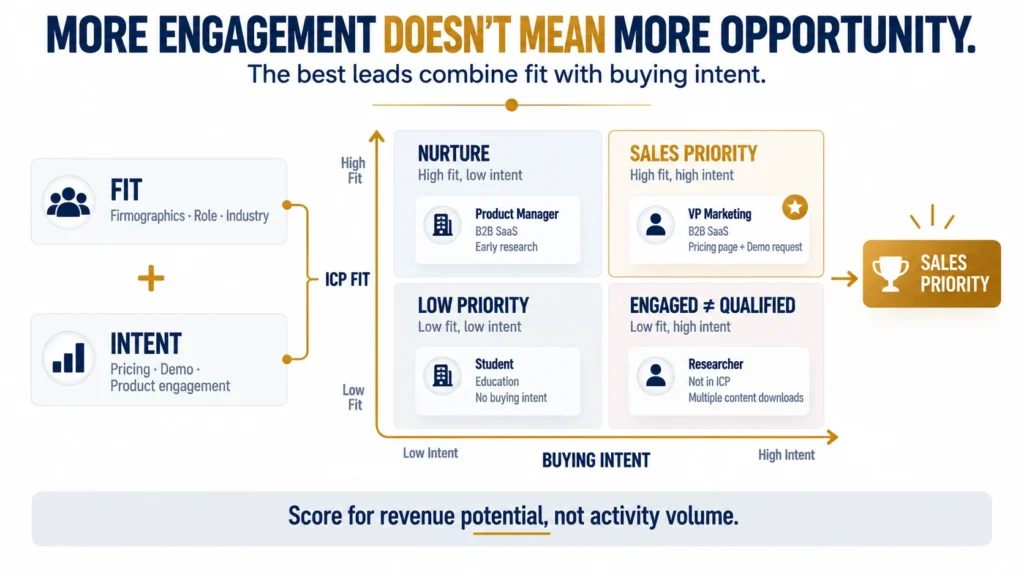
A lead scoring model b2b companies can trust does more than assign points to website visits or email clicks. It creates a shared framework for determining which prospects fit the business, which prospects are showing buying intent, and which prospects deserve sales attention.
For companies investing in growth marketing services, a scoring model can become the bridge between demand generation agency activity and revenue execution. Without that bridge, marketing may generate large volumes of MQLs while sales struggles to identify which opportunities are genuinely worth pursuing.
A useful lead scoring system answers three questions:
- Is this prospect a good fit?
- Are they demonstrating meaningful buying behavior?
- Is there enough evidence to justify sales involvement?
The objective is not to create more MQLs. It is to create a more reliable path from marketing engagement to qualified pipeline.
Why Lead Scoring Matters
Lead scoring is a methodology for ranking prospects according to characteristics and behaviors that indicate fit, engagement, or likelihood to convert. Modern CRM platforms can score records using both properties and actions, allowing teams to prioritize prospects based on defined criteria.
For a B2B SaaS company, consider two leads:
| Lead | Profile Fit | Behavior | Sales Priority |
| Individual researcher | Low | Downloaded 3 guides | Low |
| VP Marketing at ICP account | High | Viewed pricing + requested demo | High |
| Student | Low | Attended webinar | Low |
| Head of Growth at target SaaS | High | Multiple product visits | High |
Both may technically qualify as MQLs, but they should not receive the same sales attention.
This matters because poor qualification creates several revenue problems:
- Sales representatives spend time on low-fit prospects.
- High-intent prospects can receive delayed follow-up.
- Marketing is judged on lead volume rather than pipeline quality.
- Sales and marketing develop different definitions of a qualified lead.
- Forecasting becomes less reliable.
An effective B2B lead generation services system therefore needs scoring connected to downstream outcomes such as SQL creation, opportunity creation, pipeline value, and closed revenue.
Behavioral vs Demographic Scoring
A strong lead scoring model b2b approach generally combines two dimensions: fit and behavior.
Demographic or firmographic scoring evaluates who the prospect is. Behavioral scoring evaluates what the prospect does.
| Dimension | What It Measures | Example |
| Firmographic | Company characteristics | 200 to 1,000 employees |
| Role | Buying influence | VP Marketing |
| Industry | ICP alignment | B2B SaaS |
| Geography | Market relevance | United States |
| Engagement | Interest level | Repeated product-page visits |
| Intent | Buying signals | Demo request |
| Negative signals | Poor fit or low intent | Student email address |
This is more useful than simply awarding points for every interaction.
For example, a product-page visit might indicate interest, but a pricing-page visit by an executive at a target account may be substantially more meaningful.
The principle is simple:
Fit determines whether the account should matter. Behavior determines whether it may matter now.
This approach also helps distinguish account based marketing vs demand generation. ABM may emphasize account-level fit and engagement, while broader demand generation can generate and nurture prospects across a wider market.
Building Your Scoring Model
The best starting point is not your marketing automation platform. It is your historical revenue data.
Salesforce recommends using sales input and conversion information when establishing scoring criteria, while modern platforms can combine engagement and fit signals within scoring models.
Use this five-step framework.
Step 1: Define the ICP
Document:
- Target industry
- Company size
- Geography
- Revenue range
- Technology environment
- Buyer roles
- Common business problems
A U.S. SaaS company selling workflow software to 100 to 1,000 employee organizations should not treat a five-person company as equally valuable simply because that company downloaded the same whitepaper.
Step 2: Identify meaningful behaviors
Rank actions by their relationship to purchase intent.
| Behavior | Example Score Direction |
| Blog visit | Low |
| Newsletter subscription | Low |
| Educational content download | Low to medium |
| Webinar attendance | Medium |
| Multiple product-page visits | Medium |
| Pricing-page visit | High |
| Demo request | Very high |
| Sales conversation | Very high |
The exact numerical values should come from your own data rather than arbitrary industry benchmarks.
Step 3: Add negative scoring
A sophisticated model should also reduce scores for signals that indicate poor fit.
Examples include:
- Student or personal email
- Unsupported geography
- Company size below ICP
- Competitor
- Long-term inactivity
- Job roles outside the buying committee
Step 4: Establish qualification thresholds
Create clear categories such as:
| Score | Action |
| Low | Continue nurture |
| Medium | Marketing engagement |
| High | Sales review |
| Very high | Sales follow-up |
The threshold should be validated against actual MQL-to-SQL and opportunity conversion rather than selected because it looks logical.
Step 5: Connect scoring to revenue
The model should ultimately answer:
Which score ranges produce the strongest sales outcomes?
Track:
Lead → MQL → SQL → Opportunity → Customer
This is where demand generation analytics becomes strategically important. A scoring model should be evaluated against pipeline quality, not simply the number of leads reaching a threshold.
Aligning Scoring With Sales
Lead scoring fails when marketing creates the model independently and sales receives the output without context.
Sales and marketing should jointly define:
- What constitutes an MQL
- What constitutes an SQL
- Minimum qualification criteria
- Sales follow-up expectations
- Disqualification reasons
- Feedback mechanisms
- Review frequency
Salesforce identifies shared definitions, communication, and common metrics as important elements of effective sales and marketing alignment.
A practical governance structure is:
| Responsibility | Marketing | Sales | Revenue Leadership |
| ICP definition | Input | Input | Owner |
| Engagement scoring | Owner | Input | Review |
| Qualification threshold | Joint | Joint | Approve |
| Lead acceptance | Monitor | Owner | Review |
| Conversion analysis | Owner | Input | Review |
| Model changes | Recommend | Validate | Approve |
A B2B marketing organization should also give sales representatives visibility into why a prospect scored highly.
A score of 82 is less useful than:
“Target SaaS company, VP Marketing, visited pricing page twice, attended product webinar, and requested implementation information.”
The context improves the quality of the sales conversation.
Common Scoring Mistakes
The most common mistake is treating every marketing interaction as evidence of purchase intent.
Other problems include:
1. Scoring volume instead of intent
Ten blog visits do not necessarily indicate stronger buying intent than one pricing-page visit.
2. Ignoring fit
A highly engaged prospect outside the ICP may still be a poor opportunity.
3. Never using negative scoring
Without negative signals, inactive or irrelevant contacts can remain artificially qualified.
4. Setting thresholds without historical validation
A score of 70 has no inherent meaning. Its value depends on how that score correlates with actual business outcomes.
5. Separating marketing and sales ownership
When sales rejects large numbers of MQLs, the problem is often not simply sales execution. It may indicate that qualification criteria need refinement.
6. Measuring only MQL volume
If MQL volume increases while SQL conversion and opportunity creation decline, the scoring system may be creating false confidence.
For organizations investing in growth strategy consulting, this is an important distinction: growth systems should optimize the quality and economics of the funnel, not simply increase activity.
Reviewing and Refining the Model
A lead scoring model should be treated as an operating system that evolves with the market, customer behavior, product, and sales process.
Review the model using this cycle:
Score → Route → Sell → Measure → Learn → Refine
At minimum, examine:
- MQL-to-SQL conversion
- SQL-to-opportunity conversion
- Opportunity-to-customer conversion
- Pipeline value by score range
- Average deal size by score range
- Sales response time
- Disqualification reasons
- Conversion by source
- Conversion by industry
- Conversion by buyer role
HubSpot notes that lead scores can be analyzed and customized based on record properties and actions, while predictive models can use historical customer patterns to estimate likelihood to close.
Lead Scoring Review Checklist
Before changing the model, ask:
- Are high-scoring leads actually converting?
- Are sales representatives accepting the leads?
- Are certain criteria overweighted?
- Are high-value accounts being under-scored?
- Are negative signals adequately represented?
- Has the ICP changed?
- Have product or pricing changes altered buying behavior?
- Which attributes correlate with closed revenue?
- Are marketing and sales using the same qualification definition?
For a growth-stage SaaS company, reviewing these questions quarterly can provide a structured basis for refining the model. Higher-frequency reviews may be appropriate during major changes in ICP, product positioning, or go-to-market strategy.
The strategic goal is not to build the most complicated scoring system. It is to build one that sales trusts, marketing can operate, and leadership can connect to pipeline.
References:
- HubSpot: Understand the lead scoring tool
- Salesforce: Lead Scoring: How to Find the Best Prospects in 4 Steps
Frequently Asked Questions
Lead scoring is a method of assigning values to prospects based on characteristics, behaviors, engagement, or other signals that help determine their fit and likelihood of becoming customers.
A scoring model is built by defining the ICP, identifying meaningful demographic and behavioral signals, assigning relative values, establishing qualification thresholds, connecting scores to sales workflows, and validating the model against actual conversion and revenue data.
Scoring criteria should be reviewed regularly rather than treated as permanent. The appropriate frequency depends on sales volume, data quality, market changes, ICP changes, and the maturity of the model. Major changes in product, pricing, positioning, or target market should trigger an earlier review.
Marketing can typically manage the operational model, but ownership should be shared with sales and revenue leadership. Marketing understands engagement data, sales understands qualification quality, and revenue leadership ensures the model supports broader pipeline and revenue objectives.