
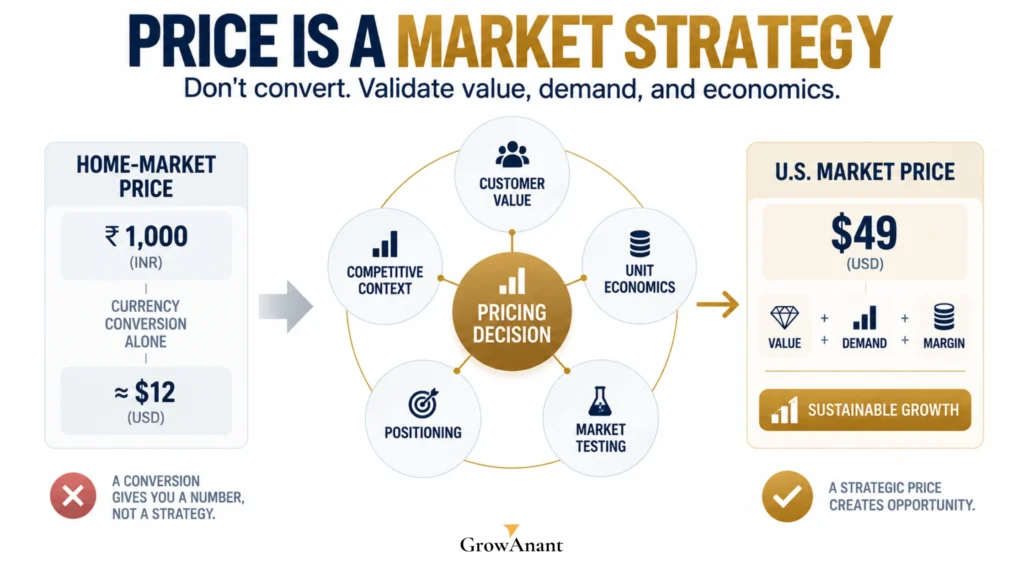
Entering the U.S. market requires more than converting an existing price from one currency into another. A practical us market pricing strategy considers customer willingness to pay, competitive positioning, costs, margins, perceived value, and the broader market entry strategy USA businesses use to establish themselves.
For a company expanding from India, Europe, or another international market, simply applying the home-market price can create two problems: the product may be positioned too cheaply and weaken perceived value, or priced too aggressively and reduce adoption. Pricing therefore needs to be treated as a strategic growth decision, not just a finance exercise.
A strong approach connects pricing to positioning, customer acquisition, demand generation, and long-term revenue economics.
Why U.S. Pricing Differs From Home Markets
The U.S. market has different competitive conditions, buyer expectations, purchasing processes, and perceived value benchmarks. A price that works in the home market may not communicate the same value to a U.S. buyer.
This is especially important for B2B SaaS companies, professional services firms, and funded startups entering the country.
Market research can help businesses understand customers, competitors, demand, pricing expectations, and buying behavior before making major decisions.
Consider a SaaS company that sells workflow software in India at an equivalent of $40 per user per month. Converting that price directly into U.S. dollars does not establish whether $40 is appropriate. The relevant questions are:
- What alternatives do U.S. buyers already use?
- What business problem does the product solve?
- What economic value does the solution create?
- Who is the buyer?
- What does implementation cost the customer?
- Is the product positioned as an affordable alternative, a specialist solution, or a premium platform?
Pricing should therefore reflect the economics and positioning of the new market.
A useful pricing framework is:
Customer Value + Competitive Context + Cost Structure + Strategic Positioning = Market Price Decision
This is why companies expanding into the U.S. may benefit from go to market strategy consulting, growth strategy consulting, or business strategy consulting USA before committing to a permanent pricing structure.
Competitive Pricing Research
Competitive research should establish the range within which buyers already make purchasing decisions. However, competitor pricing should be an input, not the entire pricing strategy.
Market-based pricing compares similar products and can help businesses understand whether they are positioned below, at, or above competitors. HubSpot also notes that relying exclusively on competitor pricing can ignore customer price sensitivity and perceived value.
Build a competitive pricing matrix:
| Factor | Competitor A | Competitor B | Your Product |
| Entry price | $ | $ | $ |
| Premium tier | $ | $ | $ |
| Pricing metric | User | Usage | User/Usage |
| Target customer | SMB | Mid-market | Target ICP |
| Core differentiation | Feature | Service | Your advantage |
| Implementation | Low | Medium | Your requirement |
| Support level | Standard | Premium | Your model |
Then classify competitors into three groups:
- Direct competitors: Solve substantially the same problem for the same buyer.
- Indirect alternatives: Solve the problem differently.
- Status quo: The existing process, internal team, spreadsheet, or manual workflow.
The third category is frequently overlooked. If your SaaS product costs $500 per month but replaces a process that costs the buyer $10,000 annually in labor and inefficiency, the relevant comparison is not simply another software subscription.
For an international company considering us market entry consulting for indian companies, research should also examine how U.S. buyers perceive the category itself. The same product may require different messaging, packaging, onboarding, or proof points to justify its price.
Currency & Margin Considerations
Currency conversion is only the first layer of international pricing.
A U.S. price needs to account for:
- Currency fluctuations
- Payment processing costs
- Taxes and compliance considerations
- Customer support costs
- Sales commissions
- Distribution expenses
- Localization
- Implementation costs
- Customer acquisition costs
- Expected gross margin
- Discounting
A simple model can be structured as:
U.S. Price – Variable Costs – Customer Acquisition Costs – Market-Specific Costs = Contribution Margin
For example, suppose an international SaaS company converts its existing $30 equivalent price into a U.S. price of $35. If U.S. customer acquisition costs, support expectations, sales costs, and payment expenses are substantially higher, the company may generate more revenue per customer but not necessarily better economics.
Pricing should therefore be evaluated alongside the entire customer acquisition model.
| Pricing Decision | Short-Term Effect | Strategic Risk |
| Lower price | Easier initial adoption | Margin pressure |
| Match competitors | Familiar benchmark | Weak differentiation |
| Premium price | Higher potential value capture | Requires stronger positioning |
| Usage-based | Aligns price with consumption | Revenue predictability can vary |
| Tiered pricing | Supports segmentation | More complex decision-making |
The objective is not to find the cheapest acceptable price. It is to find a price that supports sustainable economics while matching the value buyers perceive.
Testing Price Points
Price testing is particularly important when entering an unfamiliar market because assumptions about willingness to pay are rarely perfect.
Price testing can include:
- Customer interviews
- Sales conversations
- Pricing surveys
- Pilot programs
- Controlled geographic launches
- Packaging experiments
- Tier testing
- Discount testing
- Contract-length comparisons
HubSpot describes price testing as a way to determine an appropriate price point and notes that regional pilots can be an alternative to directly testing different prices with every prospect.
For a new U.S. launch, a controlled test can be structured like this:
Step 1: Select one ICP segment.
Step 2: Establish two or three credible price hypotheses.
Step 3: Keep positioning and core product experience consistent.
Step 4: Track conversion, sales objections, discount requests, sales-cycle length, and retention indicators.
Step 5: Compare results against contribution margin and pipeline quality.
Do not evaluate pricing purely through conversion rate. A lower price may generate more sign-ups but attract customers with lower willingness to pay, higher support requirements, or weaker retention.
A better decision framework is:
| Signal | Interpretation |
| High conversion + healthy margin | Strong candidate |
| High conversion + heavy discounting | Price or value communication issue |
| Low conversion + strong engagement | Investigate price sensitivity |
| Low conversion + weak engagement | Positioning or demand problem |
| Strong sales interest + price objections | Test packaging/value communication |
Pricing research should also be conducted before a full-scale launch where possible. McKinsey emphasizes understanding customer value and willingness to pay rather than relying solely on cost or competitor benchmarks.
Positioning Price Within GTM Strategy
Pricing should never operate separately from the broader market entry strategy USA companies use.
The same $1,000 monthly product can communicate very different value depending on its positioning.
For example:
- “Affordable automation software” creates a price-sensitive frame.
- “Enterprise workflow optimization platform” creates a value and business-impact frame.
- “Specialist compliance workflow platform” creates a category-specific frame.
This means price, packaging, positioning, demand generation, sales enablement, and customer experience should reinforce one another.
A practical GTM pricing framework is:
Segment → Problem → Value → Alternative → Positioning → Price → Proof → Acquisition
For a B2B SaaS company, the product page, sales deck, demo narrative, case studies, and pricing page should all communicate the same economic logic.
For a professional services firm, pricing may instead depend on expertise, scope, risk reduction, strategic value, and access to senior resources.
For a startup entering the U.S. market, a phased approach can reduce risk:
- Validate demand within one ICP.
- Test positioning and pricing with real prospects.
- Measure sales objections and conversion.
- Refine packaging.
- Expand acquisition investment.
- Reassess pricing as market knowledge improves.
This is where growth consulting services, business growth consulting, and growth roadmap consulting can connect pricing decisions to the wider revenue system instead of treating pricing as an isolated product decision.
Many growth-stage businesses also discover that their pricing problem is actually a positioning problem. If prospects repeatedly say the product is expensive without understanding its economic value, changing the price may not solve the underlying issue.
A strategy-first growth partner such as GrowAnant can help connect pricing research with positioning, demand generation, GTM planning, and revenue execution rather than treating each activity independently.
Common Mistakes
1. Simply converting currencies
A currency conversion creates a number, not a market strategy.
2. Copying competitor prices
Competitor pricing provides context, but your product may deliver different value or target a different segment.
3. Competing primarily on price
Lower pricing can create an acquisition advantage while simultaneously weakening margins and perceived differentiation.
4. Ignoring customer economics
A price that appears reasonable to the business may not make sense relative to the customer’s cost of doing nothing.
5. Testing price without testing positioning
If buyers do not understand the value proposition, a price test may incorrectly suggest that the price is too high.
6. Scaling before validating
Increasing growth marketing services, paid acquisition, or demand generation before validating pricing can amplify an inefficient model.
U.S. Pricing Readiness Checklist
Before launching, confirm:
- U.S. customer segments are clearly defined.
- Direct and indirect competitors have been researched.
- Customer willingness to pay has been investigated.
- U.S. unit economics have been modeled.
- Currency and margin risks have been considered.
- Pricing tiers match customer segments.
- Sales objections have been documented.
- Pricing has been tested with real prospects where practical.
- Pricing supports the broader GTM positioning.
- Marketing and sales teams can clearly explain the value behind the price.
A U.S. pricing decision should ultimately answer one question: Does this price create a credible exchange of value for the customer while supporting a sustainable business model?
Frequently Asked Questions
Not necessarily. Pricing can differ across markets because customer willingness to pay, competitive benchmarks, costs, positioning, taxes, purchasing behavior, and market economics can differ. Maintaining identical pricing may be appropriate for some businesses, but it should be a deliberate strategic decision rather than a default rule.
Start by identifying direct competitors, indirect alternatives, and the status quo. Compare public pricing pages, sales offers, packaging, contract structures, features, support, implementation, and target customers. Then combine competitive research with customer research because competitor prices alone do not reveal how much your target buyers are willing to pay.
Currency affects more than the displayed selling price. Exchange-rate movement can change revenue when converted into the company’s reporting currency, while U.S.-specific sales, support, payment, operational, and acquisition costs can also affect contribution margin. Model pricing under multiple exchange-rate and cost scenarios rather than using a single conversion rate.
Use controlled pilots, customer interviews, pricing research, sales conversations, packaging tests, and limited market experiments. Evaluate conversion alongside discounting, sales-cycle length, customer quality, retention indicators, and contribution margin. Avoid making major pricing decisions from a single metric.