
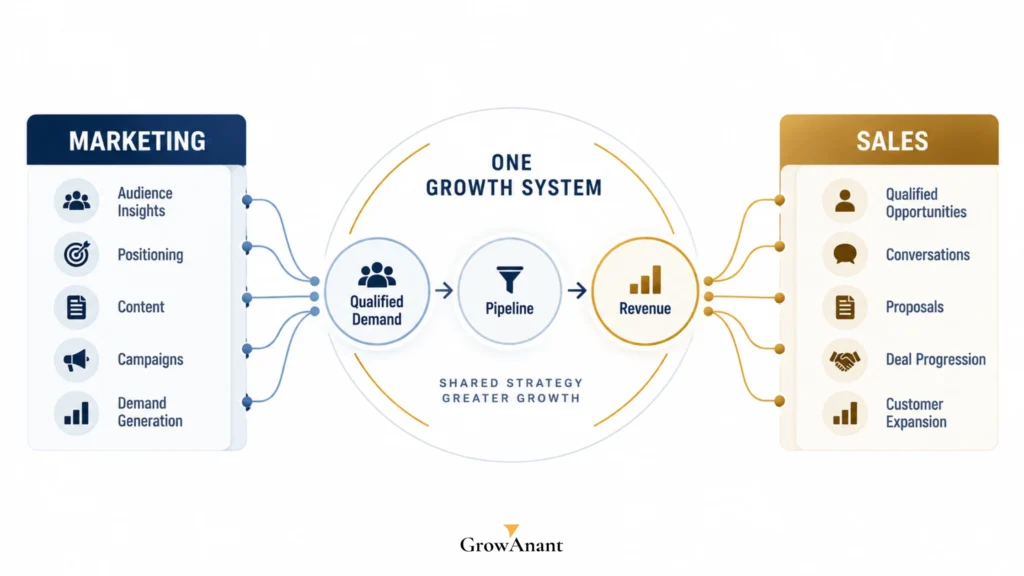
Growth marketing and sales consulting brings marketing and sales under a shared growth strategy instead of treating them as separate functions with disconnected targets. The objective is not simply to generate more leads or close more deals. It is to create a coordinated system where positioning, demand generation, lead qualification, sales execution, and revenue measurement reinforce one another.
For growth-stage SaaS companies, professional service firms, funded startups, and founder-led businesses, this distinction matters. Marketing can generate significant activity while sales struggles with lead quality. Sales can pursue opportunities while marketing continues targeting the wrong segments. The result is often inconsistent pipeline, inefficient customer acquisition, and limited visibility into what actually drives revenue.
This is why sales and marketing alignment should be treated as a strategic operating model rather than a meeting between two departments.
HubSpot describes alignment around shared goals, data, definitions, processes, and service-level expectations.
The executive principle: Marketing creates and influences demand, sales converts qualified demand, and leadership ensures both functions operate against the same commercial strategy.
The unified growth framework
| Area | Marketing responsibility | Sales responsibility | Shared outcome |
| ICP | Define and refine target segments | Validate fit in conversations | Better-fit opportunities |
| Positioning | Develop market messaging | Test messaging with buyers | Stronger differentiation |
| Demand | Create awareness and intent | Identify active buying signals | Qualified pipeline |
| Qualification | Establish lead criteria | Validate opportunity quality | Better handoffs |
| Enablement | Create useful sales assets | Apply them in deals | Higher sales effectiveness |
| Measurement | Track campaign and funnel data | Track opportunity progression | Revenue visibility |
Strategy before activity
The first problem with disconnected marketing and sales is that both teams can be busy while the business remains commercially inefficient.
A marketing team may measure traffic, leads, campaign engagement, or MQLs. Sales may focus on meetings, opportunities, win rates, and bookings. Each metric can look reasonable independently while the overall funnel underperforms.
A stronger approach is to begin with the revenue objective and work backward.
For example, a U.S. B2B SaaS company entering a competitive market may decide that its growth priority is increasing qualified opportunities among mid-market companies. That decision should influence:
- Target account and buyer definition
- Market positioning
- Content and messaging
- B2B lead generation services
- Lead qualification
- Sales development
- Sales enablement
- Pipeline measurement
This is fundamentally different from asking marketing to “generate more leads” and sales to “close more deals.”
For organizations evaluating growth strategy consulting, the key question should therefore be: Can the strategy connect market demand to sales execution and revenue measurement?
Building one commercial strategy
A unified strategy should establish five decisions before campaigns or sales initiatives are scaled.
1. Who are we trying to win?
Marketing and sales should share the same ICP definition. This should include company characteristics, business situation, decision-maker, pain points, buying triggers, and disqualifiers.
2. Why should they choose us?
Positioning should be consistent across advertising, content, sales conversations, website messaging, and proposals.
3. What creates buying intent?
Not every interaction represents purchase intent. Teams should distinguish between passive engagement and meaningful commercial signals.
4. What makes a lead sales-ready?
Define the conditions that justify sales involvement. This prevents marketing from optimizing for volume while sales receives poorly qualified contacts.
5. Which metrics determine success?
The measurement framework should progress from activity to commercial impact:
Reach → Engagement → Qualified Demand → Opportunities → Pipeline → Closed Revenue
This structure makes growth consulting services more commercially accountable because marketing activity is evaluated in the context of pipeline progression.
Creating an effective handoff
One of the most common sources of friction is the marketing-to-sales handoff.
Marketing believes it has delivered qualified leads. Sales believes the leads are weak. Leadership sees rising acquisition costs but cannot determine where the problem originates.
A shared service-level agreement can reduce this ambiguity. HubSpot’s documented approach includes expectations around lead quantity and quality, sales follow-up, qualification, and measurable outcomes.
A practical handoff framework can include:
| Decision | Agreement required |
| MQL definition | What qualifies as marketing-ready? |
| SQL definition | What qualifies as sales-ready? |
| Lead routing | Who receives each lead? |
| Response expectation | How quickly should sales respond? |
| Rejection reason | Why can sales reject an opportunity? |
| Feedback loop | How does feedback reach marketing? |
| Reporting | Which funnel metrics are reviewed jointly? |
This is particularly important when using external growth marketing services or a demand generation agency alongside an internal sales team. External execution should operate against the company’s commercial definitions rather than creating an independent funnel.
Aligning campaigns with sales conversations
The strongest marketing and sales systems do not merely share leads. They share market intelligence.
Sales conversations reveal:
- Which objections repeatedly delay decisions
- Which competitors appear most frequently
- Which use cases generate urgency
- Which buyer roles influence deals
- Why prospects choose alternatives
- Why qualified opportunities become lost deals
Marketing can convert these insights into messaging, content, case studies, comparison resources, nurture programs, and campaign themes.
For example, suppose a U.S. HR SaaS company discovers that prospects understand its product category but do not understand why its approach is different from established platforms. Marketing should not simply increase advertising volume. It should address the positioning gap.
Sales, meanwhile, can use the resulting comparison content during active opportunities.
That creates a reinforcing system:
Sales insight → Marketing message → Buyer engagement → Sales conversation → Revenue feedback
This is where growth marketing and sales consulting becomes more valuable than treating marketing and sales as independent service functions.
Measuring the combined impact
A unified model requires shared metrics.
A useful scorecard should include both leading and commercial indicators.
| Funnel level | Example metrics |
| Demand | Qualified traffic, target-account engagement |
| Lead | MQL volume, lead quality |
| Qualification | MQL-to-SQL conversion |
| Pipeline | Opportunities created, pipeline value |
| Sales | Win rate, sales cycle |
| Revenue | Closed revenue, customer acquisition cost |
| Efficiency | Pipeline generated per marketing investment |
The critical principle is to avoid optimizing one stage at the expense of another.
If lead volume increases but qualified opportunities decline, the system is not necessarily improving.
If sales meetings increase but opportunities do not progress, qualification or positioning may be weak.
If pipeline increases but win rates decline, the business may be attracting the wrong opportunities or failing to communicate differentiated value.
This is why revenue growth consulting should examine the complete commercial system rather than evaluate isolated marketing metrics.
Where different capabilities fit
Companies often ask whether they need internal marketing, sales leadership, a consultant, or an external execution partner.
The answer depends on the problem.
| Need | Best strategic focus |
| Campaign execution | Internal team or specialist partner |
| Demand generation | Marketing strategy + execution |
| Funnel problems | Marketing and sales process review |
| Weak positioning | Growth and market strategy |
| Poor sales conversion | Sales process + messaging alignment |
| Fragmented growth activity | Strategic growth leadership |
| New-market expansion | GTM and market-entry planning |
A digital growth agency may be highly effective when the primary requirement is channel execution. A strategic consulting engagement becomes more relevant when the business lacks clarity around positioning, ICP, funnel architecture, measurement, or growth ownership.
GrowAnant approaches this gap as a growth partner rather than a tactical marketing provider, connecting strategy, B2B marketing, demand generation, sales alignment, and revenue execution.
A practical 90-day alignment framework
For a growth-stage company, alignment does not need to begin with a major organizational redesign.
A practical sequence is:
Days 1 to 30: Diagnose
- Review ICP and segmentation
- Analyze funnel performance
- Audit lead quality
- Review sales objections
- Identify conversion leakage
- Establish shared definitions
- Map current marketing-to-sales handoffs
Days 31 to 60: Align
- Finalize positioning
- Establish shared KPIs
- Create lead qualification criteria
- Define sales and marketing responsibilities
- Build sales enablement priorities
- Establish reporting structure
Days 61 to 90: Optimize
- Launch aligned campaigns
- Monitor pipeline progression
- Review lead quality
- Compare channel performance
- Analyze lost opportunities
- Adjust messaging and qualification
- Establish an ongoing optimization cadence
The objective is not to make every function identical. Marketing and sales should retain different responsibilities while operating within one commercial system.
The leadership test
For CEOs and founders, the simplest test is this:
Can the marketing leader explain what sales needs to convert more qualified opportunities?
Can the sales leader explain which marketing programs create the strongest commercial intent?
Can both leaders agree on the ICP, qualification criteria, pipeline definition, and revenue metrics?
If the answer is no, the organization likely has an alignment problem rather than simply a lead-generation problem.
Companies working with GrowAnant can use this type of strategy-first framework to connect growth strategy, demand generation, sales execution, and revenue measurement without creating another disconnected marketing initiative.
The goal is not more marketing activity.
The goal is a clearer growth system where marketing and sales understand the same market, pursue the same commercial priorities, and learn from the same revenue outcomes.
References
- HubSpot: Sales and Marketing Alignment
- Harvard Business Review: Are Your Marketing and Sales Teams on the Same Page?
Frequently Asked Questions
Yes, when the primary business challenge involves disconnected demand generation, sales execution, positioning, or pipeline performance. Combining the strategic view can help identify problems that are difficult to see when each function is evaluated separately.
However, combining consulting does not mean eliminating functional ownership. Marketing should still own marketing execution, while sales should own sales execution. The strategic framework should connect their responsibilities.
A unified engagement can cover ICP definition, positioning, growth strategy consulting, demand generation, lead qualification, sales enablement, funnel design, reporting, and revenue alignment.
The exact scope should depend on the company’s growth constraints. A SaaS company with strong demand but weak conversion may need a different engagement from a professional services company struggling with inconsistent lead generation.
Combined impact should be measured across the funnel rather than through isolated departmental metrics. Useful indicators include qualified demand, MQL-to-SQL conversion, opportunities created, pipeline generated, win rate, customer acquisition efficiency, and closed revenue.
The important principle is shared accountability. Marketing should not be evaluated only on lead volume, and sales should not be evaluated without considering the quality and source of opportunities.
The CEO, founder, or designated growth leader should typically provide executive ownership, while marketing and sales leaders retain responsibility for their respective functions.
For companies without sufficient internal strategic leadership, a fractional growth consultant or external growth partner can provide coordination across functions while internal teams continue executing their specialized responsibilities.