
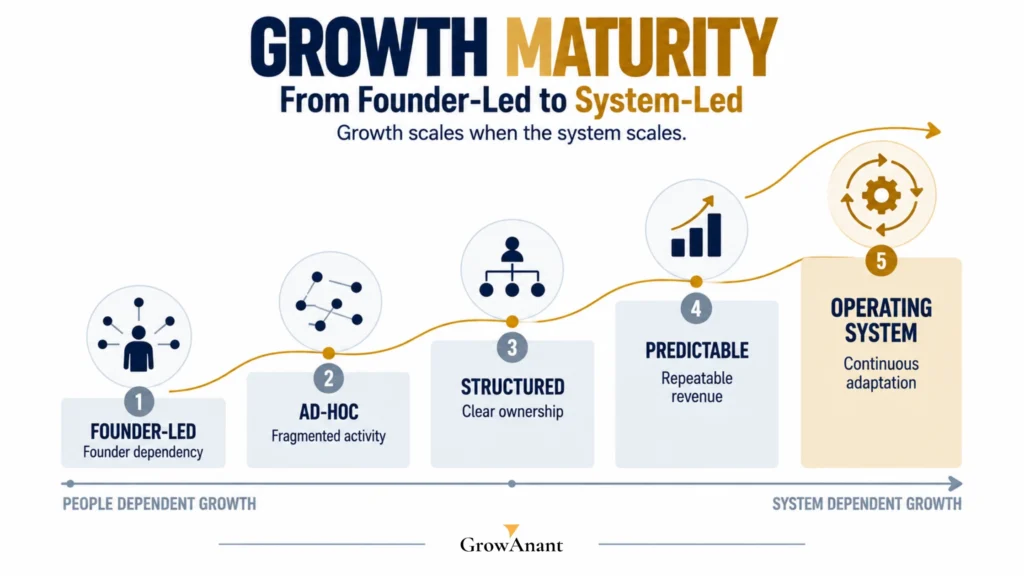
A growth leadership maturity model helps companies understand how their approach to growth evolves from founder-led activity into a coordinated, measurable revenue system. For a growth-stage business, the question is not simply whether marketing is happening. It is whether strategy, people, processes, technology, and accountability are organized to create sustainable growth.
Companies often move through recognizable stages. A founder may initially manage sales and marketing personally. As the business grows, different people begin executing campaigns, managing channels, and generating leads. Eventually, the company needs a structured growth function that connects fractional growth leadership, marketing, sales, customer experience, and revenue operations.
This progression can be viewed as a maturity journey rather than a rigid organizational formula.
McKinsey research similarly emphasizes that strategy alone does not guarantee performance. An effective operating model connects strategy with leadership, governance, processes, technology, talent, and accountability.
| Stage | Primary characteristic | Typical growth challenge |
| Stage 1 | Founder-led growth | Founder dependency |
| Stage 2 | Ad-hoc execution | Fragmented activity |
| Stage 3 | Structured growth function | Coordination and accountability |
| Stage 4 | Predictable revenue system | Optimization and scalability |
| Stage 5 | Growth operating system | Continuous adaptation |
Stage 1: Founder-Led Growth
At this stage, the founder is usually the central growth engine.
The founder may personally handle sales conversations, partnerships, positioning, customer research, marketing decisions, and major acquisition opportunities. This can work effectively when the company has a small customer base and a relatively simple sales process.
The challenge appears when founder involvement becomes a constraint.
Typical characteristics include:
- Sales opportunities depend heavily on the founder.
- Marketing decisions are based on immediate priorities.
- Customer acquisition is inconsistent.
- There is limited formal measurement.
- Positioning changes based on individual conversations.
- There is no dedicated growth roadmap.
For example, an early B2B SaaS founder may generate initial customers through personal LinkedIn relationships and referrals. As the company attempts to expand beyond that network, the same approach may not provide enough predictable demand.
At this stage, business growth consulting can help convert founder knowledge into a documented growth strategy without immediately creating a large internal function.
Leadership question: Can someone other than the founder explain how the company generates demand and converts it into revenue?
Stage 2: Ad-Hoc Marketing Execution
The second stage begins when companies start adding marketing resources.
A business may hire a marketer, freelancer, agency, content writer, paid media specialist, or SEO resource. Activity increases, but strategic coordination may remain limited.
This creates a common pattern:
More activity → More channels → More reporting → Limited strategic clarity
Typical symptoms include:
- Content without a clear commercial purpose
- Paid campaigns without clear funnel ownership
- SEO disconnected from sales priorities
- Multiple agencies or specialists working independently
- Inconsistent positioning
- Lead volume increasing without corresponding pipeline
- Difficulty identifying marketing ROI
A company might simultaneously invest in growth marketing services, paid acquisition, content, social media, and B2B lead generation services, while no one owns the complete growth system.
This is where leadership maturity becomes important. Execution capacity has increased, but strategic ownership has not necessarily increased with it.
Leadership question: Does every major growth activity have a clear connection to an ICP, business objective, funnel stage, and revenue metric?
Stage 3: Structured Growth Function
At Stage 3, the company begins treating growth as a defined business function.
There is greater clarity around:
- ICP and segmentation
- Positioning
- Demand generation
- Sales and marketing alignment
- Funnel stages
- KPIs
- Reporting
- Budget allocation
- Experimentation
- Ownership
The company may have a Head of Growth, VP Marketing, growth team, or fractional head of growth supported by internal specialists and external partners.
The difference is not simply having more people. It is having clearer accountability.
| Stage 2 | Stage 3 |
| Campaign-led | Strategy-led |
| Channel metrics | Funnel metrics |
| Individual ownership | Cross-functional ownership |
| Activity focused | Revenue focused |
| Reactive decisions | Planned experimentation |
| Fragmented reporting | Shared performance framework |
A SaaS company at this stage may create a quarterly growth roadmap connecting product adoption, demand generation, pipeline, conversion, and retention.
A professional services company may formalize its ICP, service positioning, lead qualification, content strategy, and business development process.
This is also where growth strategy consulting can help leadership identify capability gaps before adding more execution resources.
Leadership question: Is there one accountable owner for the growth system, even when execution is distributed across multiple teams?
Stage 4: Predictable Revenue System
Stage 4 represents a significant shift from managing marketing activities to managing a revenue system.
The organization understands how its commercial engine works.
It can answer questions such as:
- Which segments produce the strongest opportunities?
- Which acquisition channels influence qualified pipeline?
- Where does funnel leakage occur?
- Which messages improve conversion?
- How long does the sales cycle typically take?
- Which activities create measurable commercial value?
- Where should additional investment be allocated?
The organization has developed stronger growth consulting services, sales processes, reporting infrastructure, and cross-functional accountability.
A predictable revenue system does not mean revenue becomes perfectly predictable. Markets change, customer behavior changes, and acquisition economics fluctuate.
Instead, predictability means the company has enough visibility into its growth drivers to make informed decisions.
For example, a U.S. SaaS company expanding into a new segment may compare target-account engagement, qualified opportunities, sales-cycle length, win rates, and customer acquisition efficiency before increasing investment.
This makes growth decisions more evidence-based rather than dependent on intuition.
McKinsey describes effective growth systems as requiring organizational alignment, capability building, analytics, and leadership commitment rather than treating growth as a standalone marketing activity.
Leadership question: Can leadership identify the major drivers of pipeline and revenue and explain how investment in each driver affects the broader system?
Stage 5: Growth Operating System
At Stage 5, growth becomes embedded into how the company operates.
The organization has an established growth operating system connecting:
Strategy → Priorities → Teams → Processes → Data → Experiments → Learning → Resource Allocation
Growth is no longer dependent on one person, one campaign, or one acquisition channel.
Instead, the organization continuously evaluates:
- Market changes
- Customer behavior
- Competitive positioning
- Acquisition efficiency
- Product-market signals
- Pipeline performance
- Experiment results
- Capability requirements
This does not necessarily mean the company needs a large growth department.
A mature growth organization may combine internal leaders, specialists, technology, external partners, and fractional growth leadership depending on the company’s requirements.
For example, a growth-stage fintech company might maintain internal product and sales leadership while using a fractional growth executive to coordinate positioning, demand generation, GTM priorities, and commercial experimentation.
Similarly, a healthtech company entering a new U.S. market may use a fractional growth consultant to provide strategic leadership while existing marketing and sales teams execute specialized work.
The defining characteristic is integration.
McKinsey’s recent operating-model research highlights clarity, speed, skills, and commitment as important outcomes of an effective operating model, reinforcing the idea that growth capability depends on how the organization works as a system.
Leadership question: Does the organization continuously learn and adapt its growth system, or does it wait for growth problems before changing direction?
Assessing Your Current Stage
A practical maturity assessment should evaluate five dimensions:
| Dimension | Stage 1 | Stage 3 | Stage 5 |
| Strategy | Founder intuition | Documented strategy | Continuously optimized |
| Leadership | Founder dependent | Dedicated ownership | Integrated leadership system |
| Demand | Referral/activity driven | Structured demand generation | Multi-channel revenue system |
| Measurement | Basic metrics | Funnel KPIs | Integrated commercial intelligence |
| Execution | Reactive | Coordinated | Adaptive |
| Accountability | Individual | Functional | Cross-functional |
Use these questions to assess your current position:
Growth Leadership Checklist
- Is growth strategy documented?
- Is there a clearly defined ICP?
- Does leadership agree on growth priorities?
- Is there one accountable growth owner?
- Are marketing and sales working from shared definitions?
- Can the business identify its largest funnel constraints?
- Are acquisition channels evaluated against pipeline and revenue?
- Are experiments documented and reviewed?
- Is there a consistent growth reporting cadence?
- Can the organization operate its growth process without depending entirely on the founder?
If most answers are “no,” the company may still be operating primarily through founder-led or ad-hoc growth.
If most answers are “yes,” the next question is whether the system is scalable.
A useful decision framework is:
Founder dependency → Build structure
Fragmented execution → Establish ownership
Structured function → Improve integration
Predictable revenue → Build scalability
Growth operating system → Continuously adapt
Companies do not necessarily need to move through every stage at the same speed. A funded startup may build structured growth capabilities earlier than a bootstrapped company. A business entering the U.S. market may also require temporary strategic leadership before building a permanent internal function.
This is where a partner such as GrowAnant can operate as a strategy-first growth resource, helping leadership connect growth strategy, demand generation, GTM execution, and revenue accountability while internal teams retain ownership of specialized execution.
Frequently Asked Questions
Assess your company across strategy, leadership ownership, demand generation, measurement, execution, and accountability. The defining factor is not company size. It is how consistently the organization can connect growth decisions to measurable commercial outcomes.
A small company can have a relatively mature growth system, while a larger company can still operate through fragmented execution.
Common triggers include increasing revenue complexity, declining acquisition efficiency, entering new markets, expanding product lines, increasing team size, growing sales cycles, or increasing dependence on multiple acquisition channels.
The transition usually becomes necessary when the existing growth model creates more uncertainty or operational friction than the leadership team can manage effectively.
Yes. Companies do not have to progress through the stages in a perfectly linear sequence.
A funded SaaS company may establish structured growth leadership earlier because it has greater resources and stronger growth expectations. A company entering the U.S. market may also build formal GTM and measurement capabilities earlier because market entry creates additional complexity.
However, skipping the underlying capabilities is different from skipping the stage label. A company cannot create predictable revenue simply by changing its organizational title. The underlying strategy, processes, data, ownership, and execution systems still need to exist.
Fractional leadership can support different needs depending on maturity.
At Stage 1, a fractional growth consultant can help turn founder knowledge into a structured growth roadmap.
At Stage 2, fractional growth leadership can help coordinate fragmented marketing and execution resources.
At Stage 3, a fractional chief growth officer or fractional head of growth can provide strategic direction while internal specialists execute their functions.
At Stage 4, fractional leadership can help optimize the revenue system, identify growth constraints, and improve cross-functional alignment.
At Stage 5, a fractional growth executive may provide specialized leadership for a new market, business unit, transformation initiative, or strategic growth priority.