
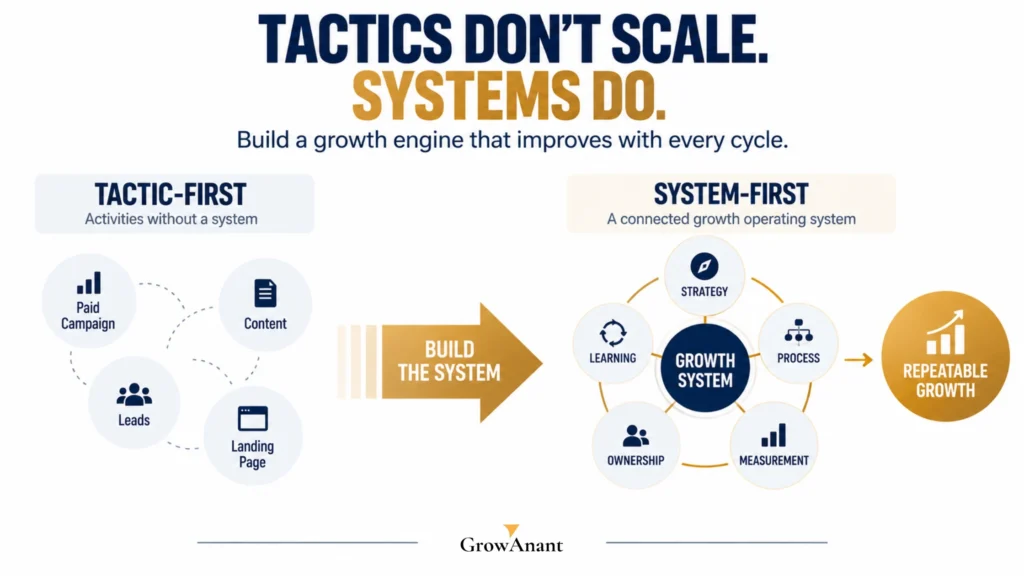
A scalable growth consultancy should do more than recommend isolated campaigns or short-term marketing activities. It should help a business build repeatable systems that connect strategy, execution, measurement, and revenue outcomes. This distinction matters for founders and CEOs dealing with inconsistent lead generation, fragmented marketing, growth plateaus, or execution without strategic direction.
A growth consultant or fractional growth consultant can provide expertise, but the long-term value depends on whether that expertise becomes embedded into the company’s operating approach. Growth strategy consulting should therefore create capabilities that continue working beyond a single campaign or engagement. Research from Harvard Business Review similarly describes sustained growth as the result of an integrated growth system rather than episodic initiatives.
The core question is simple:
Is the consultancy helping your company perform a task, or helping your company build a better way to grow?
Tactics vs Systems
A tactic is an individual action designed to produce a specific outcome. A system connects multiple activities through defined processes, ownership, measurement, and feedback loops.
For example, running a paid campaign is a tactic. Building a demand generation system that defines the target market, messaging, acquisition channels, lead qualification, attribution, sales handoff, and optimization process is a system.
| Tactics | Systems |
| Campaign focused | Business outcome focused |
| Short-term activity | Repeatable process |
| Channel specific | Cross-functional |
| Often dependent on individuals | Supported by documented processes |
| Measures activity | Measures business impact |
| Ends when campaign ends | Improves through feedback |
This distinction becomes important when businesses use growth consulting services, business growth consulting, or revenue growth consulting to solve recurring problems.
Consider a B2B SaaS company generating leads through paid search. A tactical approach may recommend new campaigns whenever pipeline slows. A systems approach asks why pipeline becomes inconsistent in the first place.
It may uncover:
- Weak ICP definition.
- Inconsistent positioning.
- Poor lead qualification.
- Slow sales follow-up.
- Limited attribution.
- No structured experimentation process.
- Disconnects between marketing and sales.
The system addresses the underlying process instead of repeatedly treating the symptom.
McKinsey describes operating models as mechanisms that connect strategy with how an organization delivers value and achieves its objectives.
What “Scalable” Means in Growth Consulting
Scalability in consulting does not simply mean handling more customers or increasing the number of campaigns.
For a growth consultancy, scalability means creating a growth approach that can support increasing complexity without requiring the same increase in manual effort, decision-making, or external dependency.
A scalable growth model typically contains five components:
| Component | What it establishes |
| Strategy | Where and how the company intends to grow |
| Process | How recurring growth activities are executed |
| Measurement | How performance and business impact are evaluated |
| Ownership | Who makes decisions and manages execution |
| Learning | How results improve the next cycle |
This can form the foundation of a growth operating system.
For example, a U.S.-focused SaaS company entering a second customer segment may initially rely on founder-led selling and individual marketing experiments. As demand grows, that approach can become difficult to manage.
A scalable model would document:
- ICP and segmentation criteria
- Positioning and messaging
- Demand generation processes
- Lead qualification
- Sales handoff
- Campaign testing
- Reporting
- Revenue attribution
- Strategic review cadence
The objective is not to remove human judgment. It is to make good decisions easier to repeat.
This is particularly relevant to growth consulting business models and growth consulting engagement structure. A consultancy that repeatedly delivers recommendations without transferring processes can create dependency. A consultancy that builds repeatable capabilities can create organizational leverage.
Signs a Consultancy Builds Scalable Systems
Not every consultancy approaches growth in the same way. Before engaging a digital growth agency, growth marketing agency USA, or broader strategic partner, founders should examine how the consultancy actually works.
Look for evidence across six areas.
1. Strategy before execution
The consultancy should establish the business objective before recommending channels.
For example:
Business objective → Growth constraint → Strategy → System → Execution → Measurement
If the discussion starts with a list of campaigns before understanding the growth constraint, the engagement may be overly tactic-driven.
2. Documented processes
Ask whether the consultancy creates frameworks, operating procedures, dashboards, decision rules, and reusable processes.
Documentation matters because knowledge that exists only inside meetings is difficult to scale.
3. Cross-functional thinking
Growth rarely sits entirely within marketing.
A scalable approach considers:
- Marketing
- Sales
- Customer experience
- Product
- Revenue operations
- Leadership
For a B2B company, improving lead volume without improving qualification may increase workload without improving pipeline quality.
4. Clear measurement
A scalable consultancy should establish how activities connect to meaningful business metrics.
For example:
Traffic → Qualified demand → Opportunities → Pipeline → Revenue
This does not mean every result can be perfectly attributed to one activity. It means leadership has a structured way to evaluate performance and make resource decisions.
5. Capability transfer
A useful question is:
“What will our team be able to do better after this engagement?”
The answer should include more than completed deliverables.
A strong growth roadmap consulting engagement may leave behind better processes for prioritization, experimentation, reporting, and decision-making.
6. Continuous improvement
Scalable systems are not static. They should improve through feedback.
Harvard Business Review’s research on consistent growth similarly emphasizes building an integrated growth system capable of supporting both short-term and long-term growth. Harvard Business Review
Scalability checklist
Before selecting a consultancy, ask:
- Is there a defined growth strategy?
- Are processes documented?
- Are responsibilities clear?
- Are marketing and revenue metrics connected?
- Can the framework be used by internal teams?
- Is there a regular review and optimization process?
- Does the consultancy explain why activities are prioritized?
- Can the system adapt as the company grows?
Questions to Ask About Scalability
A consultancy pitch can tell you what will be delivered. The right questions reveal whether the work can compound.
Question 1: “What remains after the engagement?”
Look for processes, frameworks, documentation, dashboards, decision models, and internal capabilities.
Question 2: “How do you prioritize growth initiatives?”
A strong answer should connect prioritization to business objectives, constraints, resources, customer segments, and expected impact rather than simply listing popular channels.
Question 3: “How will our team operate this system?”
This reveals whether the consultancy expects to remain the permanent operator or intends to build organizational capability.
Question 4: “What happens when a tactic stops working?”
A scalable system should have a testing and learning mechanism rather than requiring a completely new strategy every time performance changes.
Question 5: “How do you connect activity to revenue?”
This is especially important when evaluating B2B growth marketing agency, B2B marketing strategy consulting, or demand generation agency services.
Question 6: “How does the model change as we scale?”
The answer should address changing customer segments, team structures, channels, markets, and operational complexity.
A practical decision framework is:
If the answer focuses mainly on deliverables: evaluate execution capability.
If the answer explains processes, ownership, measurement, learning, and capability transfer: evaluate the potential for a scalable system.
For companies considering startup growth strategy consulting, SaaS growth consulting, or go to market strategy consulting, this distinction can materially affect how internal teams and external partners work together.
A Systems-vs-Tactics Scenario
Consider a founder-led B2B software company experiencing inconsistent pipeline.
Tactic-first approach
The company hires a consultancy and immediately launches:
- Search campaigns
- LinkedIn campaigns
- New landing pages
- Several content assets
Traffic and leads increase temporarily, but the company still struggles to understand which prospects are commercially valuable.
When performance declines, another set of campaigns is introduced.
Systems-first approach
A scalable growth consultancy starts by identifying the growth constraint.
The team maps:
ICP → Positioning → Demand → Qualification → Sales → Pipeline → Revenue
It then establishes:
- A defined target customer profile.
- Clear positioning.
- A demand generation process.
- Lead qualification criteria.
- Sales handoff rules.
- Attribution and reporting.
- Experimentation priorities.
- A recurring growth review.
The difference is not that the systems approach avoids tactics. It places tactics inside a structure.
This is particularly important for businesses experiencing growth uncertainty, fragmented marketing efforts, inefficient customer acquisition, or marketing activity disconnected from revenue outcomes.
GrowAnant’s growth partner model reflects this systems-oriented approach by connecting strategy, demand generation, execution, and revenue rather than treating individual campaigns as the complete growth solution. Pasted text
For a founder evaluating growth consulting services USA, the strategic question is therefore not simply “What will the consultancy do?”
It is:
“What growth capability will the business have after the work is done?”
A consultancy may still execute campaigns, support growth marketing services, develop B2B lead generation services, or provide digital marketing consulting services. The distinction is whether those activities contribute to a repeatable growth architecture.
Practical systems test
Use this five-part test when reviewing a proposal:
| Question | Systems-oriented answer |
| What are we solving? | Defines the business constraint |
| What will we build? | Defines repeatable processes |
| Who owns it? | Establishes internal accountability |
| How will we measure it? | Connects activity to business outcomes |
| How will it improve? | Establishes a learning cycle |
A one-off tactic can create a result.
A well-designed system can create a way of repeatedly pursuing results.
That difference is central to evaluating whether a consultancy can support sustainable growth as the business, team, customer base, and market become more complex.
References
- Harvard Business Review
Frequently Asked Questions
A tactic is an individual action designed to address a specific objective. A system connects strategy, processes, ownership, measurement, and continuous improvement so growth activities can be repeated and adapted.
Ask what remains after the engagement. Look for documented processes, frameworks, measurement structures, decision rules, internal capabilities, and clear ownership rather than only completed campaigns or deliverables.
Ask how the consultancy prioritizes initiatives, connects activities to revenue, transfers knowledge, measures performance, handles underperforming tactics, and adapts its approach as the business grows.
One-off tactics often address individual activities without creating repeatable processes or organizational learning. Without a system connecting strategy, execution, measurement, and improvement, each new growth initiative may require starting the decision-making process again.