
Small and midsize businesses rarely have the same resources as large enterprises, but their growth challenges can be just as complex. An growth consulting agency for smb can help an owner identify where growth is getting blocked, prioritize investments, and create a practical path forward without building a large internal strategy function.
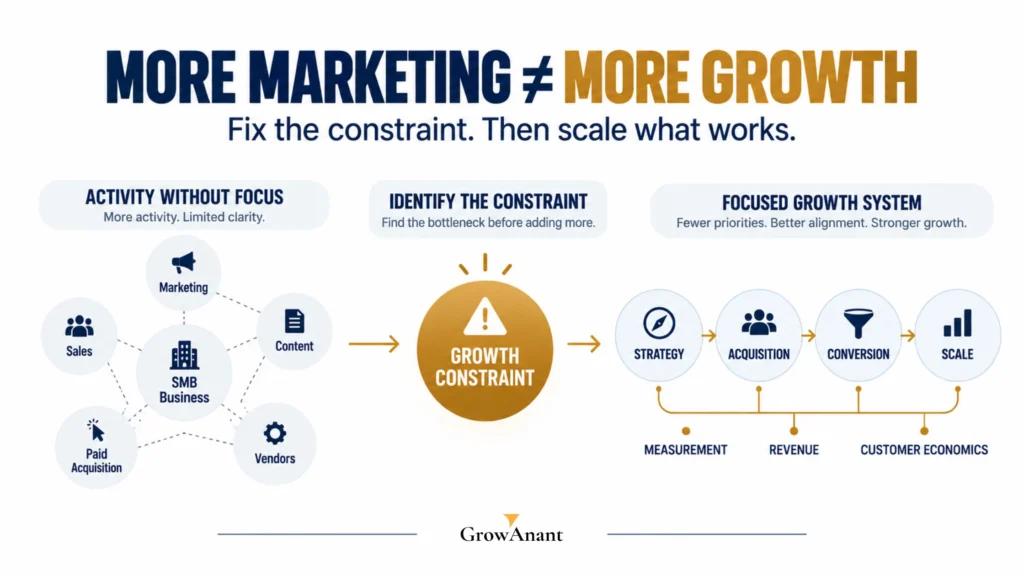
For an SMB, growth consulting is not about adding more marketing activities. It is about determining which activities can contribute to pipeline, customer acquisition, positioning, and revenue, then building a system around them. This is where growth strategy consulting, a growth consultant, or a fractional growth consultant can provide strategic direction without requiring an enterprise-sized team.
Why SMB Growth Consulting Looks Different
Enterprise organizations can often support specialized teams for marketing, sales operations, strategy, analytics, demand generation, and revenue operations. SMBs usually cannot.
An owner may be managing sales while a small marketing team handles campaigns, content, social media, and advertising. The result can be significant activity without a clear connection between marketing investment and business outcomes.
SMB growth consulting therefore starts with business growth consulting, not with a long list of marketing tactics.
The first question should be:
Where is the biggest constraint preventing the business from growing predictably?
That constraint might be:
| Growth Challenge | What It Can Look Like |
| Positioning | Prospects do not understand why the company is different |
| Lead generation | Pipeline depends heavily on referrals |
| Conversion | Leads enter the funnel but rarely become opportunities |
| Demand generation | Marketing activity creates traffic but limited qualified demand |
| Customer acquisition | CAC continues increasing without corresponding revenue improvement |
| Sales process | Marketing and sales operate around different priorities |
| Strategy | Teams execute activities without a shared growth roadmap |
This is also where the difference between startup vs smb growth consulting becomes important.
A startup may be searching for product-market fit, while an established SMB may already have customers, revenue, and market knowledge but struggle to scale efficiently.
The consulting approach should reflect that difference.
A practical SMB growth framework
Diagnose → Prioritize → Build → Measure → Refine
- Diagnose: Identify the biggest growth constraint.
- Prioritize: Select the few initiatives with the strongest strategic relevance.
- Build: Create the systems required to execute them.
- Measure: Connect activities to pipeline and revenue indicators.
- Refine: Adjust based on performance and market feedback.
The objective is not to imitate enterprise marketing. It is to build an appropriate growth system for the business’s current stage.
Low-Cost High-Impact Starting Points
Limited budgets make prioritization more important, not less.
An SMB does not necessarily need more channels. It needs clarity around which existing opportunities deserve investment.
A practical starting point is to examine four areas:
1. Existing customer economics
Review:
- Average deal size
- Customer acquisition cost
- Sales cycle
- Repeat purchase behavior
- Customer retention
- Highest-value customer segments
This can reveal which customers create the strongest economic foundation for growth.
2. Existing demand
Before investing heavily in new acquisition channels, examine current sources of demand.
For example, a U.S. professional services company might discover that referrals produce the highest-quality opportunities while paid campaigns generate significantly more inquiries but fewer qualified conversations.
The answer may not be to eliminate paid marketing. It may be to understand why the two sources behave differently and build the acquisition system around actual customer economics.
3. Conversion bottlenecks
More leads do not automatically solve a growth problem.
A company generating 500 inquiries but converting very few into qualified opportunities may have a qualification, positioning, sales process, or offer problem.
This is why growth consulting services should examine the complete journey from market positioning to revenue rather than evaluating individual marketing channels in isolation.
4. Message and positioning
SMBs often compete against larger companies with substantially bigger budgets.
Clear positioning can therefore become an important strategic asset.
A specialized IT services company, for example, may have difficulty competing broadly for “managed IT services.” Narrowing its positioning around a specific industry, business problem, or buyer can make its existing marketing resources more focused.
The 80/20 investment check
Before adding another channel, ask:
- Which activity currently generates qualified opportunities?
- Which customer segment has the strongest economics?
- Where is the funnel losing potential customers?
- Which activities are difficult to measure?
- What can be stopped without affecting revenue?
- What requires strategic expertise rather than additional execution capacity?
This approach allows SMBs to protect limited budgets while increasing strategic focus.
When to Invest in Fractional Leadership
An SMB may reach a point where execution is no longer the primary problem.
The business may already have:
- A marketing employee or team
- Sales representatives
- External vendors
- CRM infrastructure
- Advertising campaigns
- Content production
Yet leadership still lacks a unified growth strategy.
This is where a fractional growth consultant or fractional growth leadership model can become relevant.
A fractional leader provides strategic direction without requiring the business to immediately hire a full-time senior growth executive.
When fractional leadership may make sense
| Situation | Potential Need |
| Marketing activity is fragmented | Strategic prioritization |
| Sales and marketing disagree on priorities | Revenue alignment |
| Owner remains the growth decision-maker | Delegated growth leadership |
| Marketing team is execution-heavy | Strategic direction |
| Expansion requires a GTM plan | Go-to-market leadership |
| Growth has plateaued | Constraint diagnosis |
| Multiple vendors operate independently | Integrated growth management |
The important distinction is that fractional leadership should not simply become another execution resource.
The role should clarify priorities, establish accountability, connect functions, and create a repeatable operating rhythm.
For example, an SMB expanding into a new U.S. region may already have a designer, paid media specialist, salesperson, and content writer. What it lacks may be the strategic layer connecting market selection, positioning, acquisition, qualification, and revenue.
That is a leadership problem rather than a production problem.
Budget-Friendly Engagement Models
Growth consulting does not have to follow one fixed structure.
The appropriate growth consulting engagement structure depends on the company’s needs, internal capabilities, and decision-making complexity.
| Model | Best Used When | Primary Focus |
| Strategy Project | Business needs clarity | Growth diagnosis and roadmap |
| Growth Audit | Existing activities need evaluation | Identify inefficiencies |
| Advisory Engagement | Leadership needs ongoing guidance | Strategic decisions |
| Fractional Leadership | Company needs ongoing growth ownership | Strategy + leadership |
| Strategy + Execution | Internal team needs direction and support | Integrated growth execution |
A strategy-first engagement can be particularly useful when budget is limited.
Instead of immediately committing to extensive execution, the company can first establish:
Business objective → Target customer → Positioning → Growth constraint → Acquisition model → Funnel → Metrics → Execution priorities
This creates a clearer basis for future investment.
For an SMB, the goal should be to avoid paying for activity before understanding what that activity is supposed to accomplish.
A growth consulting business model can therefore be structured around the level of strategic involvement required rather than the number of deliverables produced.
What should the budget actually prioritize?
A practical allocation framework is:
- Strategy: Clarify where to compete and how to grow.
- Measurement: Establish reliable visibility into funnel performance.
- Core acquisition: Invest in the channels that match the customer journey.
- Conversion: Improve the movement from interest to qualified opportunity.
- Scale: Increase investment only after the underlying system is understood.
This can also help SMB owners distinguish strategic consulting from execution vendors.
A digital growth agency may be valuable when the business needs execution capacity. A growth consultant may be more valuable when the business needs strategic clarity. In some cases, the two can work together.
Common SMB Growth Mistakes
1. Adding channels before fixing the strategy
Opening another advertising channel will not resolve unclear positioning or weak qualification.
2. Measuring activity instead of business outcomes
Website traffic, impressions, clicks, and content volume can provide useful operational information, but they should ultimately connect to qualified demand and revenue.
3. Treating every customer as the same
Different segments can have different acquisition costs, sales cycles, retention patterns, and lifetime value.
4. Hiring execution before leadership
An SMB may add specialists while still lacking someone responsible for integrating the overall growth system.
5. Copying enterprise strategies
Enterprise organizations have different budgets, teams, processes, and operational complexity.
SMBs need a strategy appropriate to their economics.
6. Expecting immediate results from every investment
Growth systems often require testing, measurement, and refinement. A responsible growth plan should establish learning milestones rather than promise a specific revenue outcome.
7. Keeping the owner at the center of every decision
Founder involvement is valuable, but if every growth decision requires the owner’s direct intervention, the company can struggle to build scalable systems.
SMB Growth Checklist
Before investing in another growth initiative, ask:
- Do we know our highest-value customer segment?
- Is our positioning clear?
- Can we identify where qualified opportunities come from?
- Do sales and marketing share the same priorities?
- Can we connect marketing activity to pipeline?
- Do we know our primary growth constraint?
- Is the proposed investment solving that constraint?
- Do we have someone accountable for growth strategy?
- Can our current team execute the plan?
- Do we have a measurement system for reviewing progress?
GrowAnant approaches these challenges as a growth consulting partner rather than a tactical vendor. The focus is on connecting strategy, demand generation, go-to-market planning, and revenue execution into a practical growth system.
For an SMB owner, that distinction matters because the objective is not simply to do more marketing. It is to create greater clarity around where investment, leadership, and execution should be focused.
References
U.S. Small Business Administration: U.S. Small Business Administration
Frequently Asked Questions
SMBs can begin by identifying their highest-value customers, reviewing current acquisition channels, fixing major funnel constraints, clarifying positioning, and prioritizing a small number of measurable growth initiatives. Limited budgets make prioritization especially important.
Fractional leadership can make sense when an SMB has execution resources but lacks senior strategic direction. It can provide growth leadership across positioning, demand generation, go-to-market planning, measurement, and prioritization without requiring an immediate full-time executive hire.
Strategy projects, growth audits, advisory engagements, and focused fractional leadership can all be structured around an SMB’s requirements. The right model depends on whether the primary need is strategic clarity, ongoing leadership, or support connecting strategy with execution.
A common mistake is increasing marketing activity before identifying the underlying growth constraint. More channels, campaigns, or leads cannot necessarily solve unclear positioning, poor qualification, weak conversion, or disconnected sales and marketing processes.