
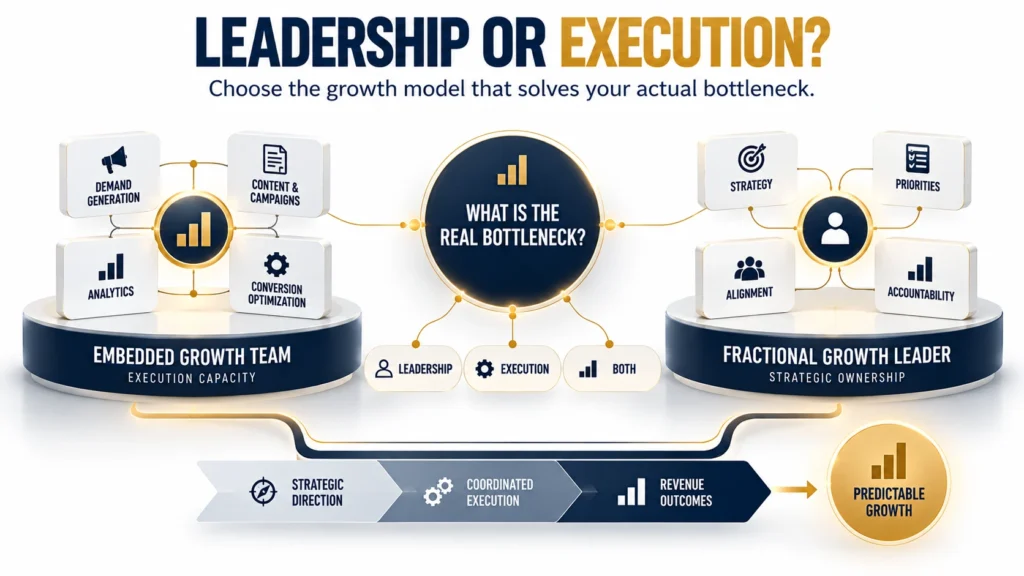
Choosing between an embedded growth team vs fractional growth leader is a decision about the capability your business needs, not simply how many people to hire. An embedded team provides hands-on execution capacity, while fractional growth leadership provides senior strategic direction, prioritization, and accountability without requiring a full-time executive hire.
For a growth-stage B2B SaaS company, the problem might be that marketing campaigns are running but qualified pipeline remains inconsistent. For a professional services firm, the challenge might be overdependence on referrals and the absence of a repeatable acquisition strategy. Each business needs to determine whether its primary constraint is leadership, execution, or both.
Understanding what is an embedded growth team helps clarify the distinction. The right model connects people, decisions, and execution to business outcomes. The goal is to establish a growth system that improves how the company attracts customers, converts opportunities, and scales revenue over time.
What Is an Embedded Growth Team?
An embedded growth team is a group of external specialists who work closely with a company’s internal team, systems, and operating processes to execute a coordinated growth plan.
Rather than operating as disconnected service providers, team members collaborate around shared priorities, timelines, and performance measures. Depending on the engagement, the team may include growth strategy, demand generation, paid acquisition, content, analytics, marketing operations, and conversion optimization capabilities.
Typical responsibilities include:
- Translating business objectives into an executable growth roadmap.
- Implementing demand generation and customer acquisition initiatives.
- Improving landing pages, conversion paths, and lead qualification.
- Connecting marketing performance with CRM and pipeline reporting.
- Running structured experiments and documenting what works.
- Coordinating with sales, product, and leadership teams.
For example, a U.S. B2B SaaS company may already have a sales team and junior marketers but lack the capacity to execute a coordinated acquisition plan. An embedded team could help improve campaign execution, landing-page conversion, lead routing, and reporting while collaborating with the company’s existing employees.
The defining advantage is execution capacity combined with operational integration. The company gains access to multiple capabilities without having to recruit every specialist individually.
However, an embedded team does not automatically provide executive-level leadership. Its strategic authority, management responsibilities, and accountability depend on the engagement design. Without clear ownership, additional execution capacity can simply produce more activity.
What Is a Fractional Growth Leader?
A fractional growth leader is an experienced growth executive who works with a company on a part-time or defined engagement basis, providing strategic direction, cross-functional alignment, and leadership accountability.
This role may operate as a fractional head of growth, fractional chief growth officer, or fractional growth consultant, depending on the company’s requirements and the individual’s responsibilities.
Typical responsibilities include:
- Defining the company’s growth strategy and priorities.
- Clarifying ideal customer profiles, positioning, and differentiation.
- Aligning marketing, sales, and customer success around revenue goals.
- Establishing pipeline metrics, performance reviews, and decision-making processes.
- Allocating resources across channels and initiatives.
- Guiding internal employees and external execution partners.
- Identifying whether growth constraints originate in acquisition, conversion, retention, pricing, or positioning.
Consider a founder-led U.S. consulting firm that receives most of its business through referrals. It has a website, a few marketing specialists, and external vendors, but nobody owns the complete growth strategy. A fractional growth leader can diagnose the acquisition problem, establish priorities, align execution, and create a consistent operating rhythm.
The central advantage is senior decision-making and strategic ownership. The company gains experienced leadership without necessarily committing to a full-time executive position.
The role is not automatically limited to advice. An appropriately scoped leader can manage execution partners, guide teams, and oversee performance. The important distinction is whether the engagement includes genuine leadership responsibility or only strategic recommendations.
Staffing and Cost Differences
The two models differ in team composition, management requirements, cost structure, and the type of gap they address.
| Factor | Embedded growth team | Fractional growth leader |
| Core purpose | Increase execution capacity | Add senior strategic leadership |
| Staffing | Multiple specialists, depending on scope | One senior growth leader |
| Primary contribution | Implementation, testing, optimization | Direction, prioritization, alignment |
| Time commitment | Depends on team size and engagement | Part-time or defined leadership commitment |
| Internal management | Requires clear coordination and decision rights | Requires access to leadership and internal stakeholders |
| Cost structure | Based on team composition and execution scope | Based on seniority, time commitment, and responsibility |
| Best use case | Strategy exists, but delivery capacity is insufficient | Teams are active, but strategic ownership is missing |
| Main risk | More activity without clear priorities | Strong strategy without enough execution capacity |
Is an embedded team cheaper?
Not necessarily. An embedded team may cost more in absolute terms because it includes multiple specialists. A fractional leader may require less direct spending, but that comparison changes if the company must separately fund execution resources.
A fair growth consulting cost breakdown should include the complete operating model, not just the monthly fee.
Evaluate:
- Leadership and specialist fees.
- Internal management time.
- Recruitment and onboarding costs, where relevant.
- Technology, advertising, and other execution expenses.
- Time required to implement recommendations.
- The business cost of delayed decisions or incomplete execution.
For instance, a startup with a capable marketing team may benefit more from fractional leadership than from adding another execution team. Conversely, a business with clear priorities but insufficient delivery capacity may get more value from an embedded team.
The decision should be based on the constraint being solved and the total resources required to address it.
Speed to Execution Compared
Speed depends on both decision-making and implementation capacity. A team can execute quickly but still waste resources if priorities are unclear. A strong leader can identify the right priorities but struggle to deliver results if nobody has the capacity to implement them.
An embedded team can accelerate execution when it has access to internal systems, timely approvals, and the authority to carry out agreed work. A fractional leader can accelerate decision-making by clarifying priorities, resolving disagreements, and connecting initiatives to business objectives.
| Business situation | More suitable starting point | Reason |
| Marketing activities lack a clear direction | Fractional growth leader | Establishes priorities and strategic ownership |
| Strategy is defined, but execution is delayed | Embedded growth team | Adds hands-on delivery capacity |
| Lead quality is weak across multiple channels | Depends on diagnosis | May require leadership, execution, or both |
| Sales and marketing use different performance metrics | Fractional growth leader | Aligns teams around shared outcomes |
| Multiple experiments are waiting for implementation | Embedded growth team | Increases execution throughput |
| Growth initiatives lack measurement and accountability | Fractional growth leader | Establishes ownership and review processes |
A practical example is a Series A SaaS company with rising customer acquisition costs. If the company is spending on multiple channels without understanding which segments convert, leadership should first establish a clear diagnostic and prioritization framework. Once the highest-value opportunities are identified, an embedded team can help implement and test the required changes.
The key is to avoid confusing faster activity with faster progress. Both models should work toward measurable improvements in qualified pipeline, conversion, acquisition efficiency, or other outcomes relevant to the business.
Which Model Fits Which Company Size
Company size can help inform the decision, but the real determinant is organizational maturity and the nature of the growth constraint.
| Business stage | Common challenge | Model to consider |
| Founder-led startup | No clear growth strategy or senior ownership | Fractional growth leader |
| Early-stage SaaS with limited internal capacity | Need for coordinated execution across several growth activities | Embedded growth team, if priorities are established |
| Series A company | Need to improve repeatability and align marketing with sales | Fractional leadership, embedded execution, or both |
| Series B company | Need to scale an established acquisition system efficiently | Embedded team supported by internal or fractional leadership |
| Professional services firm | Referral dependence and inconsistent pipeline | Fractional growth leader to establish the system, followed by execution support |
| SMB with an existing marketing team | Activity is high, but results are inconsistent | Fractional growth leader to diagnose the underlying constraints |
These are starting points rather than fixed rules.
A smaller company may need an embedded team if it has validated its market and knows which initiatives to execute. A larger business may need fractional leadership if its teams are busy but disconnected from commercial priorities.
Before selecting a model, answer three questions:
- Is the growth strategy clear? If not, prioritize leadership and diagnosis.
- Is the execution capacity sufficient? If not, consider an embedded team.
- Who owns business outcomes? Assign responsibility for decisions, performance reviews, and corrective action.
For companies evaluating growth consulting services, this framework helps distinguish between purchasing additional labor and establishing the leadership needed to direct growth effectively.
Combining Both Models
An embedded growth team and a fractional growth leader can complement each other when their responsibilities are clearly defined.
The fractional leader establishes the direction, prioritizes opportunities, aligns stakeholders, and reviews performance. The embedded team implements the agreed roadmap, conducts experiments, improves processes, and reports on results.
For example, a U.S. B2B software company entering a new market may need a leader to oversee positioning, target-segment selection, pricing assumptions, and go-to-market priorities. An embedded team can then support content, campaigns, landing pages, analytics, and demand generation execution.
A practical operating model could look like this:
| Responsibility | Fractional growth leader | Embedded growth team |
| Growth strategy | Owns direction and priorities | Provides execution insights |
| Market positioning | Guides decisions | Implements approved messaging |
| Demand generation | Sets objectives and allocation priorities | Builds and manages initiatives |
| Performance measurement | Defines business KPIs and reviews outcomes | Maintains reporting and analyzes execution |
| Experimentation | Prioritizes tests | Designs and executes tests |
| Revenue alignment | Coordinates with leadership and sales | Connects activity to pipeline reporting |
To make this model work, establish a shared growth roadmap, named owners, agreed performance indicators, and a regular review cadence. Decide in advance who can approve budgets, change priorities, and stop underperforming initiatives.
GrowAnant’s strategy-first approach reflects this principle: growth execution should operate within a clear business strategy, with responsibilities connecting marketing activity to pipeline and revenue objectives.
Combining both models is most useful when the company needs strategic ownership and additional implementation capacity. If the roles overlap or decision rights remain unclear, the arrangement can introduce unnecessary complexity instead of improving performance.
Frequently Asked Questions
An embedded growth team works alongside a company’s internal employees to execute a coordinated growth plan. Depending on the scope, it may manage demand generation, paid acquisition, content, conversion optimization, analytics, and marketing operations. Its purpose is to increase execution capacity and connect work across functions. The engagement should define its responsibilities, reporting structure, and contribution to business outcomes.
Not always. An embedded team generally includes multiple specialists, while a fractional leader provides senior expertise on a part-time basis. The embedded model may have a higher direct fee, but a fractional leader may require additional execution resources. Compare total costs, internal management time, delivery capacity, and the business problem being solved rather than choosing solely by monthly price.
Yes. A fractional growth leader can set priorities, coordinate stakeholders, allocate resources, and review an embedded team’s performance when those responsibilities are included in the engagement. This structure works best when decision-making authority, team responsibilities, reporting expectations, and escalation procedures are agreed upon before execution begins.
Neither model scales better in every situation. An embedded team can increase execution capacity across multiple growth activities, while a fractional leader can improve strategic alignment and resource allocation. Businesses with both leadership and execution gaps may combine the models. The best choice depends on growth maturity, internal capabilities, budget, and whether the main constraint is strategic direction or implementation capacity.