
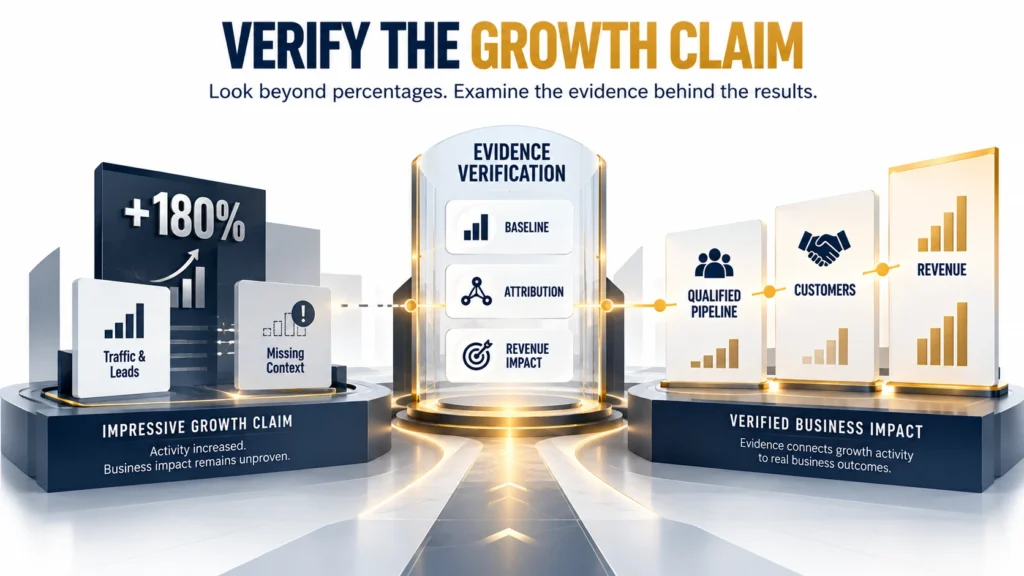
Growth consulting case studies can help founders evaluate whether a potential growth partner understands their business challenges and can connect strategy to measurable outcomes. However, impressive charts and headline growth percentages do not always tell the complete story. Effective growth strategy consulting should demonstrate how business decisions influenced pipeline quality, customer acquisition, conversion, and revenue performance.
For founders and CEOs, the objective is not to find the most impressive presentation. It is to identify evidence that a consultant can solve problems relevant to their business.
A B2B SaaS company struggling with rising customer acquisition costs needs different evidence from a professional services firm that depends heavily on referrals. Similarly, a startup entering the U.S. market needs proof of market understanding, positioning, and go-to-market execution.
This guide explains how to identify growth consulting case study red flags, assess business results, and verify claims before committing budget to a consulting engagement.
Why Case Studies Can Be Misleading
A growth consulting case study is a documented account of a business challenge, the intervention undertaken, and the results observed. A useful case study explains the starting conditions, strategic decisions, implementation process, measurement period, and business impact.
The problem arises when a case study emphasizes the outcome without explaining the conditions that produced it.
For example, a consultant might report that a SaaS company increased website traffic by 180%. That sounds promising, but it does not establish whether the company attracted qualified buyers, generated sales opportunities, or improved revenue.
Three common problems make case studies difficult to evaluate:
- Selective reporting: Only the strongest results are presented, while unsuccessful experiments and limitations are omitted.
- Unclear attribution: Results are credited to the consultant even though pricing changes, product improvements, sales hiring, or market conditions may have contributed.
- Missing baseline data: Percentage increases are presented without showing the original numbers, making the actual business impact difficult to judge.
Consider a U.S. B2B software company that reports a 100% increase in demo requests. If requests grew from 10 to 20 per month, the percentage increase is accurate, but the commercial significance depends on qualification, conversion, deal size, and sales capacity.
When conducting a brand growth consulting comparison, examine the quality of the evidence rather than the visual presentation or headline percentage.
A credible case study should answer five questions:
- What business problem existed before the engagement?
- What did the consultant actually change?
- How long did implementation take?
- What measurable outcomes followed?
- What evidence supports the claimed relationship between the intervention and the results?
If these questions remain unanswered, treat the case study as an initial discussion point rather than proof of performance.
Vanity Metrics vs Revenue Metrics
Vanity metrics are numbers that can look impressive without demonstrating meaningful business progress. Revenue metrics connect marketing and growth activity to commercial outcomes.
Neither category is automatically useless. Website traffic, impressions, and engagement can reveal useful patterns. The issue is treating these indicators as evidence of business success without showing what happened further down the funnel.
| Vanity or activity metric | Stronger business metric | What to investigate |
| Website traffic | Qualified opportunities generated | Did the additional visitors match the ideal customer profile? |
| Total leads | Sales-qualified leads | How many leads met agreed qualification criteria? |
| Social media impressions | Influenced pipeline | Did target accounts engage and progress toward a sales conversation? |
| Email open rate | Meetings and opportunities generated | Did outreach produce meaningful buyer engagement? |
| Cost per lead | Cost per qualified opportunity | Did lower acquisition costs preserve lead quality? |
| Demo requests | Demo-to-opportunity conversion | Did prospects enter the sales pipeline? |
| Number of campaigns | Revenue contribution and efficiency | Did execution improve commercial performance? |
A practical example
Imagine a U.S. professional services firm hires a consultant to improve inbound acquisition.
The case study reports the following illustrative results:
| Metric | Before | After |
| Monthly website visitors | 5,000 | 10,000 |
| Monthly leads | 100 | 200 |
| Qualified opportunities | 20 | 18 |
| New customers | 5 | 4 |
Traffic and lead volume doubled, but qualified opportunities and new customers declined. The additional activity did not translate into stronger commercial outcomes during the period measured.
This does not automatically mean the engagement failed. Sales-cycle delays, changes in qualification criteria, or a temporary shift toward earlier-stage prospects might explain the results. Those explanations, however, need evidence.
For revenue growth consulting, the stronger evaluation considers the complete acquisition process: lead quality, opportunity conversion, customer acquisition cost (CAC), sales-cycle length, average contract value, and revenue contribution.
For SaaS companies, retention and expansion revenue may also matter. For professional services firms, qualified consultations, proposal conversion, contract value, and sales-cycle duration may be more relevant.
Decision rule: If a case study celebrates marketing activity but cannot explain its connection to pipeline or revenue, request additional evidence before using it to assess a consultant’s capabilities.
Missing Context to Watch For
Even accurate numbers can create a misleading impression when important context is missing. Before trusting a case study, assess the following factors.
1. No clear starting point
A 200% improvement is difficult to interpret without baseline numbers. Ask whether the business started with limited activity, an established acquisition engine, or a temporary performance decline.
2. An unclear measurement period
A result achieved over three months is different from one achieved over two years. Confirm the reporting window and whether the comparison uses equivalent periods.
3. No explanation of the intervention
A case study should distinguish between strategy, implementation, and other business changes. Did the consultant refine positioning, improve qualification, redesign the funnel, introduce new acquisition channels, or simply manage existing campaigns?
4. Missing investment and cost information
A revenue increase does not necessarily mean improved profitability. Ask about media spend, consulting fees, additional staffing, technology costs, and other material expenses.
This is particularly important when evaluating a growth consulting cost breakdown. A low-cost engagement that generates unqualified leads may be less valuable than a more expensive engagement that improves pipeline efficiency, although the evidence must support that comparison.
5. Unclear attribution
Results often reflect contributions from multiple teams. A new sales leader, product launch, pricing change, or expansion into a new market could have influenced performance.
A responsible consultant should explain what they controlled, what other teams contributed, and what cannot be confidently attributed to the engagement.
6. Results that do not match your business
A large enterprise case study may not translate directly to a founder-led company with a smaller budget and limited internal resources.
For example, a Series B SaaS business with an established sales team has different operating conditions from a bootstrapped startup validating its first repeatable acquisition channel.
7. No explanation of what did not work
Real growth initiatives involve trade-offs and experiments. A case study that presents every decision as successful provides limited insight into the consultant’s judgment.
Look for explanations of failed experiments, adjustments made, limitations encountered, and lessons that influenced subsequent decisions.
These checks are also relevant when evaluating a growth consultant, a fractional growth consultant, or a digital growth agency. The key question is whether the evidence demonstrates relevant problem-solving ability, not simply whether the provider has published impressive results.
Questions to Ask About Any Case Study
A structured review helps founders evaluate consultants consistently instead of relying on presentation quality or personal confidence.
Use the following questions during a discovery call or evaluation process.
| Evaluation area | Questions to ask | Strong evidence looks like |
| Business problem | What specific problem was the client trying to solve? | A defined commercial challenge and baseline |
| Strategy | Why was this approach selected? | Clear reasoning linked to customer and market conditions |
| Execution | What did the consultant personally own? | Defined responsibilities and contributions |
| Measurement | Which metrics changed, and over what period? | Consistent definitions and comparable reporting |
| Revenue impact | How did results affect pipeline, customers, or revenue? | A documented connection to business outcomes |
| Economics | What costs and resources were involved? | Relevant investment and efficiency context |
| Attribution | What other factors influenced performance? | Transparent treatment of shared responsibility |
| Sustainability | Did results continue after the engagement? | Follow-up evidence or clear limitations |
Use a three-level evidence framework
Level 1: Activity evidence
The consultant demonstrates that work occurred, such as campaigns launched, pages optimized, or outreach programs implemented.
This establishes execution, but not effectiveness.
Level 2: Performance evidence
The consultant shows changes in conversion rates, qualified leads, opportunity creation, or acquisition efficiency.
This provides stronger evidence that the work influenced the growth process.
Level 3: Business outcome evidence
The consultant demonstrates how the work contributed to pipeline, customer acquisition, revenue, retention, or improved unit economics.
This is generally the most commercially relevant level, provided the measurement and attribution are credible.
Not every engagement can demonstrate immediate revenue impact. A positioning or market research project may initially be evaluated through validated buyer insights, improved conversion quality, or reduced strategic uncertainty. The consultant should explain how those intermediate outcomes support the larger business objective.
For founders comparing growth consulting services, use this framework alongside the proposed scope, reporting cadence, and definition of success.
How to Request Verifiable Proof
You do not need unrestricted access to another company’s confidential information to evaluate a case study. You do need a reasonable way to distinguish documented results from unsupported claims.
Follow this verification process before making a decision.
Step 1: Request the complete case study
Ask for the business challenge, baseline, intervention, timeline, results, and relevant limitations. A short public summary may be useful, but request additional context if the headline claims are insufficient.
Step 2: Clarify metric definitions
Ask what counts as a qualified lead, sales opportunity, converted customer, or attributed revenue. Confirm whether the figures represent total volume, percentage growth, influenced revenue, or directly attributed results.
Step 3: Request supporting evidence
Depending on the claim, this might include redacted analytics reports, CRM pipeline summaries, conversion reports, or an anonymized performance dashboard. Sensitive customer information does not need to be disclosed.
Step 4: Ask for a reference when appropriate
With the former client’s permission, request a conversation with a relevant decision-maker. Ask about the consultant’s role, communication, strategic judgment, implementation quality, and whether the work addressed the original problem.
Step 5: Test relevance to your business
Determine whether the case resembles your company’s stage, sales cycle, target audience, budget, and growth constraints. A successful approach in one market may require substantial adaptation in another.
Step 6: Review the proposed engagement
Connect the evidence to the work being proposed. A strong past result does not guarantee future performance, but relevant experience can help you assess the quality of the plan.
Also review potential growth consulting contract red flags, including vague deliverables, undefined responsibilities, unclear reporting expectations, and success criteria that depend entirely on activity rather than agreed business objectives.
A growth strategy consulting partner should be willing to explain how progress will be measured, what decisions the engagement will support, and how the team will respond if the initial approach underperforms.
For example, a founder considering go to market strategy consulting for U.S. expansion should request evidence of relevant market-entry experience, buyer research, positioning decisions, and pipeline development. General traffic growth from an unrelated industry is not equivalent proof.
GrowAnant approaches growth as a connected system of strategy, demand generation, and execution. That means evaluating success in the context of the client’s commercial objectives, rather than treating isolated campaign metrics as the final measure of progress.
Before selecting a growth partner, request a detailed explanation of the results most relevant to your business, the work behind those results, and the evidence available to support them.
References
- Salesforce, Customer Success Stories
- Harvard Business Review, Harvard Business Review
Frequently Asked Questions
Founders should watch for impressive percentages without baseline figures, missing measurement periods, vague descriptions of the consultant’s contribution, and claims that focus exclusively on traffic or lead volume. Other warning signs include no explanation of investment, unclear attribution, and an absence of verifiable evidence. Ask for the business context and how the reported results connect to qualified opportunities, customers, revenue, or efficiency.
Traffic and lead numbers are useful indicators, but they are not sufficient proof of business success. Traffic must be relevant to the target audience, and leads must meet appropriate qualification criteria. For a stronger assessment, examine the progression from visitors to qualified leads, sales opportunities, customers, and revenue. The most useful metrics depend on the engagement’s objectives and the company’s sales cycle.
Start by requesting baseline data, the measurement period, metric definitions, and a clear explanation of the work performed. Where appropriate, ask for redacted analytics or CRM reports and request a client reference with permission. Check whether the claimed outcomes align with the proposed engagement and whether other factors contributed to the results. If evidence is confidential, the consultant should explain what can be independently reviewed without exposing sensitive information.
Ask what the starting numbers were, how long the results took, what the consultant personally controlled, what the engagement cost, and how the results were measured. Then ask whether revenue or pipeline improved, what other business changes occurred, and whether the results continued afterward. These questions reveal whether a case study offers meaningful evidence or presents selected metrics without enough context to support the conclusion.