
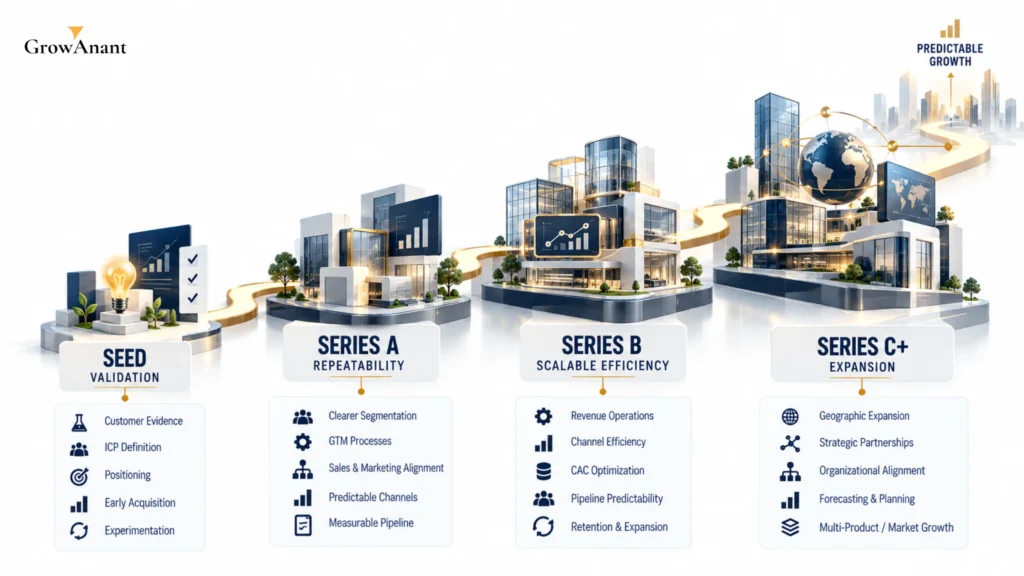
A company’s go-to-market requirements change significantly as it moves from Seed to Series C. A Seed startup may still be validating its ICP and positioning, while a company looking for a series a gtm consultant may be trying to turn early traction into a repeatable acquisition and sales model. By Series B and Series C, the focus shifts toward scaling proven motions, entering markets, improving efficiency, and building organizational systems.
This is why go to market strategy consulting should not be treated as a standardized playbook. The right GTM priorities depend on the company’s stage, product maturity, market evidence, sales motion, team capabilities, and growth expectations.
A useful principle is:
Early-stage GTM is about finding what works. Later-stage GTM is about making what works repeatable, efficient, and scalable.
For founders, the important question is therefore not simply whether they need a startup gtm consultant. It is what kind of GTM problem the business needs to solve at its current stage.
Seed Stage GTM Priorities
At Seed stage, the primary GTM objective is usually validation.
The company may have a product, early customers, or initial market signals, but it may not yet know which customer segment, message, channel, and sales motion can support repeatable growth.
Seed-stage GTM should therefore focus on learning before scaling.
Core Seed priorities
- Define and validate the ICP
- Identify the strongest customer problem
- Test positioning
- Understand buying triggers
- Validate pricing assumptions
- Identify early acquisition channels
- Build an initial sales process
- Establish basic funnel measurement
- Document customer feedback
- Determine whether the GTM motion is repeatable
| Seed Question | What the Company Needs to Learn |
| Who buys? | Best-fit customer segment |
| Why do they buy? | Core problem and trigger |
| Why do they choose us? | Differentiation |
| How do they discover us? | Acquisition channels |
| How do they evaluate us? | Buying process |
| What prevents purchase? | Objections and friction |
| Can we repeat the motion? | Early GTM evidence |
A common Seed mistake is investing heavily in scaling acquisition before understanding whether the underlying GTM assumptions are correct.
For example, a SaaS startup might invest in paid acquisition while still changing its ICP every few weeks. More traffic will not resolve an unresolved market-selection problem.
At this stage, growth strategy consulting should create learning velocity rather than unnecessary complexity.
The same applies to a company considering startup consulting services USA. The priority should be establishing evidence for the business model and GTM motion before building a large marketing organization.
Series A GTM Priorities
Series A is often the point where GTM expectations begin to change.
The company may have evidence of product-market fit, early customers, and a clearer ICP. The question becomes whether that early success can be turned into a repeatable growth system.
This is where a series a gtm consultant can help leadership move from experimentation toward structured GTM execution.
Core Series A priorities
- Refine ICP segmentation.
- Establish repeatable acquisition channels.
- Strengthen positioning and messaging.
- Build a predictable sales process.
- Align marketing and sales.
- Improve funnel conversion.
- Establish meaningful pipeline reporting.
- Create a scalable GTM roadmap.
The key transition is:
Seed: “Can we acquire customers?”
Series A: “Can we acquire the right customers repeatedly?”
A Series A SaaS company, for example, may discover that customers from one industry have higher retention and faster sales cycles than customers from other segments.
The GTM strategy should respond to that evidence.
Instead of treating every potential customer equally, leadership can prioritize the segment with stronger commercial economics.
Series A diagnostic checklist
- Is the ICP supported by customer evidence?
- Which acquisition channels produce qualified pipeline?
- Are sales and marketing using the same ICP?
- Is positioning consistent across channels?
- Can the sales process be documented?
- Are conversion rates visible by stage?
- Is CAC understood by segment?
- Can the company forecast pipeline with reasonable confidence?
This is where growth roadmap consulting becomes useful. The objective is to create a prioritized sequence of GTM investments rather than allowing every potential channel to compete for budget.
Series B GTM Priorities
By Series B, the question is usually no longer whether the company has found some form of product-market fit.
The challenge becomes scaling efficiently without breaking the GTM system.
A Series B company may have a larger sales organization, marketing team, established acquisition channels, and multiple customer segments.
That introduces a new set of problems.
Core Series B priorities
- Scale proven acquisition channels
- Improve CAC efficiency
- Strengthen sales and marketing alignment
- Expand into adjacent segments
- Improve pipeline predictability
- Build revenue operations
- Standardize GTM processes
- Improve retention and expansion
- Strengthen management reporting
- Test new markets systematically
A series b company may have enough historical data to make more informed decisions about channel economics and customer segmentation.
For example, a B2B SaaS company might discover that enterprise accounts generate larger contracts but require substantially longer sales cycles. Leadership then needs to determine whether the organization should continue optimizing for mid-market velocity, invest in enterprise sales capabilities, or operate separate motions.
This is no longer simply a marketing question.
It is a business model and GTM design question.
A mature business growth consulting engagement at this stage may therefore involve marketing, sales, customer success, pricing, segmentation, and revenue operations.
Series C and Beyond
Series C and later-stage companies generally need a different type of GTM discipline.
The business may have substantial revenue, larger teams, multiple markets, and several acquisition channels.
The challenge is often scale with control.
At this stage, GTM consulting may focus on:
- Geographic expansion
- New market entry
- Segment expansion
- Product expansion
- Channel partnerships
- International GTM
- Revenue efficiency
- Organizational design
- Customer expansion
- Forecasting
- Attribution
- GTM governance
- Portfolio-level investment decisions
For companies entering the United States, market entry strategy USA may become a major component of the GTM roadmap.
A company expanding into the U.S. should not simply replicate its existing international strategy. It may need to validate the U.S. ICP, competitive environment, pricing expectations, sales channels, partnerships, positioning, and buyer behavior.
A company considering market sizing vendors for us launch may use external market research as one input, but the GTM decision should connect market size to reachable customers, commercial economics, competitive intensity, and execution capability.
Stage progression
| Stage | Primary GTM Question | Main Priority |
| Seed | Can we find a repeatable customer motion? | Validation |
| Series A | Can we repeat acquisition? | Repeatability |
| Series B | Can we scale efficiently? | Efficiency |
| Series C+ | Can we scale across markets and segments? | Optimization and expansion |
The maturity shift is important.
A strategy that worked at Seed may become inefficient at Series B.
A sales process that worked at Series A may become difficult to manage at Series C.
The GTM system has to evolve with the company.
What Type of GTM Partner Fits Each Stage
The appropriate external partner should match the company’s actual constraint.
| Stage | Appropriate Partner Profile | Primary Need |
| Seed | Strategic advisor or startup gtm consultant | Validation |
| Series A | series a gtm consultant or growth strategist | Repeatability |
| Series B | GTM strategist and growth operator | Scaling |
| Series C+ | Senior GTM advisor or transformation partner | Expansion and efficiency |
A Seed company may need a consultant who can challenge assumptions and conduct focused customer and market analysis.
A Series A company may need someone who can turn validated learning into a structured GTM model.
A Series B company may benefit from an embedded growth team or growth operator who can work across marketing, sales, analytics, and leadership.
A Series C company may require strategic support for market expansion, organizational alignment, revenue efficiency, or complex GTM transformation.
The partner’s operating model should also match the internal team.
If a company already has capable marketing and sales specialists but lacks senior direction, fractional growth leadership can be more useful than adding another execution-focused resource.
If the organization lacks basic marketing capabilities, a more hands-on model may be necessary.
This distinction matters when evaluating growth consulting services, SaaS growth consulting, or a digital growth agency.
The question should always be:
What capability is missing, and what level of ownership does the business require?
Common Stage-Mismatch Mistakes
Many GTM problems are caused not by a lack of effort but by applying the wrong strategy to the company’s stage.
1. Scaling before validating
Seed companies sometimes increase paid acquisition before validating the ICP, positioning, or sales motion.
Why it fails: More acquisition amplifies unresolved GTM problems.
2. Treating Series A like Seed
A Series A company may continue experimenting indefinitely without building repeatable processes.
Why it fails: Learning is valuable, but the organization eventually needs systems that turn successful experiments into repeatable execution.
3. Scaling channels without economics
Series B companies may increase spending because a channel generates leads without understanding customer quality, CAC, conversion, or payback.
Why it fails: Revenue growth without economic discipline can create an inefficient growth engine.
4. Entering markets without localized GTM
A company entering the U.S. may assume its existing positioning and acquisition model will transfer directly.
Why it fails: Market dynamics, competition, buyer expectations, pricing, and sales processes may differ.
5. Adding specialists without strategic ownership
Companies sometimes respond to growth problems by hiring more channel specialists.
Why it fails: More specialists do not automatically create a unified growth strategy.
6. Measuring activity instead of business outcomes
Traffic, leads, impressions, and campaign activity can increase while qualified pipeline remains flat.
Why it fails: Activity is not the same as commercial progress.
A practical stage-mismatch test is:
| Question | If “No” |
| Is our ICP validated? | Prioritize market and customer learning |
| Is our positioning clear? | Fix positioning before scaling |
| Is our acquisition motion repeatable? | Focus on channel and funnel validation |
| Can we measure pipeline? | Improve GTM measurement |
| Are unit economics understood? | Prioritize efficiency |
| Can our organization support scale? | Strengthen GTM operating systems |
| Are we ready for new markets? | Conduct market and GTM validation |
GrowAnant approaches these stage differences through strategy-first growth consulting services, helping growth-stage companies connect GTM planning, demand generation, execution, and revenue priorities rather than applying the same marketing playbook at every stage.
The core principle is straightforward:
GTM strategy should mature at the same pace as the business.
At Seed, the company needs evidence.
At Series A, it needs repeatability.
At Series B, it needs scalable efficiency.
At Series C and beyond, it needs disciplined expansion and organizational alignment.
That progression should determine both the GTM roadmap and the type of strategic partner the company brings into the business.
Frequently Asked Questions
Yes. GTM priorities generally evolve as the company matures. Seed companies typically focus on validating ICP, positioning, and acquisition assumptions. Series A companies focus on repeatability. Series B companies focus on efficient scaling, while Series C companies often prioritize market expansion, organizational alignment, and revenue efficiency.
The most important Seed priorities are ICP validation, customer problem validation, positioning, buying triggers, early acquisition channels, pricing assumptions, and evidence that the sales motion can become repeatable. The objective is learning what works before investing heavily in scale.
A company should consider dedicated GTM support when founders or internal teams lack the strategic capacity to define, validate, or scale the go-to-market model. The need often becomes more pronounced when the company is preparing for a major growth stage, entering a new market, experiencing inconsistent pipeline, or struggling to align marketing and sales.
Series A GTM typically focuses on creating a repeatable acquisition and sales model. Series C GTM is more likely to involve scaling across segments or markets, improving revenue efficiency, strengthening organizational systems, expanding customer relationships, and managing a more complex GTM operation.