
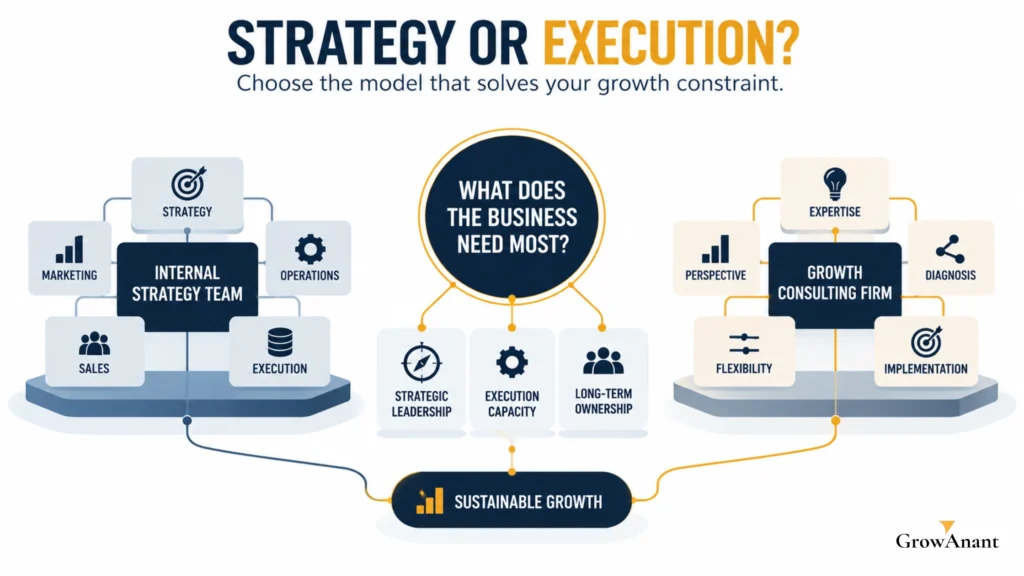
If you are asking should i hire a growth consulting firm or build an internal strategy team, the answer depends on your company’s growth stage, internal capabilities, budget, and need for strategic leadership. An internal team provides long-term organizational knowledge and ownership, while a consulting firm can bring specialized expertise, an external perspective, and structured guidance without requiring multiple permanent hires.
For a growth-stage B2B SaaS company, the challenge may be inconsistent pipeline despite ongoing marketing activity. For a professional services firm, it may be dependence on referrals and a lack of repeatable customer acquisition. Both need a clear growth strategy, but they may not need the same staffing model.
The decision between growth strategy consulting vs hiring internal team should begin with one question: What is preventing the business from growing predictably? If the problem is unclear strategy, fragmented execution, or limited senior leadership, a consulting engagement may be the right starting point. If the strategy is established but requires continuous ownership, an internal team may be the stronger long-term investment.
What an Internal Strategy Team Provides
An internal strategy team works within the organization to develop growth plans, coordinate business functions, track performance, and support long-term decision-making. Depending on its composition, it may include a strategy leader, growth managers, marketing analysts, and specialists who work closely with sales, product, and finance.
Its greatest advantage is continuity. Internal employees develop an understanding of the company’s customers, products, culture, competitive position, and operational constraints over time.
An internal team can provide:
- Continuous ownership of strategic priorities and performance reviews.
- Direct access to customer, sales, product, and financial information.
- Long-term coordination between marketing, sales, and leadership.
- Institutional knowledge that remains within the company.
- Ongoing experimentation and refinement of the growth model.
Consider a U.S. SaaS company with a validated market, a functioning sales process, and several acquisition channels. It now needs to improve conversion rates, manage acquisition costs, and coordinate quarterly growth initiatives. An internal strategy team can continuously monitor performance and adjust priorities as the business evolves.
However, hiring internally does not automatically solve strategic problems. A company can employ several capable marketers and still lack a coherent growth plan if nobody owns the relationship between positioning, demand generation, pipeline, and revenue.
Internal teams also require recruitment, onboarding, management, and professional development. A senior strategy hire may need additional analysts or execution specialists to implement recommendations.
For founders evaluating growth consulting services or internal hiring, the key question is whether the organization needs permanent ownership, external expertise, additional execution capacity, or a combination of these capabilities.
What a Growth Consulting Firm Provides
A growth consulting firm helps businesses diagnose growth constraints, define strategic priorities, and establish a practical roadmap connecting business objectives to execution. Depending on the engagement, it may also provide hands-on implementation and ongoing growth leadership.
Unlike an internal team that develops organizational knowledge over time, a consulting firm can bring experience from comparable business challenges, established diagnostic frameworks, and specialized capabilities that may not exist internally.
Typical contributions include:
- Assessing the current growth model, customer acquisition process, and revenue constraints.
- Refining ideal customer profiles, positioning, and go-to-market priorities.
- Identifying weaknesses in demand generation, conversion, and pipeline management.
- Establishing performance metrics and accountability structures.
- Helping leadership prioritize investments and coordinate execution.
- Supporting implementation through specialist resources or fractional leadership.
For example, a founder-led U.S. professional services company may have a capable delivery team but an inconsistent pipeline. A growth consultant can assess its referral dependence, target segments, messaging, lead qualification, and sales process before recommending a focused acquisition strategy.
The benefit is access to strategic experience without immediately committing to a permanent senior hire. This can be especially useful when the company is uncertain about which leadership role or capabilities it needs.
However, consulting has limitations. An external partner requires access to relevant information, cooperation from internal stakeholders, and clear decision-making authority. If the engagement only produces recommendations without implementation ownership, the company may still lack the resources to execute them.
A fractional growth consultant or consulting firm can help bridge this gap when the scope includes ongoing leadership, coordination, and performance reviews.
The right partner should also explain its methodology, responsibilities, assumptions, and evidence of relevant experience. Reviewing growth consulting case study red flags, conducting a growth consulting reference check, and understanding potential growth consulting contract red flags can help founders assess whether a provider is suitable for the business.
Cost Comparison Over Time
The financial comparison should include more than a consulting fee or an employee’s salary. Internal hiring creates ongoing employment costs, while consulting costs depend on the scope, duration, and level of involvement.
| Cost factor | Internal strategy team | Growth consulting firm |
| Compensation | Salary and potential bonuses | Contract or retainer fees |
| Benefits and employment costs | Employer taxes, benefits, and other applicable costs | Usually included in the agreed commercial fee, subject to contract terms |
| Recruitment | Sourcing, interviewing, and hiring expenses | Vendor evaluation and onboarding time |
| Ramp-up | Time required to learn the business | Time required to understand the business and access relevant data |
| Expertise | Depends on the people hired | Access to the capabilities included in the engagement |
| Execution resources | Additional hires may be required | May be included or priced separately |
| Long-term ownership | Strong organizational continuity | Depends on engagement duration and knowledge transfer |
An illustrative cost comparison
Suppose a company is considering hiring one senior growth strategist or engaging a consulting firm for a defined period.
The internal option may involve salary, benefits, recruitment, onboarding, and additional execution resources. The consulting option may involve a monthly retainer, a defined project fee, or a fractional leadership arrangement.
The company should model the full cost of each option over the same time horizon.
For internal hiring, include:
- Annual compensation and employer costs.
- Recruitment and onboarding expenses.
- Tools, training, and specialist support.
- Management time and expected ramp-up.
- Additional hires required to execute the strategy.
For consulting, include:
- Initial diagnostic or strategy fees.
- Recurring advisory or implementation costs.
- Any separately billed specialist work.
- Internal time required to support the engagement.
- Transition and knowledge-transfer costs.
A useful growth consulting cost breakdown compares these expenses against the business problem being solved, not just the immediate cash outlay.
A consulting engagement may be appropriate when a company needs senior expertise for a specific period. Internal hiring may become more economical when the need is continuous, the responsibilities are clearly defined, and the company can support the role.
Neither model guarantees better returns. The decision should reflect the required capabilities, expected duration, and cost of leaving the growth problem unresolved.
Speed and Objectivity Trade-Offs
Internal teams and consulting firms offer different advantages in decision-making and execution.
Internal teams generally have easier access to organizational context and can remain involved in daily operations. Consulting firms can introduce an outside perspective, challenge existing assumptions, and help leadership evaluate options without being as closely tied to internal routines.
| Factor | Internal strategy team | Growth consulting firm |
| Organizational knowledge | Develops deeply over time | Must learn the business |
| External perspective | May be influenced by internal assumptions | Can challenge established thinking |
| Decision speed | Depends on internal processes and authority | Can accelerate diagnosis when access and decisions are available |
| Execution continuity | Embedded in daily operations | Depends on scope and engagement length |
| Specialized expertise | Limited to hired capabilities and available resources | Can access broader expertise if included in the engagement |
| Long-term ownership | Strong | Requires transition or ongoing engagement |
Objectivity matters when a company has invested heavily in a strategy that is no longer working. For example, a SaaS company may continue spending on a channel because it historically generated leads, even though qualified opportunities have declined.
An external advisor can question that assumption and evaluate whether the real constraint lies in targeting, messaging, sales follow-up, or conversion. An internal team can then provide the context needed to determine which changes are practical.
However, external perspective is not automatically superior. Consultants can make incorrect assumptions if they lack customer knowledge or access to internal data. Internal employees often understand operational realities that an outside partner cannot see immediately.
The strongest model combines internal context with objective evaluation and clear accountability.
A Decision Framework
Use the following framework to determine which model best fits your current business needs.
| Business condition | Recommended starting point | Reason |
| Growth strategy is unclear | Growth consulting firm | Diagnose constraints and establish priorities |
| Internal team lacks senior strategic direction | Fractional growth leader or consulting firm | Add leadership without immediately building a full department |
| Strategy is clear but execution capacity is limited | Internal hiring or specialist execution support | Fill specific operational gaps |
| Growth requires continuous cross-functional coordination | Internal strategy leader | Establish ongoing ownership and continuity |
| Business is entering the U.S. market | Consulting support, potentially followed by internal hiring | Validate market assumptions before expanding permanent resources |
| Growth system is established and scaling | Internal team, with external support where needed | Maintain continuous execution and improve the operating model |
Before making the decision, answer these five questions:
1. Is the growth problem clearly defined? If not, begin with diagnosis rather than hiring several specialists.
2. Is the capability needed continuously? Recurring responsibilities may justify internal ownership, while a defined strategic challenge may suit a consulting engagement.
3. Does the company have execution capacity? Strategy without implementation resources will struggle to create business impact.
4. Is senior leadership missing? If teams are busy but priorities remain fragmented, the first requirement may be strategic leadership rather than more activity.
5. Can the investment be sustained? Consider total costs, available cash, internal management capacity, and the consequences of delaying action.
For many growth-stage companies, the most practical approach is sequential. First, clarify the strategy and diagnose the constraint. Next, establish the required capabilities and responsibilities. Then decide which roles should remain external and which should become permanent internal positions.
GrowAnant’s strategy-first approach follows this logic by connecting growth planning, demand generation, and execution to measurable business priorities. The aim is to help companies build a growth system that fits their stage, rather than assume every business needs the same organizational structure.
CTA recommendation: Compare Strategy Team Options
Compare the models against your current growth constraints, leadership gaps, execution requirements, and budget. Choose the structure that provides the capabilities you need while preserving clear ownership of business outcomes.
References
- Harvard Business Review, Harvard Business Review
- U.S. Small Business Administration, Business Guide
Frequently Asked Questions
An internal team often provides stronger long-term continuity because its members remain embedded in daily operations and develop institutional knowledge. A consulting firm can provide specialized expertise, objective diagnosis, and flexible support. The better choice depends on whether the business needs continuous ownership, temporary strategic guidance, or a combination of both.
The cost depends on the role’s seniority, location, experience, and responsibilities. Total employer cost can include salary, bonuses, benefits, payroll expenses, recruitment, onboarding, and tools. Companies should use current compensation benchmarks for their target location and compare the full employment cost with the scope and duration of a consulting engagement.
Neither is universally more important. Objectivity helps challenge assumptions and identify overlooked problems, while internal context helps ensure recommendations reflect customer needs, operational constraints, and company priorities. The strongest decisions combine external perspective with reliable internal information and direct input from the teams responsible for implementation.
Yes. A consulting firm can help establish the growth strategy, diagnose constraints, or provide fractional leadership while an internal team manages daily execution and long-term ownership. Responsibilities should be clearly defined, with agreed priorities, performance measures, decision rights, and knowledge-transfer processes to prevent duplication and maintain accountability.