
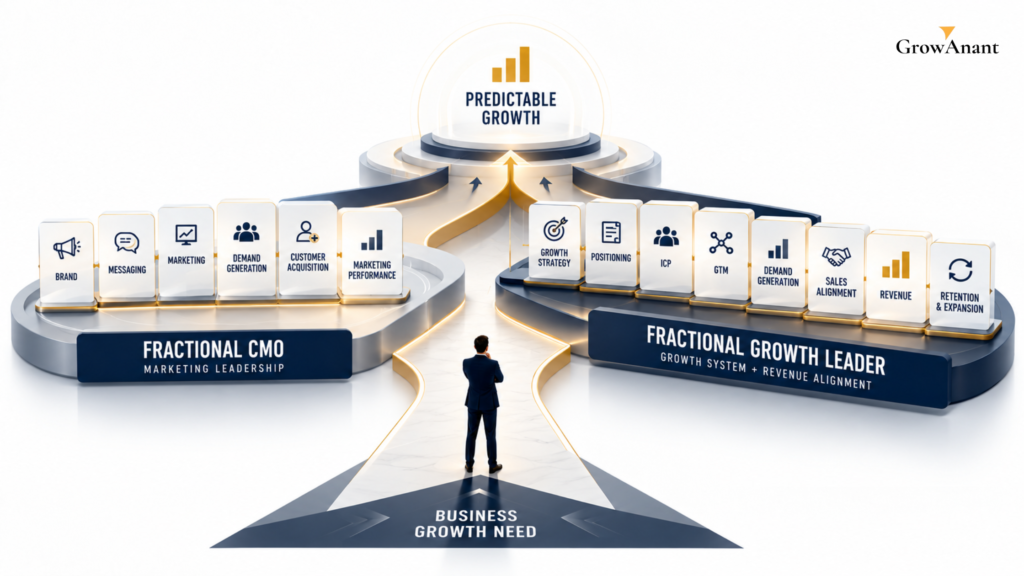
The difference between a fractional cmo vs fractional growth leader is less about the title and more about what the business needs that executive to own. A fractional CMO typically leads marketing, brand, customer acquisition, and marketing performance. A growth leader usually has a broader mandate across strategy, positioning, demand generation, go-to-market, customer acquisition, and revenue growth.
For a founder deciding between fractional growth leadership and traditional marketing leadership, the important question is not “Which title sounds better?” It is:
What growth problem does the company need an executive to solve?
This distinction becomes particularly important when a company already has marketers and execution resources but lacks strategic direction, cross-functional alignment, or clear ownership of the growth system.
McKinsey research also shows that marketing leadership is increasingly expected to connect brand, growth opportunities, technology, commercial priorities, and business outcomes rather than operate as an isolated function.
What a Fractional CMO Focuses On
A fractional CMO is typically responsible for leading the marketing function without requiring the company to hire a full-time C-suite marketing executive.
The traditional CMO mandate usually includes:
- Marketing strategy
- Brand positioning
- Messaging
- Content
- Demand generation
- Marketing channels
- Customer acquisition
- Marketing performance
- Marketing team leadership
- Budget management
- Marketing technology
- Reporting and measurement
A fractional CMO can be particularly valuable when the company knows its market and business model but needs senior marketing leadership to professionalize the function.
For example, consider a U.S. B2B SaaS company with a strong product, an established ICP, and several junior marketers. The company may have plenty of marketing activity but no senior person setting priorities, allocating budget, establishing measurement standards, and aligning marketing with the CEO’s growth objectives.
That is a classic fractional CMO requirement.
The same can apply to a health tech fractional CMO engagement. A health technology company may need stronger brand credibility, messaging, content, customer acquisition, and marketing governance while operating within a complex buying environment.
A fractional CMO’s core question is generally:
“How do we build and lead a marketing function that contributes more effectively to business growth?”
That can include growth responsibilities, but the center of gravity remains marketing.
What a Fractional Growth Leader Focuses On
A fractional growth leader operates with a broader mandate.
The role may cover marketing, but it is not necessarily limited to marketing. Fractional growth leadership focuses on the complete system through which a company creates, captures, converts, and expands demand.
A fractional growth consultant, fractional chief growth officer, or fractional head of growth may therefore work across:
- Growth strategy
- Market selection
- ICP definition
- Positioning
- Demand generation
- GTM strategy
- Customer acquisition
- Sales and marketing alignment
- Funnel optimization
- Revenue analytics
- Customer retention
- Expansion opportunities
- Growth experimentation
- Strategic planning
The central question becomes:
“What needs to change across the growth system to create more sustainable revenue?”
Consider a funded SaaS startup that has marketing, sales, and product teams but is struggling to determine which customer segment to prioritize. Marketing is generating leads, sales is pursuing opportunities, and product is building features, but the functions are not operating from one growth strategy.
Adding another marketing leader may not solve the fundamental problem.
The company may need broader growth strategy consulting, GTM prioritization, segmentation, positioning, demand generation, and cross-functional coordination.
That is where a growth leader’s mandate becomes more relevant.
Brand vs Revenue Ownership
The most useful way to distinguish these roles is by looking at what each executive is ultimately expected to influence.
| Responsibility | Fractional CMO | Fractional Growth Leader |
| Brand strategy | Primary | Strategic |
| Messaging | Primary | Strategic |
| Marketing strategy | Primary | Shared |
| Demand generation | Primary | Primary |
| GTM strategy | Often involved | Primary |
| ICP definition | Often involved | Primary |
| Sales alignment | Strong | Strong |
| Revenue strategy | Influences | Often owns strategically |
| Funnel optimization | Marketing focus | End-to-end |
| Customer acquisition | Primary | Primary |
| Retention and expansion | May support | Often involved |
| Product-market alignment | Usually indirect | Often strategic |
| Growth roadmap | Marketing roadmap | Business growth roadmap |
| Cross-functional leadership | Marketing-centered | Growth-centered |
This does not mean a CMO cannot own revenue outcomes.
The modern CMO role has expanded considerably. McKinsey notes that marketing leaders are increasingly expected to identify growth opportunities, connect marketing to business outcomes, and work across functions beyond traditional marketing responsibilities.
The difference is therefore one of default mandate.
A fractional CMO generally starts with the marketing organization and expands outward.
A fractional growth leader generally starts with the growth objective and works backward across functions.
This distinction is especially relevant when evaluating growth consulting services, revenue growth consulting, or an embedded growth team.
Industry Patterns in FinTech and HealthTech
Industry context can influence which title companies search for, even when the underlying growth problem is broader.
FinTech companies, for example, often search for a fintech fractional CMO because marketing leadership can be closely associated with trust, brand credibility, customer acquisition, partnerships, and regulated-market communications.
A fintech startup may need to establish credibility before scaling acquisition. Its marketing leader may therefore need to coordinate brand, content, demand generation, partnerships, and customer communication.
HealthTech presents a similar pattern.
A health tech fractional CMO may be expected to understand complex buyer groups, longer decision cycles, trust requirements, provider or enterprise audiences, and the difference between user acquisition and organizational adoption.
But industry-specific marketing needs do not necessarily mean the role should remain marketing-only.
For example, a HealthTech company selling to hospitals may need to solve a broader commercial challenge involving:
Market segment → Buyer → Positioning → GTM → Demand → Sales → Adoption
If the executive is expected to influence this entire chain, the business may actually need broader fractional growth leadership.
The same applies to a FinTech company entering a new U.S. segment. If the assignment includes market selection, competitive positioning, acquisition economics, partnerships, sales alignment, and revenue planning, the mandate is broader than traditional marketing.
The title should reflect the actual responsibility.
Which Title to Search For
Founders often begin with the title they recognize rather than the problem they need to solve.
A better approach is to search according to the business constraint.
| Business Need | Search Term to Consider |
| Marketing function needs senior leadership | Fractional CMO |
| Brand and messaging need direction | Fractional CMO |
| Marketing team needs management | Fractional CMO |
| Demand generation needs improvement | Fractional CMO or Growth Leader |
| GTM strategy is unclear | Fractional Growth Leader |
| ICP and positioning are unclear | Fractional Growth Leader |
| Marketing and sales are disconnected | Fractional Growth Leader |
| Revenue growth lacks strategic ownership | Fractional Growth Leader |
| Company is entering a new market | Fractional Growth Leader |
| Multiple functions lack one growth strategy | Fractional Growth Leader |
| Existing execution team lacks senior direction | Fractional Growth Leader |
This is also why searches such as fractional cro vs fractional cgo and fractional cmo vs fractional growth leader can produce overlapping results.
Titles increasingly overlap because executive marketing roles themselves are becoming broader.
The better search strategy is to define the mandate first.
For example:
- Need marketing leadership → search for a fractional CMO.
- Need broader growth ownership → search for a fractional growth consultant.
- Need executive growth strategy → consider a fractional chief growth officer.
- Need hands-on growth leadership → consider a fractional head of growth or growth operator.
The goal is to find the executive whose expertise matches the constraint, not simply the person with the most familiar title.
Decision Framework
Use this framework before deciding which role to hire.
Choose a fractional CMO when:
- The company has a defined market.
- Positioning is reasonably clear.
- Marketing leadership is the primary gap.
- Brand and messaging need improvement.
- Marketing execution lacks strategic direction.
- The marketing team needs senior leadership.
- Marketing performance and budget accountability need improvement.
- The CEO needs an experienced marketing leader without hiring full-time.
Choose a fractional growth leader when:
- The company lacks an integrated growth strategy.
- ICP or segmentation is unclear.
- Positioning and GTM need strategic work.
- Marketing and sales are disconnected.
- Demand generation is inconsistent.
- The company is entering a new market.
- Multiple functions contribute to growth but lack shared ownership.
- Revenue growth is the central executive concern.
- The organization has execution resources but lacks senior growth leadership.
Decision tree
What is the primary constraint?
Marketing leadership?
→ Consider a Fractional CMO.
Broader growth strategy?
→ Consider a Fractional Growth Leader.
Sales and revenue execution?
→ Consider whether a CRO-oriented role is more appropriate.
Marketing, sales, product, and GTM are disconnected?
→ Consider broader fractional growth leadership.
Need both marketing execution and strategic growth direction?
→ Define a combined mandate before deciding on the title.
The final decision should also consider the company’s stage.
A founder-led professional services business may need a hands-on growth operator who can establish the foundation.
A Series A SaaS company may need a growth leader to connect positioning, demand generation, and GTM.
A larger organization with an established marketing function may benefit more from a fractional CMO focused on marketing leadership.
GrowAnant approaches these situations through strategy-first growth consulting services, connecting growth strategy, demand generation, GTM planning, and revenue-focused execution when the business requires broader ownership.
The principle is straightforward:
Hire the executive for the growth problem you have, not the title you recognize.
For some companies, that person is a fractional CMO. For others, it is a fractional growth leader. The distinction becomes clear when the company defines what the executive is actually accountable for.
References
McKinsey & Company
Connecting for growth: A makeover for your marketing operating model
Deloitte Insights
From brand steward to growth architect: The bank CMO agenda for the AI age
Frequently Asked Questions
No. A fractional CMO primarily leads the marketing function, including brand, messaging, demand generation, acquisition, marketing performance, and team leadership. A fractional growth leader typically has a broader mandate across strategy, positioning, GTM, demand generation, customer acquisition, and revenue growth.
FinTech and HealthTech companies often associate the CMO role with trust, brand credibility, customer acquisition, messaging, and complex market communications. However, if the company’s challenge extends into market selection, GTM strategy, sales alignment, or broader revenue growth, a growth leadership mandate may be more appropriate.
A fractional CMO will typically have direct ownership of brand positioning and messaging. A fractional growth leader may also own or significantly influence positioning when it is directly connected to ICP definition, differentiation, GTM strategy, and revenue growth.
Yes. A company can need both marketing leadership and broader growth leadership, particularly as the organization becomes more complex. However, smaller or growth-stage companies may be able to combine these responsibilities under one executive if the mandate, decision rights, KPIs, and reporting structure are clearly defined.