
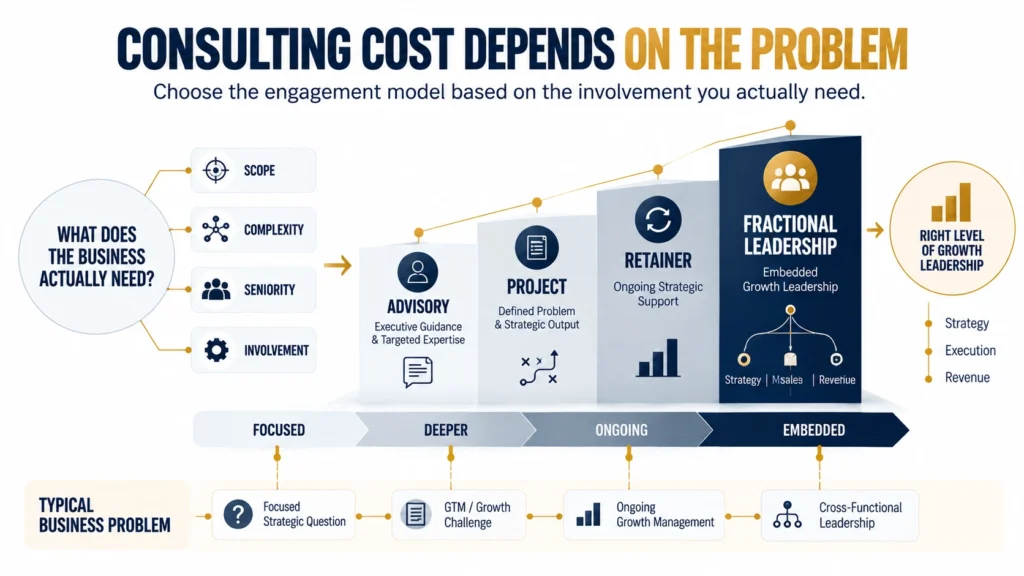
If you are researching a growth consulting cost breakdown, the first thing to understand is that there is no universal consulting price. A growth consultant may charge hourly, by project, through a monthly retainer, or through a fractional leadership arrangement depending on the complexity of the business problem and level of involvement required.
For founders evaluating growth consulting services, the more useful question is not simply, “What is the hourly rate?” It is:
What level of strategic involvement does the business actually need, and what should that engagement accomplish?
A focused diagnostic may require a few thousand dollars, while ongoing growth strategy consulting or fractional leadership can require a substantially larger investment. The right benchmark depends on scope, seniority, business stage, and whether the consultant is providing advice alone or helping lead execution.
Why Growth Consulting Pricing Is Rarely Public
Unlike standardized software or advertising platforms, consulting is difficult to price from a simple rate card.
Two companies could both ask for business growth consulting but have completely different requirements.
One may need a two-week GTM assessment. Another may need market research, positioning, demand generation, sales alignment, reporting, and ongoing executive leadership.
Several factors make consulting pricing less transparent:
- Scope changes from company to company.
- Senior consultants may spend limited but highly valuable time on the engagement.
- Some engagements are strategic while others include execution.
- Business complexity affects the amount of analysis required.
- The level of access to leadership changes the engagement model.
- U.S. market expansion can require additional research and GTM work.
- Some firms price around deliverables while others price around ongoing access or outcomes.
This is why comparing a digital growth agency with a senior growth consultant solely on monthly cost can be misleading.
Professional services can also use different commercial structures, including retainers and arrangements where clients purchase ongoing advisory capacity or defined outputs. Deloitte, for example, describes retained advisory models where clients buy specialized expertise and ongoing support rather than simply purchasing individual hours.
The practical implication is simple:
Price should be evaluated against scope and business problem, not just the number on the proposal.
Typical Hourly and Project Rates
Hourly consulting is generally most appropriate when the company needs limited access to expertise rather than a broader transformation.
For U.S.-focused planning purposes, a reasonable market benchmark for independent or boutique growth consulting can look approximately like this:
| Engagement Type | Typical Planning Range | Best Used For |
| Advisory consultation | 150-350/hour | Executive guidance or focused expertise |
| Senior growth consulting | 250-500/hour | Strategy, GTM, positioning, growth diagnostics |
| Specialized executive consulting | 400-750+/hour | Complex commercial or leadership problems |
| Focused diagnostic project | 3,000-10,000+ | Audit, assessment, or strategic diagnosis |
| Growth strategy project | 8,000-25,000+ | Strategy, roadmap, positioning, GTM planning |
| Comprehensive GTM engagement | 15,000-40,000+ | Market, positioning, channels, sales alignment |
These are planning ranges, not guaranteed market prices or standardized industry rates.
A project-based engagement is often more useful than hourly billing when the company knows what problem it needs solved.
For example, a B2B SaaS company preparing for a new U.S. market launch may commission a defined strategy covering ICP validation, positioning, competitive analysis, channel priorities, and a GTM roadmap.
The business can then evaluate the engagement based on the quality and usefulness of the strategic output rather than counting consultant hours.
This is also where growth consulting case study red flags become important. If a provider presents impressive outcomes but cannot explain the original business problem, scope, timeframe, methodology, or client context, the case study provides limited evidence for evaluating the engagement.
Typical Retainer Ranges
Retainers become more relevant when growth requires ongoing strategic involvement.
A typical U.S. planning range for boutique or independent growth consulting may look like:
| Monthly Retainer | Typical Scope |
| 3,000-7,500/month | Advisory, strategic reviews, limited consulting |
| 7,500-15,000/month | Ongoing strategy, planning, analytics, selected execution oversight |
| 15,000-30,000/month | Embedded growth leadership and broader execution coordination |
| $30,000+/month | High-complexity transformation or substantial senior involvement |
Again, these are planning benchmarks rather than published universal rates.
The biggest difference between these levels is usually depth of involvement, not simply the number of deliverables.
A $5,000 monthly engagement might provide strategic direction and periodic advisory sessions.
A $20,000 engagement could involve leadership meetings, GTM planning, funnel analysis, channel prioritization, marketing-sales alignment, reporting, and active management of the growth roadmap.
For a company comparing growth marketing services, revenue growth consulting, or a demand generation agency, this distinction matters.
A low monthly fee can appear attractive until leadership realizes that the engagement does not provide enough senior involvement to solve the actual problem.
Conversely, a larger retainer may be unnecessary if the company only needs a defined strategic assessment.
The right question is:
What decisions and responsibilities does the retainer need to cover?
Typical Fractional Leadership Ranges
Fractional leadership is different from conventional consulting because the executive is often expected to operate as part of the leadership team.
A fractional growth consultant may participate in leadership meetings, establish priorities, manage strategic initiatives, coordinate internal teams, review performance, and help translate strategy into execution.
Typical planning ranges can include:
| Fractional Engagement | Approximate Monthly Range | Typical Commitment |
| Light advisory | 5,000-10,000 | Limited executive involvement |
| Part-time leadership | 10,000-20,000 | Regular strategic leadership |
| Embedded fractional leadership | 20,000-35,000+ | Significant ownership and cross-functional involvement |
| High-complexity executive mandate | $35,000+ | Broad growth or revenue leadership |
The actual cost depends heavily on executive experience, company stage, scope, and expected involvement.
A founder-led professional services firm may need only several hours of senior guidance each month.
A funded SaaS company with a marketing team, sales team, and aggressive expansion plan may require significantly more executive involvement.
This is why comparing a fractional leader with a conventional digital marketing agency can produce misleading conclusions. One is primarily purchasing leadership capacity and decision-making. The other may primarily provide execution resources.
For growth-stage companies, the value of fractional leadership is often the ability to add senior expertise without immediately creating a full-time executive position.
What Drives Price Variation
Consulting prices vary because the underlying work varies.
The most important pricing drivers include:
1. Business complexity
A single-market professional services company is generally simpler to diagnose than a multi-product SaaS business selling into several segments.
2. Strategic scope
An engagement focused on one channel costs differently from a full go to market strategy consulting engagement covering ICP, positioning, pricing, acquisition, sales alignment, and market expansion.
3. Seniority
A founder may pay more for direct access to a highly experienced growth leader, but may receive fewer total hours because the engagement is based on expertise rather than volume.
4. Execution responsibility
Advice-only engagements generally require less ongoing capacity than engagements where the consultant coordinates implementation.
5. Market expansion
A company entering the United States may need additional market research, competitive analysis, localization, positioning, and GTM planning.
6. Data and technology complexity
Broken attribution, fragmented CRM data, unclear funnel stages, and incomplete reporting can increase diagnostic effort.
7. Internal team capability
A company with experienced marketing and sales leaders may need strategic direction.
A company with junior execution teams may need significantly more hands-on leadership.
Pricing evaluation framework
| Factor | Lower Complexity | Higher Complexity |
| Market | One established market | Multiple/new markets |
| ICP | Validated | Unclear |
| Positioning | Strong | Requires redevelopment |
| Team | Experienced | Limited expertise |
| Data | Reliable | Fragmented |
| Scope | Advisory | Strategy + execution |
| Leadership | Occasional | Embedded |
A credible proposal should make these drivers visible.
Watch for growth consulting contract red flags such as vague deliverables, unclear ownership, automatic renewals without review points, undefined meeting commitments, or large scopes described only through generic language.
How to Budget for Growth Consulting
The best way to budget for consulting is to start with the business problem rather than selecting a monthly number first.
Use this five-step framework.
Step 1: Define the constraint
Is the company struggling with positioning, demand generation, GTM execution, customer acquisition, revenue operations, or overall growth strategy?
Step 2: Determine the required level of involvement
Choose between:
Advisory → Project → Retainer → Fractional Leadership
The more continuous the problem, the more relevant ongoing models become.
Step 3: Define measurable business outputs
Examples include:
- ICP definition
- Positioning framework
- GTM strategy
- Growth roadmap
- Demand generation plan
- Funnel diagnostic
- Revenue reporting framework
- Executive growth dashboard
Step 4: Establish an investment ceiling
A company should consider consulting spend alongside the economic importance of the problem.
If a weak GTM strategy is causing significant wasted acquisition spend or preventing a major expansion initiative, the appropriate consulting budget may be materially different from a business seeking basic advisory support.
This is consistent with value-based thinking in professional services. McKinsey’s pricing research emphasizes that pricing should account for the value created rather than relying exclusively on cost or hours.
Step 5: Check the engagement before signing
Use this buyer checklist:
- Is the business problem clearly defined?
- Are deliverables specific?
- Is senior consultant involvement clear?
- Are meeting frequencies documented?
- Are execution responsibilities defined?
- Are KPIs identified?
- Is the contract term reasonable?
- Are renewal terms clear?
- Can references be checked?
- Are case studies sufficiently detailed?
- Is there a clear review point?
A growth consulting reference check should also focus on questions that reveal how the consultant actually worked:
- Did the consultant understand the business quickly?
- Did recommendations translate into decisions?
- Did internal teams know what they owned?
- Was communication consistent?
- Did the engagement remain focused on business priorities?
- Would the client hire the consultant again?
The objective is not to find the cheapest consultant.
It is to find the engagement structure that gives the company the right level of strategic expertise for the problem it needs to solve.
For growth-stage businesses, GrowAnant approaches this through strategy-first growth consulting services, combining strategic growth leadership, demand generation, GTM planning, and revenue-focused execution where the engagement requires it.
The right investment therefore depends on the gap between where the company is today and the level of growth leadership it needs to move forward.
Frequently Asked Questions
Growth consulting can range from approximately 150-750+ per hour for specialized advisory work, while project engagements can range from several thousand dollars to $40,000 or more. Monthly retainers can range from roughly $3,000 to $30,000+, with fractional executive engagements potentially exceeding $35,000 per month depending on scope, seniority, and involvement.
These figures should be treated as planning benchmarks rather than fixed market rates.
Rates vary because consulting engagements differ in complexity, seniority, scope, market, data requirements, execution responsibility, and leadership involvement. A focused strategic review requires a different level of effort from an embedded growth leadership engagement.
No. Price alone does not establish consulting quality. A higher-priced engagement can be unnecessary if the company has a narrow problem, while a low-priced engagement can be insufficient for a complex growth challenge. Evaluate expertise, relevant experience, scope, methodology, senior involvement, references, and expected business value together.
Start with a clearly defined business problem and choose the smallest engagement capable of diagnosing or addressing it properly. For many companies, a focused diagnostic or strategy project is a better starting point than immediately committing to a long-term retainer. Establish the scope, decision criteria, deliverables, and review point before expanding the engagement.