
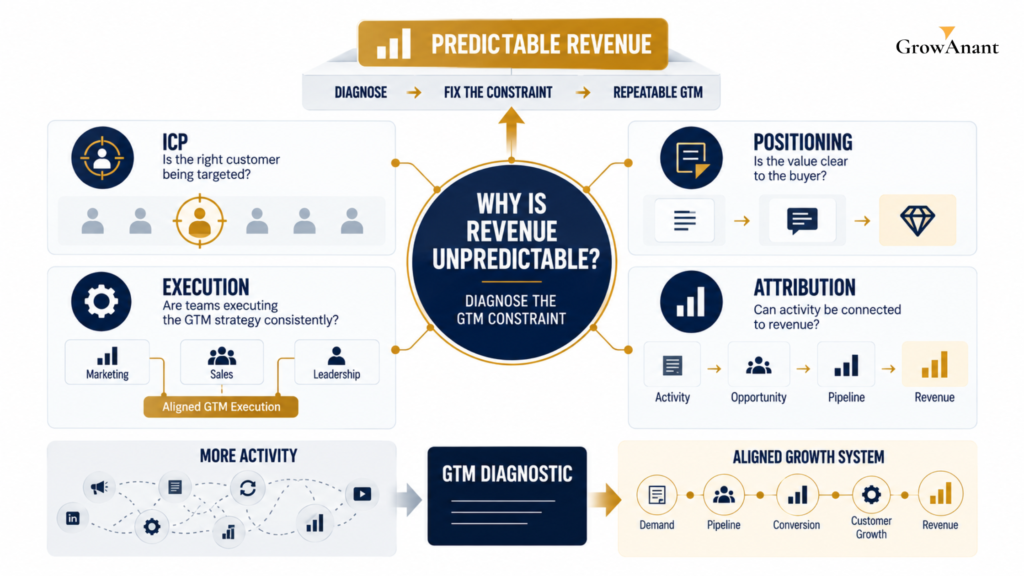
If you are asking why is our go-to-market strategy not turning into predictable revenue, the problem may not be that your company lacks a GTM plan. More often, the issue is a disconnect between the strategy, the market being targeted, the way the offer is positioned, how teams execute it, and how revenue is measured.
This is where go to market strategy consulting and growth strategy consulting can become valuable. A GTM strategy should create a clear connection between the right customers, the right market position, the right acquisition motion, and measurable revenue outcomes.
For a founder or CEO, the important question is not simply whether the company has a documented GTM strategy. The better question is:
Can the current GTM system repeatedly turn market opportunity into qualified pipeline and revenue?
If the answer is no, the first step is diagnosis, not another campaign.
The Gap Between “Having a GTM Strategy” and Predictable Revenue
A GTM strategy describes how a business intends to reach and convert a specific market. Predictable revenue requires that strategy to work consistently enough that leadership can understand where opportunities come from, which customers convert, what resources are required, and where the funnel is breaking.
These are different levels of maturity.
| GTM Situation | What It Looks Like | Revenue Risk |
| Strategy exists | ICP, positioning and channels are documented | Execution may still be disconnected |
| Strategy is being executed | Marketing and sales are active | Activity may not equal pipeline |
| Strategy is measurable | Pipeline and conversion are tracked | Attribution may still be incomplete |
| Strategy is repeatable | Successful motions can be repeated | Requires consistent execution |
| Strategy is predictable | Leadership can forecast with confidence | Requires alignment across GTM functions |
A common mistake is treating increased marketing activity as evidence that the GTM strategy is working.
For example, a B2B SaaS company may launch paid campaigns, publish content, attend industry events, and increase outbound activity. If the resulting leads are poorly matched to the ICP, the company can become busier without becoming more predictable.
McKinsey’s research on B2B growth similarly emphasizes measuring growth against the market, developing concrete growth bets, and improving new-customer acquisition rather than relying on activity alone.
The diagnostic should therefore begin with four questions:
- Are we targeting the right customers?
- Do those customers understand why they should choose us?
- Are our teams executing the strategy consistently?
- Can we connect GTM activity to revenue outcomes?
Diagnostic Question 1: Is the ICP Actually Validated?
The first question is whether your ideal customer profile is based on evidence or assumptions.
An ICP should describe the types of companies most likely to have the problem you solve, recognize its importance, have the ability to buy, and achieve meaningful value from your solution.
This becomes particularly important for companies using startup consulting services USA, business growth consulting, or market entry strategy USA approaches because entering a market with an unvalidated ICP can create expensive downstream problems.
ICP validation checklist
Ask:
- Which customer segments generate the highest-quality opportunities?
- Which segments have the shortest or most manageable sales cycles?
- Which customers have the strongest problem urgency?
- Which customers demonstrate the highest product adoption?
- Which customer characteristics appear repeatedly among successful accounts?
- Are lost opportunities concentrated in particular segments?
- Are marketing and sales using the same ICP definition?
For a SaaS company entering the United States, the ICP might initially be defined as “mid-market U.S. companies.” That is too broad to guide a repeatable GTM motion.
A stronger version might identify a specific industry, company size, operational problem, buying trigger, technology environment, and decision-making structure.
This is why gtm consulting by funding stage can require different diagnostic priorities. A newly funded startup may still be validating market fit, while a Series B company may need to improve segmentation and scale a motion that already works.
If the ICP is wrong, improving campaigns will not solve the underlying problem.
Diagnostic Question 2: Is Positioning Clear to Buyers?
A company can have a valid ICP and still struggle if buyers cannot quickly understand its value.
Positioning answers three fundamental questions:
Who is this for?
What problem does it solve?
Why should this buyer choose this solution instead of alternatives?
Weak positioning often produces symptoms such as:
- High website traffic but weak conversion
- Sales conversations that require excessive education
- Leads that misunderstand the offering
- Strong interest but limited buying urgency
- Frequent price objections
- Marketing messages that sound similar to competitors
Consider a cleantech company pursuing cleantech us market entry. If its messaging focuses heavily on product capabilities while U.S. buyers are primarily evaluating implementation risk, compliance, operating economics, or integration requirements, the GTM strategy may attract attention without generating meaningful demand.
Positioning should therefore be evaluated against actual buyer decisions, not internal assumptions.
Positioning diagnostic
| Question | Healthy Signal | Warning Signal |
| Is the target buyer obvious? | Specific audience | Everyone is a prospect |
| Is the problem clear? | Business problem is explicit | Product features dominate |
| Is differentiation clear? | Buyer understands why you | Messaging resembles competitors |
| Is value measurable? | Business impact is articulated | Benefits remain generic |
| Is urgency established? | Clear reason to act | Buyer can easily delay |
For companies using growth roadmap consulting, positioning should be treated as a strategic dependency. A growth roadmap built on unclear positioning can simply scale an unclear message.
Diagnostic Question 3: Is Execution Aligned to the Plan?
A strong GTM strategy can fail because execution does not follow the strategy.
This happens when:
- Marketing targets one audience while sales targets another.
- Paid campaigns promote offers unrelated to sales priorities.
- Content attracts low-intent traffic.
- Sales follows up inconsistently.
- Teams use different definitions of qualified leads.
- Campaigns are changed before enough evidence is collected.
- Leadership changes priorities without updating the GTM model.
This is where growth consulting services should focus on the operating system behind GTM, not just individual marketing channels.
A useful way to diagnose execution is to map the intended strategy against actual behavior.
GTM alignment framework
Strategy → Audience → Positioning → Channel → Offer → Sales Process → Measurement
At every stage, ask:
“Does what the team is doing match what the strategy says we should be doing?”
For example, a professional services company may decide that senior decision-makers are its priority audience, but then measure success primarily through high-volume lead generation. The execution system gradually optimizes for lead quantity rather than qualified conversations.
That creates a strategic contradiction.
For companies evaluating a digital growth agency, growth marketing services, or a B2B growth marketing agency, the important question should therefore be whether the partner can connect execution back to the GTM strategy.
Diagnostic Question 4: Is Revenue Attribution Broken?
Even when the GTM motion is producing opportunities, leadership may struggle to understand what is actually driving revenue.
This creates a different problem: the company may have a GTM strategy that works, but cannot confidently identify why it works.
Common attribution gaps include:
- Leads are tracked, but opportunities are not.
- Marketing sources are disconnected from CRM records.
- Sales activity is measured separately from marketing activity.
- Pipeline stages are inconsistently defined.
- Offline interactions disappear from reporting.
- Revenue is reported without source or segment context.
A practical revenue view should connect:
Channel → Lead → Qualified Opportunity → Pipeline → Closed Revenue
The goal is not to assign every dollar of revenue to one marketing channel. The goal is to understand which parts of the GTM system contribute to pipeline and where performance breaks down.
McKinsey has highlighted the importance of data-driven commercial performance management for aligning leadership, sales teams, metrics, and actions.
Revenue attribution checklist
Before concluding that a GTM channel is ineffective, verify:
- Is the source captured?
- Is lead quality measured?
- Are opportunities tracked?
- Are conversion rates measured by segment?
- Is pipeline value visible?
- Are sales-cycle differences considered?
- Can leadership distinguish activity from revenue contribution?
Without this visibility, companies can cut effective channels, continue ineffective ones, or repeatedly change strategy without understanding the underlying economics.
Building a Fix Plan
Once the four diagnostic areas are evaluated, resist the temptation to fix everything simultaneously.
Use a simple prioritization model:
| Problem | Business Impact | Urgency | First Action |
| ICP not validated | High | High | Segment and validate customers |
| Positioning unclear | High | High | Rework buyer-facing value proposition |
| Execution misaligned | High | Medium | Align teams, channels and offers |
| Attribution broken | Medium to High | High | Connect funnel and revenue data |
| Channel underperformance | Variable | Medium | Diagnose after fundamentals |
The sequence matters.
Step 1: Validate the market
Confirm the segment, buyer, problem, urgency, and buying conditions.
For U.S. expansion, this may include market research, competitive analysis, customer interviews, and market sizing vendors for us launch where appropriate.
Step 2: Clarify positioning
Create a concise connection between the target buyer, business problem, differentiated solution, and expected business value.
Step 3: Align execution
Make sure marketing, sales, leadership, and other relevant teams are working from the same GTM priorities.
Step 4: Repair measurement
Create a consistent view from acquisition through pipeline and revenue.
Step 5: Build the growth roadmap
Only after these fundamentals are clear should the organization decide where to increase investment.
This approach is particularly relevant for companies considering revenue growth consulting, growth roadmap consulting, or broader growth strategy consulting. The objective is not to add more activity. It is to identify the constraint preventing the current GTM system from becoming more repeatable.
A useful decision tree is:
Revenue is unpredictable →
Is the ICP validated?
- No → Validate the market and customer segment.
- Yes → Continue.
Is positioning clear?
- No → Fix the value proposition and differentiation.
- Yes → Continue.
Is execution aligned?
- No → Reconnect teams, channels, offers, and sales processes.
- Yes → Continue.
Is attribution reliable?
- No → Repair funnel and revenue measurement.
- Yes → Optimize the specific growth constraint.
This is also where a strategic growth partner can add value. GrowAnant, for example, approaches growth as a connected system across strategy, demand generation, GTM execution, and revenue rather than treating each marketing activity as an isolated project.
The objective is not to promise predictable revenue simply by creating a GTM plan. It is to build the conditions that make growth more measurable, repeatable, and scalable.
References
HubSpot
What is a Go-to-Market Strategy? GTM Plan Template + Examples
Frequently Asked Questions
A GTM strategy can fail to produce revenue when the ICP is poorly validated, positioning is unclear, execution is disconnected from strategy, or revenue attribution is incomplete. The strategy may look sound on paper while the operating system required to execute it is weak.
Start with four areas: ICP validation, positioning clarity, execution alignment, and revenue attribution. These four checks help identify whether the core problem is market selection, messaging, execution, or measurement.
It can be either, and often the two are connected. If the ICP or positioning is wrong, better execution may simply scale the wrong approach. If the strategy is sound but teams execute inconsistently, the issue is operational. The diagnostic should determine which constraint comes first.
There is no universal timeline. The timeframe depends on whether the problem involves ICP validation, positioning, execution, attribution, or several of these simultaneously. A focused diagnostic can identify priorities relatively quickly, but meaningful GTM improvement requires implementation, measurement, and iteration.