
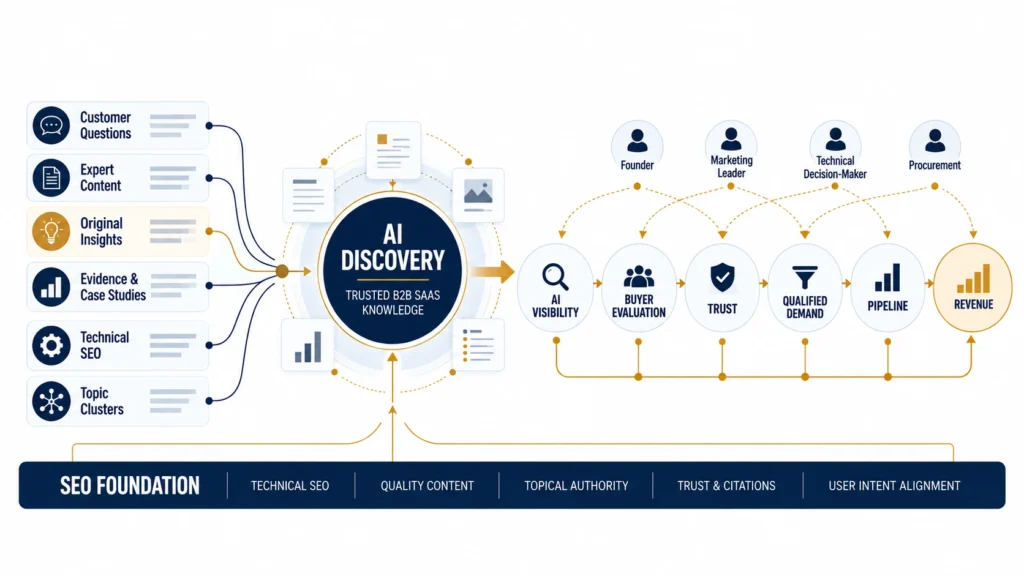
B2B SaaS buyers increasingly use AI assistants to research software, compare solutions, understand categories, and identify potential vendors. This has created growing interest in geo consultants for saas startups and in how growth marketing services can adapt to AI-driven discovery.
Generative Engine Optimization, or GEO, focuses on making a company’s content useful, understandable, trustworthy, and discoverable within generative AI search experiences. For SaaS businesses, this means going beyond ranking for individual keywords and building content that clearly answers buyer questions, demonstrates expertise, and provides information that AI systems can understand and potentially cite.
Google’s current guidance emphasizes that successful visibility in generative AI experiences still rests on foundational SEO, technical accessibility, and valuable, original content rather than separate optimization tricks.
What Is Generative Engine Optimization?
Generative Engine Optimization is the practice of structuring and improving digital content so that it can be understood, retrieved, referenced, and potentially cited by generative AI systems.
For B2B SaaS companies, GEO matters because the buyer journey increasingly involves questions such as:
- Which SaaS platforms solve this problem?
- What features should a business evaluate?
- How does one category compare with another?
- What are the risks of adopting a particular solution?
- Which vendors serve a specific industry?
- What implementation challenges should buyers expect?
Traditional SEO focuses heavily on visibility within search results. GEO expands the strategic objective toward becoming a useful and credible source within AI-generated answers.
A SaaS company therefore needs content that does more than promote its product. It needs to explain the market, answer important customer questions, demonstrate expertise, and create clear connections between problems, solutions, and outcomes.
This is where demand generation agency strategies can evolve from producing high volumes of content toward building a deeper information ecosystem.
For example, a cybersecurity SaaS company should not only publish a product page describing its platform. It could also create authoritative resources explaining security frameworks, vendor evaluation criteria, implementation considerations, compliance questions, and common operational challenges.
The goal is to become a useful information source before the buyer is ready to request a demo.
How GEO Differs From Traditional SEO
GEO and SEO are closely connected, but their strategic objectives are not identical.
Traditional SEO primarily focuses on helping pages become discoverable and competitive within search results. GEO focuses on whether content can also contribute useful information to generative answers.
| Area | Traditional SEO | GEO |
| Primary objective | Search visibility | Visibility within generative experiences |
| Core asset | Search-optimized page | Useful, authoritative information |
| User behavior | Keyword-based search | Conversational research |
| Content structure | Search intent and topical relevance | Clear answers and contextual depth |
| Authority | Links, relevance, expertise | Expertise, usefulness, evidence, context |
| Measurement | Rankings, organic traffic, conversions | AI visibility, citations, referral signals, assisted conversions |
| Strategy | Page and topic optimization | Information ecosystem optimization |
This does not mean SaaS companies should abandon SEO.
Google explicitly states that foundational SEO practices remain relevant to AI search experiences, and pages generally need to be indexed and eligible to appear in traditional Search to be eligible as supporting links in AI Overviews or AI Mode.
The practical implication is important:
GEO should complement SEO rather than replace it.
A strong B2B SaaS content strategy can therefore combine technical SEO, topical authority, structured information, original insights, customer evidence, and clear answers to high-intent questions.
For a SaaS company, this can create an integrated approach across growth marketing agency USA, content, demand generation, and broader growth strategy.
Why AI Citations Matter for B2B Buyers
B2B SaaS purchases often involve longer research cycles and multiple stakeholders.
A founder may ask an AI assistant for software recommendations. A marketing leader may research competing platforms. A CTO may investigate technical requirements. A procurement team may compare vendors.
In each case, the company needs to be visible during research, not only when someone searches its brand name.
AI citations can therefore contribute to an important part of the buyer journey: third-party discovery.
Consider a company searching:
“What should a mid-market manufacturer consider when selecting a predictive maintenance SaaS platform?”
A vendor that has published a detailed, evidence-based guide covering implementation, integrations, data requirements, adoption challenges, and evaluation criteria has created an information asset that can answer the broader question.
That content may support visibility even before the buyer searches for the vendor’s name.
However, citation visibility should not be treated as a guaranteed ranking mechanism. Google states that its AI features use different models and techniques, and the responses and links shown can vary.
For leadership teams, the strategic value is therefore broader than citation counts.
The real objective is to build trust, authority, discoverability, and influence throughout the buying journey.
Building Content That AI Assistants Cite
Content designed for AI-assisted discovery should begin with customer information needs rather than keyword volume alone.
A practical framework is:
1. Start with real buyer questions
Identify questions asked by:
- Founders
- Marketing leaders
- Sales teams
- Technical decision-makers
- Procurement teams
- Existing customers
For example, a B2B SaaS company selling workflow automation software might build content around:
- How should companies evaluate workflow automation platforms?
- What does workflow automation implementation involve?
- How much does workflow automation typically cost?
- What integrations matter most?
- When should a company build versus buy?
2. Provide direct answers
Do not force readers to search through 2,000 words to find a basic answer.
Use:
- Definitions
- Short explanations
- Comparison tables
- Checklists
- Step-by-step frameworks
- FAQs
- Examples
- Decision criteria
This makes the information easier for both people and information systems to understand.
3. Add original insight
Generic summaries are increasingly easy to reproduce.
Google’s current guidance specifically emphasizes unique, valuable, non-commodity content and warns against simply recycling information that already exists elsewhere.
For SaaS businesses, original insight can come from:
- Customer research
- Internal data
- Product expertise
- Industry observations
- Expert interviews
- Implementation experience
- Original frameworks
- First-party case studies
4. Build topical depth
One isolated article rarely establishes authority around a complex B2B category.
A stronger content system may include:
Pillar topic → supporting guides → comparison content → use cases → implementation resources → FAQs → case studies
For example:
SaaS revenue intelligence
could expand into:
- Revenue intelligence fundamentals
- Revenue intelligence vs CRM
- Revenue forecasting
- Pipeline analytics
- Sales forecasting
- Revenue intelligence implementation
- Revenue intelligence for SaaS
- Vendor evaluation checklist
This creates a stronger knowledge structure than publishing unrelated articles based only on search volume.
5. Connect content to the commercial journey
GEO should not exist separately from revenue strategy.
A content ecosystem should support:
Problem awareness → Education → Evaluation → Comparison → Vendor consideration → Sales conversation
This is where B2B growth marketing agency thinking becomes important. Content should not simply attract traffic. It should support demand creation and help buyers move toward informed decisions.
Measuring GEO Impact
GEO measurement is still developing, so businesses should avoid relying on one metric.
A practical measurement framework can include four layers.
| Measurement Layer | Example Metrics |
| Search visibility | Organic impressions, rankings, clicks |
| AI visibility | AI mentions, citations, linked references |
| Engagement | Qualified traffic, engagement, returning visitors |
| Revenue impact | Assisted conversions, opportunities, pipeline influence |
Layer 1: Search visibility
Continue monitoring traditional SEO indicators through tools such as Google Search Console and other SEO platforms.
Layer 2: AI visibility
Track whether important brand, category, product, and problem-related questions produce mentions or citations associated with your content.
Because AI responses can vary by query, model, context, and time, individual observations should not automatically be treated as stable performance measurements.
Layer 3: Engagement
Measure whether AI and organic discovery produce meaningful visitors.
Useful indicators include:
- Engagement
- Time spent with important resources
- Returning visitors
- Product-page visits
- Content-assisted conversions
Layer 4: Revenue impact
Ultimately, B2B SaaS leadership should connect visibility to commercial outcomes.
Track:
Content → Qualified visitor → Lead → Opportunity → Pipeline → Revenue
This prevents GEO from becoming another vanity-metric exercise.
A company might receive thousands of AI mentions but generate little commercial value if the content reaches the wrong audience.
Common Mistakes
Mistake 1: Treating GEO as a replacement for SEO
GEO should build on technical SEO, crawlability, indexing, helpful content, and strong information architecture. Google’s current documentation reinforces this relationship.
Mistake 2: Creating content only for AI systems
Content should serve humans first.
Google recommends creating helpful, reliable, people-first content rather than content primarily designed to manipulate search visibility.
Mistake 3: Publishing generic AI-generated articles
Simply producing large quantities of generic content does not create authority.
The stronger approach is to use research, expertise, original examples, first-party insights, and meaningful analysis.
Mistake 4: Chasing every possible query
A B2B SaaS company does not need an article for every variation of every question.
Instead, prioritize topics that matter to:
- Your ICP
- Your product category
- Your sales process
- Your strategic positioning
- Your revenue goals
Mistake 5: Measuring citations without business context
AI visibility is useful only when connected to the broader buyer journey.
Ask:
Are the right buyers discovering us?
Are they consuming our expertise?
Are they moving toward commercial conversations?
Is content influencing pipeline?
Mistake 6: Ignoring authority and trust
AI systems need useful information to work with. SaaS companies should therefore demonstrate who created the content, why the company has relevant expertise, and where important claims originate.
Google’s guidance encourages clear authorship and trustworthy, expert-led content as part of creating useful information.
For a B2B SaaS company, GEO is therefore not simply another content tactic.
It is part of a broader shift in how buyers discover and evaluate information.
The companies that benefit from this shift are unlikely to be those that simply publish more pages. They are the companies that create genuinely useful information, organize it around customer questions, demonstrate expertise, maintain strong technical foundations, and connect content to a broader growth system.
For growth-stage SaaS businesses, this creates an opportunity to align growth consulting services, SaaS growth consulting, demand generation, SEO, and content strategy around one objective: becoming easier for the right buyers to discover, understand, and trust.
References
Google Search Central
Google’s Guide to Optimizing for Generative AI Features on Google Search
Google Search Central
AI Features and Your Website
Frequently Asked Questions
GEO, or Generative Engine Optimization, is the practice of creating and structuring useful, authoritative content so that it can be understood and potentially referenced within generative AI search experiences.
SEO primarily focuses on improving discoverability and visibility within search engines. GEO extends the strategy toward generative AI experiences, where users may receive synthesized answers that reference multiple information sources. The two approaches overlap heavily, and strong technical SEO and helpful content remain foundational to AI-search visibility.
B2B buyers increasingly use conversational search and AI tools to research problems, categories, vendors, and solutions. AI-citation visibility can help a company become part of that research process before a buyer directly searches for its brand or visits its website.
Measure GEO across multiple layers, including traditional search visibility, AI mentions and citations, qualified engagement, assisted conversions, opportunities, pipeline influence, and revenue. The objective is to connect AI visibility to meaningful business outcomes rather than treating citations as an isolated metric.