
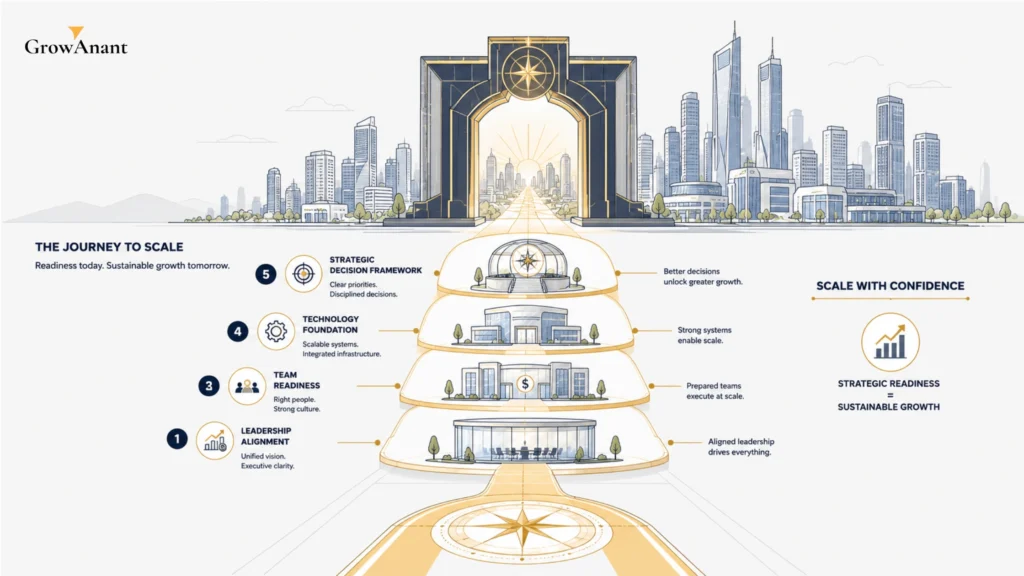
Scaling a business is not simply about increasing marketing spend or hiring additional salespeople. Sustainable growth requires leadership alignment, operational discipline, predictable revenue systems, and a clear execution roadmap. A fractional growth leadership checklist helps founders evaluate whether their organization has the strategic foundation required to scale without creating operational bottlenecks.
For many growth-stage companies, expanding too early leads to rising acquisition costs, inconsistent demand generation, fragmented execution, and unpredictable revenue. Combining a structured assessment with growth strategy consulting enables leadership teams to identify gaps before investing in expansion initiatives. Whether building a SaaS company, growing a professional services firm, or entering new markets through a market entry strategy USA, readiness should always precede scale.
What Is a Growth Readiness Assessment?
A growth readiness assessment is a structured evaluation of the leadership, commercial, operational, and technology capabilities required to support sustainable expansion. Instead of focusing only on revenue targets, it examines whether the business can consistently generate, convert, deliver, and retain customers while maintaining operational efficiency.
An effective assessment also highlights areas where additional leadership or strategic support may be required before accelerating growth initiatives.
Growth Readiness Framework
| Assessment Area | Strategic Objective |
| Leadership | Align vision and growth priorities |
| Revenue | Build predictable commercial performance |
| Team | Ensure execution capacity |
| Technology | Support scalable operations |
| Decision-Making | Improve strategic execution |
Growth Readiness Checklist
✔ Define measurable business growth objectives.
✔ Assess leadership alignment around growth priorities.
✔ Evaluate operational capacity before expanding.
✔ Identify the largest constraints affecting scalability.
✔ Review readiness regularly as business goals evolve.
For example, a founder-led SaaS business preparing for Series A expansion may discover that customer acquisition is performing well, but onboarding capacity and customer success resources are limiting sustainable growth. Similarly, a professional services firm entering the U.S. market may identify inconsistent sales processes as a larger obstacle than lead generation itself. Businesses investing in business growth consulting, growth consulting services, and revenue growth consulting often use structured readiness assessments to prioritize improvements before increasing investment.
Leadership Checklist
Leadership readiness is one of the strongest indicators of successful scaling. Businesses often possess capable marketing and sales teams but lack clear ownership of cross-functional growth initiatives. Without defined accountability, execution becomes fragmented and strategic priorities compete for attention.
An effective leadership structure aligns every department around shared revenue objectives while creating clear decision-making processes. Many growing organizations strengthen this capability through a fractional chief growth officer, fractional growth consultant, or fractional growth leadership model, providing executive direction without the commitment of a full-time executive.
Leadership Evaluation Framework
| Leadership Area | Assessment Question |
| Strategic Vision | Are growth priorities clearly defined? |
| Executive Alignment | Do departments share common objectives? |
| Decision Ownership | Is accountability clearly assigned? |
| Cross-Functional Collaboration | Are marketing, sales, and customer success aligned? |
| Growth Governance | Are strategic decisions consistently reviewed? |
Leadership Checklist
✔ Define executive ownership for growth initiatives.
✔ Align leadership around shared revenue KPIs.
✔ Establish regular strategic review meetings.
✔ Remove departmental silos that slow execution.
✔ Build a repeatable decision-making process for growth investments.
For example, a B2B software company preparing to launch a new product may assign a fractional head of growth to coordinate product marketing, sales enablement, and customer success. This approach creates unified execution while allowing founders to focus on broader business strategy. Growth partners such as GrowAnant help organizations combine fractional growth leadership, growth strategy consulting, and growth roadmap consulting to build leadership systems that support predictable, scalable growth.
Revenue Checklist
Predictable revenue is one of the clearest indicators that a business is ready to scale. Revenue readiness is not measured by growth alone, but by the ability to generate qualified demand consistently, convert opportunities efficiently, and retain profitable customers. A structured revenue review helps leadership identify whether current commercial performance can support expansion without increasing operational risk.
Revenue Readiness Framework
| Revenue Area | Strategic Question |
| Pipeline Quality | Are enough qualified opportunities entering the pipeline? |
| Customer Acquisition | Is acquisition cost sustainable? |
| Conversion Performance | Are opportunities progressing efficiently? |
| Customer Retention | Are customers renewing and expanding? |
| Revenue Forecasting | Is future revenue predictable? |
Revenue Checklist
✔ Measure qualified pipeline instead of lead volume.
✔ Track customer acquisition cost alongside customer lifetime value.
✔ Monitor sales conversion rates across every stage.
✔ Evaluate retention and expansion revenue regularly.
✔ Review forecasting accuracy before increasing investment.
For example, a SaaS company preparing for international expansion may discover that strong lead generation is offset by declining conversion rates. Addressing sales qualification and onboarding before expanding marketing investment improves long-term scalability. Organizations using business growth consulting, growth consulting services USA, SaaS growth consulting, and growth strategy consulting often prioritize predictable commercial performance before accelerating growth.
Team Checklist
Scaling successfully depends on whether the organization has the people, processes, and accountability required to execute consistently. High-performing teams operate with clearly defined responsibilities, shared objectives, and collaborative workflows across marketing, sales, customer success, and operations.
Leadership should also evaluate capability gaps that may require temporary executive expertise rather than immediate full-time hiring.
Team Readiness Framework
| Team Area | Assessment Focus |
| Role Clarity | Are responsibilities clearly defined? |
| Cross-Functional Alignment | Do teams share common goals? |
| Skills & Capability | Does the team support future growth? |
| Accountability | Are performance expectations measurable? |
| Leadership Capacity | Is executive guidance sufficient for scaling? |
Team Checklist
✔ Define ownership for every growth initiative.
✔ Align departmental objectives with revenue goals.
✔ Identify leadership and execution gaps.
✔ Standardize communication across functions.
✔ Invest in training before expanding headcount.
For instance, a founder-led professional services firm may have experienced specialists but limited coordination between marketing and sales. Introducing an interim growth leader, fractional growth executive, or fractional growth manager can improve alignment while establishing repeatable growth processes. Many businesses also strengthen execution through startup growth strategy consulting and B2B marketing strategy consulting before entering new markets.
Technology Checklist
Technology should enable scalable growth rather than create operational complexity. As businesses grow, disconnected systems often reduce visibility, slow decision-making, and increase manual work. Before scaling, leaders should evaluate whether their technology stack supports collaboration, reporting, customer management, and revenue forecasting.
Technology Readiness Framework
| Technology Area | Strategic Objective |
| CRM | Centralize customer and pipeline data |
| Marketing Automation | Improve campaign efficiency |
| Analytics | Deliver actionable business insights |
| Integrations | Connect critical business systems |
| Reporting | Support executive decision-making |
Technology Checklist
✔ Ensure customer data is centralized and accurate.
✔ Integrate marketing, sales, and customer success platforms.
✔ Automate repetitive reporting where appropriate.
✔ Monitor data quality across all systems.
✔ Review technology investments against business objectives.
For example, a startup preparing for rapid growth may integrate its CRM, marketing automation, and reporting tools before increasing acquisition spending. This provides leadership with consistent visibility into pipeline performance and revenue trends. Growth partners such as GrowAnant help organizations align fractional growth leadership, growth consulting services, go to market strategy consulting, and growth systems with scalable technology foundations that support sustainable commercial growth.
Decision Matrix
A growth readiness assessment should end with a clear decision, not simply a list of observations. Executive teams need a practical framework to determine whether the business is ready to scale immediately, should optimize existing operations first, or requires additional leadership support before making larger investments. This approach reduces unnecessary risk while improving the likelihood of sustainable business growth.
Growth Readiness Decision Matrix
| Assessment Result | Recommended Action |
| Leadership, revenue, team, and technology are aligned | Proceed with scaling initiatives |
| One or two critical gaps identified | Optimize before increasing investment |
| Multiple operational bottlenecks exist | Focus on foundational improvements first |
| Limited strategic leadership | Consider outsourced growth leadership or a fractional chief growth officer |
Executive Decision Checklist
✔ Confirm leadership alignment before scaling.
✔ Validate predictable revenue and pipeline performance.
✔ Ensure teams can support additional customer demand.
✔ Verify technology supports future growth.
✔ Review readiness before entering new markets or increasing marketing budgets.
For example, a B2B SaaS company planning U.S. expansion may postpone increasing advertising spend after discovering inconsistent forecasting and customer onboarding processes. Addressing these operational gaps first improves execution and reduces scaling risk. Similarly, a professional services firm may benefit from engaging GrowAnant to combine fractional growth leadership checklist, growth strategy consulting, business growth consulting, and revenue growth consulting into a structured readiness framework that aligns leadership, operations, and commercial execution before accelerating growth.
References
FAQs
A company is generally ready to scale when leadership is aligned, revenue generation is predictable, operational processes are repeatable, teams have sufficient capacity, and technology supports future growth. A structured readiness assessment helps identify any gaps before expansion.
A comprehensive checklist should evaluate leadership alignment, revenue performance, team capability, operational processes, technology infrastructure, and decision-making frameworks. Together, these areas provide a complete view of organizational readiness.
Founders should first assess leadership alignment, qualified pipeline consistency, customer acquisition efficiency, sales conversion performance, customer retention, and operational capacity. These factors typically have the greatest influence on sustainable scaling.
Key indicators include qualified pipeline growth, customer acquisition cost, customer lifetime value, revenue forecasting accuracy, sales conversion rates, retention rates, and recurring revenue trends. These metrics provide meaningful insight into whether the business can support continued expansion.
Yes. Improving operational efficiency before increasing marketing investment helps ensure new demand can be converted, delivered, and retained effectively. Scaling inefficient systems often increases costs without improving long-term business performance.
A fractional growth leader provides executive-level strategic direction without requiring a full-time hire. They help align leadership, strengthen growth strategy, improve cross-functional execution, establish scalable growth systems, and connect marketing, sales, and customer success to long-term revenue objectives.