
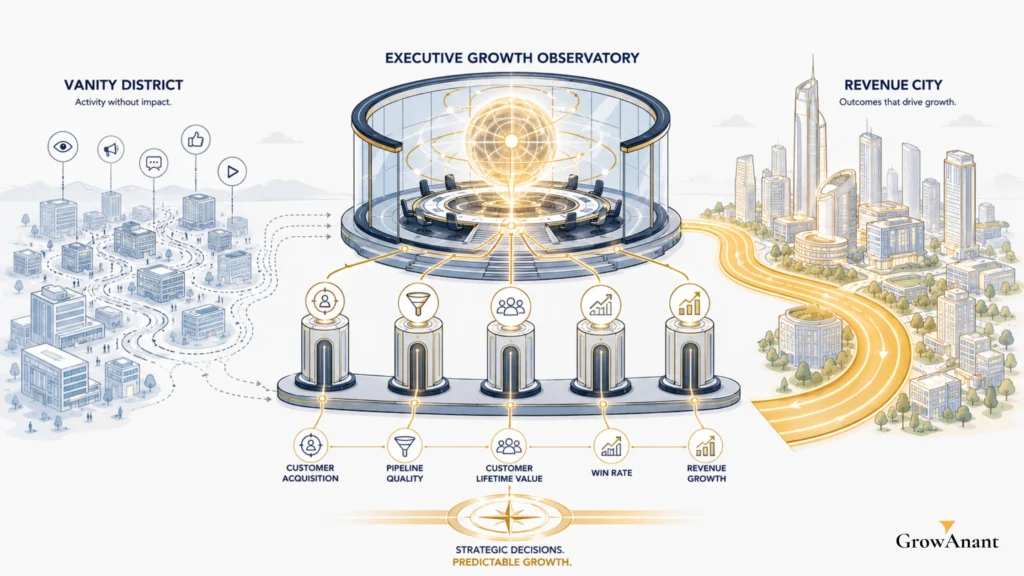
Many businesses celebrate increasing website traffic, social media engagement, or impressions as indicators of marketing success. While these metrics can signal awareness, they rarely explain whether marketing contributes to sustainable revenue. Growth Marketing focuses on connecting marketing investments directly to pipeline creation, customer acquisition, retention, and long-term revenue growth rather than measuring activity alone.
For founders and executives, the real question is not how many people visited the website, but how many qualified opportunities were created, how efficiently customers were acquired, and whether marketing investments generated measurable business outcomes. Combined with demand generation and growth marketing services, a revenue-focused measurement framework helps organizations make informed decisions while supporting predictable growth.
Why traffic isn’t enough
Website traffic is an important awareness metric, but it should never be treated as the primary indicator of marketing performance. High traffic does not necessarily produce qualified leads, paying customers, or profitable growth. Businesses that optimize only for visits often increase marketing costs without improving commercial results.
Executive teams should evaluate marketing through the lens of business impact. Every campaign should contribute to qualified demand, sales pipeline, customer acquisition, or customer retention.
Traffic vs Business Outcomes
| Metric | Business Value |
| Website Traffic | Indicates awareness |
| Qualified Leads | Measures buying intent |
| Sales Opportunities | Reflects pipeline quality |
| Customer Acquisition | Demonstrates commercial impact |
| Revenue Contribution | Connects marketing to business growth |
Marketing Evaluation Checklist
✔ Measure business outcomes instead of marketing activity.
✔ Track qualified opportunities rather than total visitors.
✔ Connect campaigns to pipeline and revenue.
✔ Monitor conversion performance across the buyer journey.
✔ Review marketing efficiency alongside financial performance.
For example, a B2B SaaS company may experience a 40% increase in website traffic after publishing educational content. However, if qualified opportunities remain unchanged, leadership should improve targeting, messaging, or conversion paths instead of celebrating higher visitor numbers. Organizations investing in B2B marketing, growth consulting services, growth strategy consulting, and B2B growth marketing agency expertise typically prioritize measurable commercial outcomes over vanity metrics.
Revenue metrics
Revenue metrics provide executives with a clearer understanding of marketing performance because they connect demand generation activities to business results. Instead of measuring isolated campaigns, leaders evaluate whether marketing contributes to predictable pipeline, profitable customer acquisition, and sustainable growth.
Revenue Measurement Framework
| Revenue Metric | Strategic Purpose |
| Marketing-Sourced Pipeline | Measures future revenue opportunities |
| Customer Acquisition Cost | Evaluates marketing efficiency |
| Customer Lifetime Value | Assesses long-term customer profitability |
| Win Rate | Measures sales effectiveness |
| Revenue Attribution | Connects marketing investment to business outcomes |
Revenue Metrics Checklist
✔ Define revenue-focused KPIs before launching campaigns.
✔ Align marketing and sales around shared business metrics.
✔ Measure pipeline contribution consistently.
✔ Compare marketing investment with revenue generated.
✔ Review revenue metrics regularly to guide strategic decisions.
For example, a professional services firm entering the U.S. market may evaluate campaign success using qualified pipeline, proposal conversions, and client lifetime value rather than page views. Growth partners such as GrowAnant help businesses align Growth Marketing, revenue growth consulting, business growth consulting, and digital marketing consulting services into measurement frameworks that improve strategic decision-making while supporting long-term commercial success.
CAC
Customer Acquisition Cost (CAC) measures the total investment required to acquire a new customer. For executives, CAC is one of the most important indicators of marketing efficiency because it reveals whether customer acquisition remains financially sustainable as the business grows. A lower CAC is valuable only when customer quality and long-term profitability remain strong.
Rather than evaluating CAC in isolation, leaders should compare it with pipeline quality, conversion rates, and customer lifetime value to gain a complete picture of marketing performance.
CAC Evaluation Framework
| CAC Factor | Executive Insight |
| Marketing Investment | Total customer acquisition spend |
| Sales Costs | Cost of converting opportunities |
| Qualified Customers | Number of new paying customers |
| CAC Trend | Efficiency over time |
| Revenue Impact | Contribution to profitable growth |
CAC Checklist
✔ Calculate CAC using both marketing and sales expenses.
✔ Compare CAC across acquisition channels.
✔ Monitor CAC trends instead of one-time results.
✔ Balance lower acquisition costs with lead quality.
✔ Review CAC alongside revenue performance.
For example, a B2B software company may reduce CAC by improving landing page conversion rates rather than increasing advertising budgets. Organizations supported by performance marketing services USA, growth marketing services, growth consulting services USA, and growth strategy consulting often focus on optimizing acquisition efficiency before expanding campaign investments.
LTV
Customer Lifetime Value (LTV) estimates the total revenue a customer generates throughout the business relationship. While CAC measures acquisition efficiency, LTV reflects long-term business value. Sustainable growth depends on increasing customer value through retention, expansion, and strong customer relationships rather than relying solely on new customer acquisition.
LTV Framework
| LTV Driver | Strategic Purpose |
| Average Revenue | Customer spending over time |
| Customer Retention | Relationship duration |
| Expansion Revenue | Upselling and cross-selling opportunities |
| Profitability | Long-term commercial value |
| Customer Satisfaction | Supports recurring revenue |
LTV Checklist
✔ Measure customer value across the entire lifecycle.
✔ Improve retention before increasing acquisition budgets.
✔ Identify expansion opportunities within existing accounts.
✔ Compare LTV with CAC regularly.
✔ Monitor customer profitability by segment.
For instance, a SaaS provider may increase LTV by strengthening onboarding and customer success instead of focusing exclusively on lead generation. Businesses investing in business growth consulting, SaaS growth consulting, growth marketing, and demand generation agency strategies often improve profitability by extending customer relationships and increasing recurring revenue.
Pipeline
A healthy pipeline demonstrates whether marketing activities are creating qualified revenue opportunities rather than simply attracting attention. Pipeline metrics help executives understand how effectively prospects progress through the buying journey and where improvements are needed to support predictable growth.
Pipeline Performance Framework
| Pipeline Metric | Business Purpose |
| Marketing Qualified Leads | Measure initial buying intent |
| Sales Qualified Opportunities | Evaluate lead quality |
| Pipeline Value | Estimate future revenue |
| Sales Velocity | Measure progression through the sales cycle |
| Pipeline Coverage | Assess future revenue capacity |
Pipeline Checklist
✔ Measure qualified opportunities instead of lead volume.
✔ Track conversion between pipeline stages.
✔ Review pipeline quality by acquisition channel.
✔ Identify bottlenecks affecting revenue generation.
✔ Align marketing and sales around shared pipeline goals.
For example, a professional services company may generate fewer leads than competitors but consistently produce higher-value opportunities because its B2B marketing, lead generation for B2B services, and demand generation strategy targets decision-makers with strong purchase intent. Strategic partners such as GrowAnant help organizations integrate Growth Marketing, B2B lead generation services, growth consulting, and growth roadmap consulting into pipeline measurement frameworks that improve commercial visibility and long-term revenue performance.
Win rate
While pipeline measures potential revenue, win rate shows how effectively opportunities become paying customers. A strong win rate often reflects clear positioning, qualified leads, effective sales execution, and alignment between marketing and sales. Monitoring this metric helps leadership identify whether growth challenges originate from demand generation, sales qualification, or the buying experience.
Win Rate Framework
| Win Rate Factor | Strategic Purpose |
| Opportunity Quality | Evaluate lead qualification |
| Sales Conversion | Measure deal effectiveness |
| Competitive Positioning | Assess market differentiation |
| Sales Cycle | Identify conversion efficiency |
| Revenue Impact | Improve forecasting accuracy |
Win Rate Checklist
✔ Measure win rates by customer segment.
✔ Compare results across acquisition channels.
✔ Review lost opportunities for recurring patterns.
✔ Improve sales enablement using customer insights.
✔ Track win rate alongside pipeline growth.
For example, a founder-led technology company may discover that enterprise opportunities consistently outperform small business deals. Leadership can then refine its B2B marketing strategy consulting, messaging, and sales resources toward higher-value customer segments instead of pursuing additional traffic.
Dashboard
An executive dashboard brings together the metrics that matter most, allowing leaders to evaluate marketing performance through a revenue lens rather than isolated campaign reports. Instead of focusing on impressions or clicks, dashboards should present a connected view of customer acquisition, pipeline health, profitability, and growth trends that supports faster strategic decisions.
Executive Growth Dashboard
| Dashboard Metric | Executive Value |
| Customer Acquisition Cost | Marketing efficiency |
| Customer Lifetime Value | Long-term profitability |
| Qualified Pipeline | Future revenue visibility |
| Win Rate | Sales effectiveness |
| Revenue Growth | Overall business performance |
Dashboard Checklist
✔ Prioritize revenue-focused KPIs over vanity metrics.
✔ Connect marketing, sales, and customer success reporting.
✔ Review dashboards consistently with leadership teams.
✔ Remove metrics that do not support strategic decisions.
✔ Continuously refine dashboards as business priorities evolve.
For instance, a SaaS business preparing for rapid expansion may use an executive dashboard to monitor CAC, LTV, pipeline coverage, and win rate before increasing marketing investment. Likewise, a professional services firm can use the same framework to evaluate proposal conversion, client profitability, and recurring revenue. Growth partners such as GrowAnant help businesses combine Growth Marketing, growth marketing agency USA, business growth consulting, and revenue growth consulting into measurement systems that connect marketing activity directly to business outcomes.
References
FAQs
The most valuable marketing KPIs are those tied directly to business performance. Founders and executives should prioritize qualified pipeline, customer acquisition cost (CAC), customer lifetime value (LTV), win rate, conversion rates, and revenue contribution instead of relying solely on website traffic or impressions.
Measure revenue impact by connecting marketing activities to qualified pipeline, closed revenue, customer acquisition costs, and customer lifetime value. Consistent attribution across marketing and sales provides a clearer understanding of how marketing contributes to business growth.
Customer Acquisition Cost (CAC) is the total marketing and sales investment required to acquire a new customer. It helps businesses evaluate acquisition efficiency and should always be reviewed alongside customer lifetime value and revenue performance.
Founders should regularly monitor qualified pipeline, CAC, LTV, win rate, revenue growth, retention, and marketing-attributed revenue. Together, these metrics provide a balanced view of growth performance and support informed strategic decision-making.