
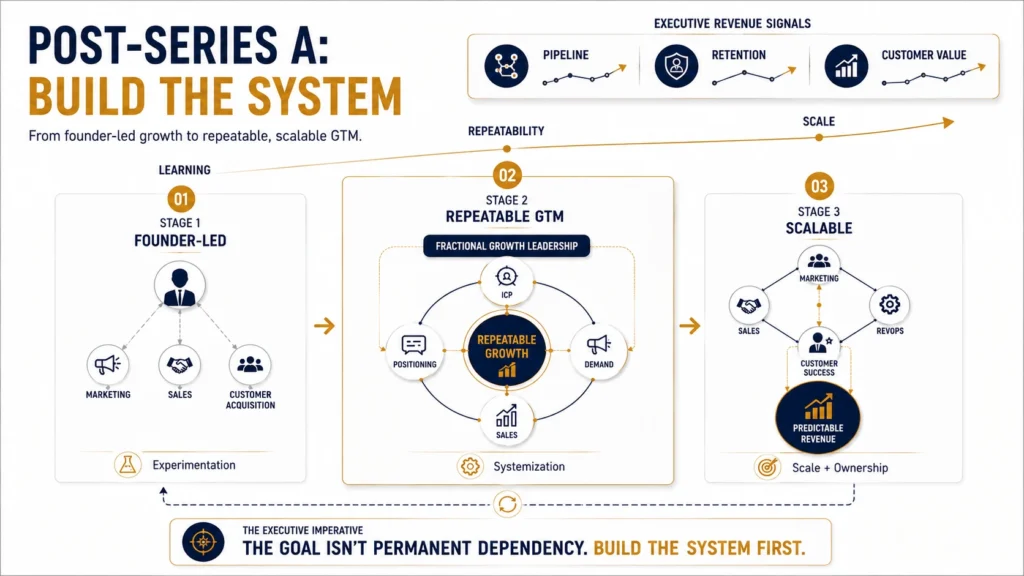
A Series A round changes what a company needs from its growth function. Early-stage experimentation must increasingly become repeatable acquisition, measurable retention, and a clearer path to efficient revenue growth. For growth stage startups, this often means moving from founder-led growth decisions toward a structured commercial system.
Fractional growth leadership series support can be useful during this transition when a company needs senior growth ownership before committing to a permanent executive hire. A fractional growth consultant, fractional head of growth, or fractional chief growth officer can help connect strategy, GTM execution, demand generation, sales alignment, and measurement.
The question is no longer simply, “What can generate growth?” It becomes, “What growth motion can the company repeat, measure, and scale?”
Growth Priorities After Series A
Before Series A, many startups optimize for learning. After Series A, leadership and investors typically need stronger evidence that the business can convert investment into a repeatable growth engine.
The priorities shift across five areas:
| Pre-Series A Focus | Post-Series A Focus |
| Product-market learning | Repeatable GTM |
| Founder-led selling | Structured sales motion |
| Channel experimentation | Channel prioritization |
| Basic reporting | Revenue visibility |
| Short-term acquisition | Sustainable customer economics |
The goal is not to stop experimenting. It is to make experimentation more disciplined.
A post-Series A company should establish:
- A clearly defined ICP
- A documented positioning strategy
- Repeatable acquisition channels
- Defined sales and marketing responsibilities
- Funnel measurement
- Customer retention visibility
- A quarterly growth roadmap
- Clear ownership of growth outcomes
This is where growth strategy consulting, business growth consulting, and revenue growth consulting can provide value beyond campaign execution.
For example, a B2B SaaS company may have generated strong early demand through founder networks. After Series A, the challenge becomes determining whether content, outbound, partnerships, paid acquisition, or other channels can create qualified pipeline consistently without depending on the founder’s personal network.
Building Repeatable GTM Motions
A repeatable GTM motion is a documented process for moving the right customer from awareness to revenue and retention.
A useful model is:
ICP → Positioning → Demand → Qualification → Sales → Onboarding → Retention → Expansion
Every stage should have an owner, metric, and feedback loop.
The Repeatability Test
Leadership should ask:
| Question | What a Strong Answer Looks Like |
| Who buys? | Clearly defined ICP and buying roles |
| Why do they buy? | Consistent problem and value narrative |
| Where do they come from? | Identifiable acquisition channels |
| How do they convert? | Documented funnel stages |
| What does sales need? | Qualified demand and clear enablement |
| What happens after purchase? | Structured onboarding and retention process |
| What scales? | Proven channels with measurable economics |
A company that cannot answer these questions may still be growing, but its growth system is not yet sufficiently repeatable.
For a U.S. SaaS startup expanding beyond its initial market, go to market strategy consulting can help leadership determine whether the existing motion should be replicated, localized, or redesigned.
The same principle applies to companies using B2B marketing strategy consulting, demand generation agency, or growth marketing services. Execution should follow a clear commercial model rather than operate as disconnected activity.
When Fractional Leadership Fits Best
A fractional growth executive is most useful when the company has meaningful growth complexity but does not yet need, or cannot yet justify, a full-time senior growth leader.
The model can work particularly well when:
- Marketing execution already exists but lacks strategic direction
- The founder remains the default growth decision-maker
- Sales and marketing are not aligned
- Multiple acquisition channels are being tested without clear prioritization
- Growth metrics are fragmented
- The company needs a senior GTM roadmap
- Leadership needs stronger accountability without immediately adding a permanent executive
Fractional vs Full-Time Leadership
| Factor | Fractional Leadership | Full-Time Leadership |
| Immediate senior expertise | High | High |
| Commitment | Defined scope and time | Dedicated |
| Flexibility | Higher | Lower |
| Best fit | Transition and scale phases | Established long-term function |
| Organizational ownership | Shared | Internal |
| Hiring commitment | Lower initially | Higher |
| Strategic reset | Strong fit | Strong fit |
A fractional growth leadership contract should establish responsibilities, decision rights, KPIs, meeting cadence, deliverables, and transition expectations.
The objective should not be to create permanent dependency.
The objective is to build the internal growth system, strengthen the team, and create clarity around the leadership capabilities the company eventually needs.
GrowAnant can operate in this role as a strategy-first growth partner, helping connect GTM planning, demand generation, revenue measurement, and execution during a critical scaling stage.
Metrics Investors Expect
Post-Series A reporting should move beyond activity metrics.
Investors need to understand whether the company is building an economically sustainable growth model.
Important metrics can include:
Growth Metrics
- ARR or recurring revenue growth
- New revenue
- Qualified pipeline
- Pipeline coverage
- Customer acquisition
- Expansion revenue
Efficiency Metrics
- CAC
- CAC payback
- Conversion rates
- Sales cycle
- Customer acquisition by channel
Retention Metrics
- Gross retention
- Net retention
- Logo churn
- Revenue churn
- Customer lifetime value
Funnel Metrics
- Marketing-qualified accounts or leads where applicable
- Sales-qualified opportunities
- Opportunity-to-close rate
- Win rate
- Average contract value
The exact metric set depends on the business model. A SaaS company should not automatically copy another company’s dashboard.
The more important principle is:
Every major growth investment should have a measurable relationship to pipeline, revenue, customer value, or efficiency.
Investor-Ready Growth Scorecard
A useful quarterly scorecard can organize metrics into four questions:
Growth: Are we growing?
Efficiency: Are we acquiring efficiently?
Retention: Are customers staying and expanding?
Predictability: Can leadership reasonably forecast future performance?
This makes the growth conversation more strategic than simply reporting that marketing generated more leads.
Transition Planning Toward Series B
Series B preparation should begin well before fundraising.
The company needs to demonstrate that growth is becoming a system rather than a collection of successful experiments.
A practical transition framework is:
Phase 1: Diagnose
Review ICP, positioning, funnel, acquisition channels, sales process, retention, team structure, and measurement.
Phase 2: Prioritize
Identify the highest-impact constraints.
For example:
Weak positioning → poor conversion
Poor qualification → sales inefficiency
Weak onboarding → retention problems
Unfocused channels → inefficient acquisition
Phase 3: Systemize
Create repeatable processes for:
- Demand generation
- Lead qualification
- Sales handoffs
- Pipeline management
- Customer onboarding
- Reporting
- Experimentation
Phase 4: Scale
Increase investment only where the underlying motion demonstrates sufficient evidence.
Phase 5: Institutionalize
Document responsibilities, operating rhythms, metrics, and leadership requirements.
This is where growth consulting services can evolve from strategic diagnosis into ongoing operating support.
Series B Readiness Checklist
- ICP clearly defined
- Positioning consistently communicated
- Repeatable GTM motion documented
- Acquisition channels measured
- Pipeline visibility established
- Sales and marketing responsibilities aligned
- Retention metrics tracked
- Growth forecast supported by operating data
- Growth roadmap established
- Leadership ownership clearly defined
The transition from fractional to full-time leadership should happen when organizational complexity, revenue scale, team size, and strategic workload justify dedicated ownership.
A fractional growth leadership model should therefore be evaluated as a stage-specific leadership solution, not simply as a lower-cost alternative to hiring.
Frequently Asked Questions
Growth shifts from primarily proving demand toward building repeatable and measurable GTM motions. Companies typically need clearer ICP definition, stronger acquisition systems, sales and marketing alignment, better funnel visibility, retention measurement, and more disciplined capital allocation.
Yes, when the company has meaningful commercial complexity but does not yet require a permanent senior growth executive. A fractional growth consultant can provide strategic ownership, establish operating systems, and help internal teams execute against a structured roadmap.
Metrics vary by business model, but investors generally need visibility into growth, acquisition efficiency, pipeline, retention, expansion, customer economics, and forecastability. For SaaS businesses, recurring revenue growth, CAC, retention, net revenue retention, pipeline, and sales efficiency are often important parts of the growth picture.
A company should consider full-time leadership when growth strategy, team management, cross-functional coordination, and revenue ownership require sustained executive attention. The decision should be based on organizational complexity and strategic workload rather than simply reaching a particular funding milestone.