
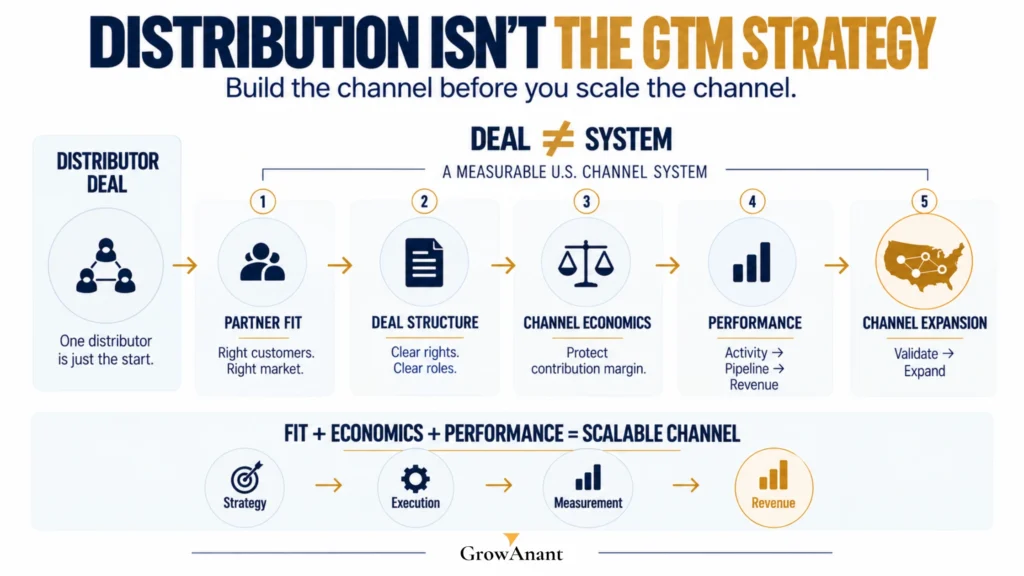
For an international startup entering the United States, distribution can provide access to established customers, sales channels, and local market knowledge without requiring an immediate full-scale U.S. commercial operation. But the goal should not simply be to secure early distributor deals us market. The real objective is to build a channel that supports sustainable market entry, protects economics, and creates a path toward repeatable revenue.
A distributor can become an important part of a market entry strategy USA, but only when the partner, commercial model, responsibilities, and performance expectations are clearly defined. This is where go to market strategy consulting, growth strategy consulting, and structured channel planning can help international companies reduce avoidable market-entry mistakes.
Why Distributor Deals Matter for Market Entry
A distributor can act as a bridge between an international company and the U.S. market. Instead of building every sales relationship, fulfillment process, and local commercial capability internally, the startup can leverage an established partner.
For example, an Indian SaaS-adjacent technology company, industrial equipment manufacturer, or specialized B2B product company may already have demand in its home market but limited access to U.S. buyers. A distributor with existing relationships can potentially shorten the path to those customers.
However, distribution is not automatically a growth strategy.
The strategic question is:
Does the distributor give the company access that would otherwise be difficult, expensive, or slow to build internally?
A useful evaluation framework is:
| Factor | Key Question |
| Market access | Does the distributor already reach the target customers? |
| Customer fit | Are those customers aligned with the ideal customer profile? |
| Capability | Can the partner sell and support the offering effectively? |
| Economics | Does the margin structure remain viable? |
| Commitment | Will the partner actively invest in the category? |
| Control | Can the startup protect positioning, pricing, and customer experience? |
| Measurement | Can performance be tracked objectively? |
The U.S. Small Business Administration identifies working with distributors or wholesalers as one possible channel for reaching markets and also recommends market research, export planning, and attention to applicable laws and regulations when expanding internationally.
For international startups, this means distributor selection should sit inside the broader market entry strategy USA, rather than being treated as a standalone sales activity.
Finding the Right Distributor Partners
The biggest mistake is choosing a distributor based only on size or the number of customers it claims to serve.
A large distributor may have hundreds of accounts but little interest in developing a new category. A smaller specialist may have fewer customers but much stronger access to the exact buyers you need.
This makes distributor selection a form of channel partner strategy market entry.
Build a distributor scorecard
Before approaching potential partners, define the characteristics that matter.
| Evaluation Area | What to Assess |
| Customer overlap | Existing relationships with your target accounts |
| Geographic coverage | Relevant states, regions, or territories |
| Industry expertise | Experience in your specific category |
| Sales capability | Dedicated sales resources and process |
| Technical capability | Ability to explain or support the product |
| Marketing capability | Ability to create local demand |
| Reputation | Customer and supplier references |
| Financial stability | Capacity to support inventory and operations |
| Strategic interest | Willingness to invest in your category |
A practical approach is to score each candidate before entering commercial negotiations.
Example
Suppose a European industrial technology startup wants to expand into the U.S. manufacturing sector.
Distributor A has national coverage but primarily sells commodity products.
Distributor B operates across three manufacturing-heavy regions and already sells complementary industrial technology to plant managers and operations leaders.
Distributor B may have fewer total accounts, but its customer relevance could make it strategically more valuable.
This is where business growth consulting, startup growth strategy consulting, and go to market strategy consulting should focus: not simply finding a partner, but determining whether the partner improves the overall economics and speed of market entry.
Structuring Early Agreements
An early distributor agreement should establish more than territory and wholesale pricing.
The agreement should clarify how the partnership operates and how both parties will know whether it is working.
A practical structure includes:
| Agreement Area | Questions to Define |
| Territory | Where can the distributor sell? |
| Customer segment | Which accounts or industries are covered? |
| Pricing | What is the distributor price and expected resale structure? |
| Minimum performance | What commercial activity or volume is expected? |
| Exclusivity | Is exclusivity justified by demonstrated performance? |
| Marketing | Who funds and executes demand generation? |
| Sales ownership | Who manages prospects and customer relationships? |
| Support | Who handles implementation and customer service? |
| Reporting | What data must the distributor provide? |
| Renewal | What conditions determine continuation? |
| Termination | What happens if expectations are not met? |
Avoid premature exclusivity
Exclusivity can appear attractive because it gives a distributor confidence to invest. But granting broad exclusivity before the partner demonstrates market development capability can restrict your expansion.
A better framework is:
Pilot → Measure → Validate → Expand
For example:
- Start with a defined territory or customer segment.
- Establish measurable performance expectations.
- Review pipeline and revenue contribution.
- Expand rights when performance justifies it.
This approach keeps the channel aligned with a broader growth roadmap consulting process rather than locking the company into assumptions made before entering the market.
Protecting Your Brand and Margins
Distributor relationships can create growth leverage, but they can also introduce pricing pressure and brand-control challenges.
The startup needs to understand the economics before signing the agreement.
A simple margin framework is:
Customer Price
− Distributor Margin
− Logistics Costs
− Duties and Applicable Fees
− Local Support Costs
= Contribution Margin
The actual structure will vary by product, industry, and agreement, but the principle remains the same: evaluate the economics across the entire channel rather than looking only at the distributor’s purchase price.
Protect the brand through clear responsibilities
Define:
- Approved product positioning
- Pricing guidelines where legally appropriate
- Brand usage requirements
- Sales materials
- Customer communication standards
- Product training
- Support responsibilities
- Escalation procedures
- Reporting requirements
For an international startup, this becomes especially important because the distributor may become the primary point of contact between the company and U.S. customers.
A company entering the U.S. should also evaluate relevant regulatory, tax, customs, and documentation requirements. SBA resources emphasize the importance of understanding applicable laws and regulations and note that businesses remain responsible for the correctness of relevant import and export documentation.
The distributor should not own the entire customer strategy
A distributor can own an important part of execution without owning your entire U.S. market strategy.
The startup should retain visibility into:
- Customer segments
- Pipeline
- Customer feedback
- Win and loss reasons
- Pricing feedback
- Product objections
- Competitive information
- Expansion opportunities
That information becomes valuable input into B2B marketing strategy consulting, SaaS growth consulting, growth strategy, and future product decisions.
Measuring Distributor Performance
A distributor relationship should be managed through measurable commercial outcomes rather than activity alone.
A useful distributor scorecard can include:
| KPI | What It Indicates |
| Qualified opportunities | Demand being created |
| Pipeline value | Future commercial potential |
| New customers | Market penetration |
| Revenue | Commercial contribution |
| Repeat purchases | Customer retention and product value |
| Average order value | Account quality |
| Sales cycle | Channel efficiency |
| Active accounts | Breadth of market development |
| Forecast accuracy | Planning reliability |
| Marketing activity | Investment in demand creation |
Do not rely exclusively on revenue.
A distributor generating one large transaction may look successful while failing to build a sustainable pipeline. Conversely, a distributor building qualified opportunities may be creating future revenue that has not yet closed.
This is where demand generation, B2B lead generation services, and growth marketing services should connect to channel performance.
Use a three-level measurement model
Level 1: Activity
Are agreed sales and marketing activities happening?
Level 2: Pipeline
Are those activities generating qualified opportunities?
Level 3: Revenue
Are qualified opportunities converting into profitable business?
This creates a clearer connection between channel execution and business growth.
Common Mistakes
Several mistakes repeatedly create problems for international startups entering the U.S.
1. Choosing the biggest distributor
Size does not necessarily mean strategic fit.
2. Giving away exclusivity too early
Exclusivity should generally be connected to clearly defined commercial expectations.
3. Ignoring channel economics
A distributor deal that produces revenue but leaves insufficient contribution margin may not support sustainable scaling.
4. Treating the distributor as the entire GTM strategy
Distribution is one route to market, not a substitute for positioning, demand generation, customer research, and commercial strategy.
5. Measuring only sales
Revenue should be tracked alongside pipeline, customer acquisition, repeat business, and partner activity.
6. Losing customer visibility
International startups should maintain access to customer insights even when the distributor owns significant parts of the sales process.
7. Scaling before validating the channel
A structured pilot can reveal whether the partner can actually sell, support, and develop the market.
A simple decision framework is:
Strong customer fit + capable partner + viable economics + measurable performance = potential channel expansion
If one or more of these elements is missing, the business should investigate the underlying issue before expanding the relationship.
For growth-stage companies, a strategic growth partner such as GrowAnant can help connect distributor strategy with broader go to market strategy consulting, demand generation, and revenue planning. The objective is not simply to add another sales channel, but to build a scalable system around market entry.
References
- U.S. Small Business Administration: Trade Tools for International Sales
- U.S. Small Business Administration: Export and Trade Assistance
Frequently Asked Questions
Start by defining your ideal customer, geography, industry, and channel requirements. Then identify distributors with relevant customer relationships, category expertise, sales capability, and a demonstrated willingness to invest in the market.
Request references, review their existing supplier relationships, examine their commercial capabilities, and assess their financial and operational capacity before entering an agreement.
For international businesses entering the U.S., government resources can also help with market research, trade assistance, and identifying potential partners. SBA points businesses toward U.S. Export Assistance Centers and other resources that support international market development.
At minimum, clarify territory, customer segments, pricing, responsibilities, sales expectations, marketing responsibilities, reporting, support, performance requirements, renewal terms, and termination conditions.
Exclusivity should be considered carefully and tied to measurable expectations rather than granted solely on the basis of projected potential.
Model the complete channel economics before negotiating. Include distributor margin, logistics, duties or applicable fees, support costs, marketing investment, and other market-entry expenses.
Then establish a minimum viable contribution margin and evaluate proposed discounts against that threshold.
The objective is not simply to maximize the initial distributor order. It is to create an economically sustainable channel.
Measure performance across activity, pipeline, and revenue.
Track qualified opportunities, pipeline value, new customers, revenue, repeat purchases, average order value, sales cycle, active accounts, forecast accuracy, and agreed marketing activity.
Review these metrics regularly and use the results to determine whether the partnership should remain unchanged, receive additional support, expand, or be reconsidered.