
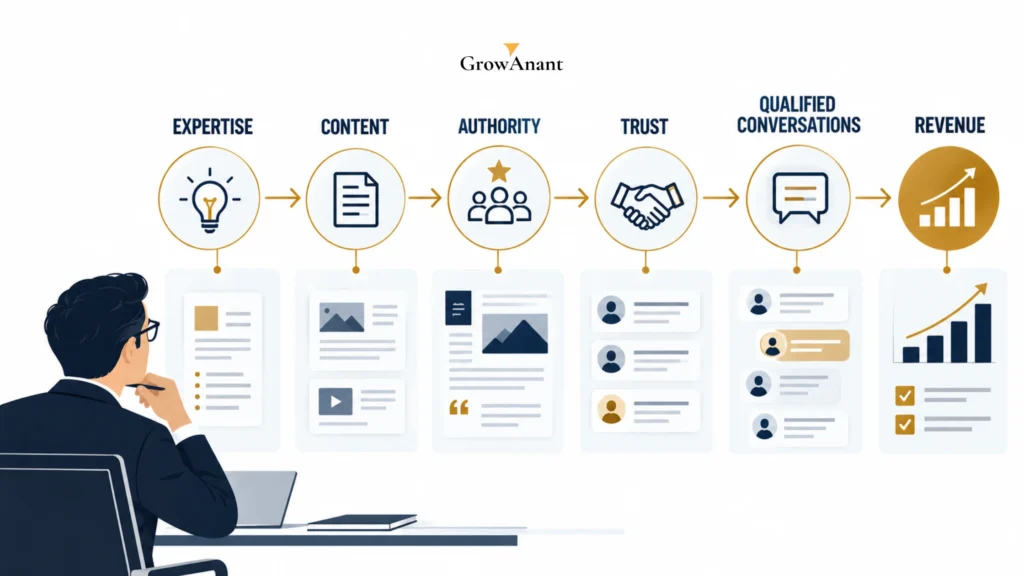
Growth consultants help businesses solve complex revenue, positioning, demand generation, and scaling problems, yet many struggle to apply the same principles to their own practices. Effective growth content marketing services for consultants should therefore do more than generate visibility. They should demonstrate expertise, create trust, generate qualified conversations, and build a repeatable path from expertise to commercial opportunity.
For a consultant, marketing is not simply about producing more content. It is about making the firm’s expertise easier to discover, understand, trust, and act upon. A focused approach to growth strategy consulting, business growth consulting, and authority building can create a stronger foundation for sustainable demand.
The Irony of Unmarketed Growth Consultants
The central problem is simple: consultants often spend their time solving growth problems for clients while treating their own marketing as optional.
This creates a common cycle:
Client work → referrals → project delivery → limited marketing → fewer new conversations → dependence on referrals
Referrals can be valuable, but relying on them exclusively creates revenue uncertainty. A consulting practice needs multiple sources of qualified demand.
For a growth consultant, the objective is not necessarily maximum traffic. It is relevant visibility among people who have a problem the consultant can credibly solve.
Why consultants neglect marketing
| Reason | Business Impact |
| Client delivery takes priority | Marketing becomes inconsistent |
| Expertise feels obvious to the consultant | Valuable knowledge remains unpublished |
| Fear of appearing promotional | Expertise becomes difficult to discover |
| Dependence on referrals | Pipeline becomes less predictable |
| Broad positioning | Prospects struggle to understand the specialty |
| Lack of measurement | Marketing activity is disconnected from opportunities |
The better question is not simply “How do I market my consulting business?”
It is:
How can my marketing demonstrate the same strategic thinking that clients are paying me for?
That distinction matters.
A consultant selling growth consulting services should make their own website, content, positioning, and lead journey evidence of how they think.
Building Authority Content as a Consultant
Authority content is content that demonstrates useful expertise before a prospect ever enters a sales conversation.
For consultants, this is particularly important because buyers are often evaluating judgment, experience, problem-solving ability, and strategic thinking rather than a standardized product.
A strong authority content system can include:
- Problem analysis
- Strategic frameworks
- Decision guides
- Industry observations
- Case-based learning
- Executive perspectives
- Implementation guidance
For example, instead of publishing a generic article about “digital marketing,” a consultant could explain how a B2B SaaS company should diagnose a pipeline slowdown before increasing advertising spend.
That content demonstrates strategic judgment.
The authority content framework
| Content Type | Purpose | Example |
| Problem content | Capture existing demand | Why B2B pipeline growth stalls |
| Framework content | Demonstrate expertise | A five-part growth diagnosis |
| Comparison content | Support decisions | In-house growth vs fractional leadership |
| Use-case content | Show application | Growth strategy for a SaaS company entering the U.S. |
| Opinion with evidence | Build perspective | Why more leads may not fix pipeline problems |
| Case-based content | Demonstrate practical thinking | How to diagnose funnel leakage |
This content can support growth marketing services, demand generation, and B2B marketing without turning every article into a sales pitch.
Build around buyer questions
A consultant should identify the questions prospects ask before buying.
For example:
- Why has our pipeline stopped growing?
- Should we hire internally or use a fractional leader?
- Why are our leads not converting?
- Should we enter a new market?
- Is our positioning too broad?
- How should we prioritize our growth investments?
- Why are marketing and sales producing disconnected results?
These questions can become an editorial system.
A growth consulting business becomes easier to understand when its content consistently addresses the problems its ideal buyers are already trying to solve.
Referral Systems for Consulting Practices
Referrals are powerful because trust has already been transferred from one person to another. However, a referral system should be designed rather than left entirely to chance.
A practical referral engine has four components:
Identify → Activate → Make It Easy → Follow Up
1. Identify referral sources
Potential sources include:
- Existing clients
- Former clients
- Technology partners
- Accountants
- Lawyers
- Investors
- Other consultants
- Agency owners
- Executive networks
- Industry communities
A consultant should prioritize people who regularly interact with the same buyer but do not directly compete with the practice.
2. Make the referral easy
A referral partner should immediately understand:
- Who you help
- What problem you solve
- When they should introduce you
- What type of company is a fit
For example:
“I help growth-stage B2B companies that have marketing execution but lack a cohesive growth strategy.”
That is easier to refer than:
“I provide comprehensive growth transformation solutions.”
Specificity reduces friction.
3. Build referral moments into delivery
A satisfied client does not necessarily know when someone in their network needs your services.
Create natural moments to ask:
- After a measurable business improvement
- After completing a strategic project
- During quarterly reviews
- After receiving positive feedback
- When a client mentions another company with a similar problem
The objective is to create a repeatable relationship system rather than occasional requests for introductions.
Positioning Against Larger Firms
A solo consultant or small practice does not need to replicate the scale of a large consulting firm.
The competitive question is different:
Where can a smaller specialist provide a clearer, more focused form of value?
Large firms may have broader teams, geographic reach, and extensive resources. A specialist consultant can instead compete through clarity, accessibility, specialization, and senior-level involvement.
| Larger Firm | Specialist Consultant |
| Broad service portfolio | Narrower specialization |
| Multiple organizational layers | Direct senior involvement |
| Larger delivery teams | Smaller focused team |
| Standardized methodologies | More adaptable engagement |
| Broad market positioning | Specific problem or ICP focus |
This does not mean one model is universally better. The right model depends on the buyer’s requirements.
For a founder-led SaaS business, for example, direct access to an experienced fractional growth consultant may be more relevant than a large consulting structure.
For a complex enterprise transformation, the requirements may be substantially different.
Position around the problem, not the profession
“Growth consultant” describes what you are.
It does not fully explain why someone should contact you.
A stronger positioning structure is:
Audience + Problem + Strategic Capability + Business Outcome
For example:
Growth-stage B2B SaaS companies + inconsistent pipeline + growth strategy and demand generation + stronger revenue visibility
This creates a clearer connection between business growth, growth strategy, and commercial outcomes.
A focused business growth agency USA or consulting practice can therefore compete through relevance rather than trying to appear larger than it is.
Common Self-Marketing Mistakes
1. Marketing every service
A consultant may list SEO, paid advertising, strategy, branding, content, CRM, analytics, and dozens of other capabilities.
The result is often unclear positioning.
Instead, organize services around the business problems you solve.
2. Publishing without a point of view
Educational content should answer a real question or challenge an assumption.
Simply producing articles does not establish authority.
3. Creating content for everyone
A consultant serving founders, enterprises, agencies, consumers, nonprofits, and government organizations simultaneously may struggle to create a recognizable position.
Specificity improves relevance.
4. Talking about tactics instead of outcomes
Prospects rarely hire a consultant because they want another marketing activity.
They may need:
- More predictable pipeline
- Better strategic clarity
- Improved customer acquisition
- Stronger positioning
- Better alignment between marketing and sales
- A clearer growth roadmap
The marketing should connect expertise to these business challenges.
5. Treating LinkedIn as the entire strategy
LinkedIn can be useful for professional visibility, but a consulting practice should also build durable assets such as:
- Website content
- Search visibility
- Case studies
- Email relationships
- Referral networks
- Strategic partnerships
- Proprietary frameworks
This creates a more resilient demand system.
6. Measuring vanity metrics
Followers and impressions can indicate visibility, but they do not necessarily demonstrate commercial value.
A better measurement framework is:
Visibility → Engagement → Qualified Conversations → Opportunities → Revenue
Not every piece of content will generate a direct lead. The purpose is to evaluate the complete system.
Consultant Self-Marketing Checklist
Before scaling marketing activity, confirm:
- The ideal client is clearly defined.
- The primary problem is specific.
- The positioning communicates business value.
- Content addresses real buyer questions.
- Expertise is demonstrated consistently.
- Referral sources are actively developed.
- The website supports credibility and conversion.
- Marketing activity can be connected to qualified conversations.
- Content supports the consulting firm’s strategic position.
- The practice has a repeatable publishing process.
A consulting practice does not need to become a high-volume media company. It needs a system that turns expertise into discoverability, trust, conversations, and eventually commercial opportunities.
For practices offering revenue growth consulting, startup growth strategy consulting, or SaaS growth consulting, this distinction is particularly important because the marketing itself becomes part of the credibility proposition.
Frequently Asked Questions
Client delivery often takes priority, and consultants may rely heavily on referrals and existing relationships. Another common issue is that consultants understand their expertise so deeply that they underestimate the value of explaining it publicly.
The solution is to treat marketing as a business-development system rather than an optional promotional activity.
Content that directly addresses high-value buyer problems tends to be more useful than generic educational content.
Strong formats include strategic frameworks, decision guides, detailed problem analysis, case-based insights, industry observations, and practical explanations of complex business decisions.
The fastest path to authority is not necessarily publishing more. It is consistently demonstrating useful expertise to the right audience.
Solo consultants can differentiate through specialization, direct senior involvement, focused positioning, responsiveness, and depth in a specific problem or market.
The objective should not be to imitate a larger firm. It should be to make the value proposition clearer for a specific buyer and business challenge.
The biggest mistake is treating marketing as a collection of disconnected activities instead of building a system.
A consultant may publish on LinkedIn, write blogs, attend events, request referrals, and update their website, yet still lack a coherent path from visibility to qualified conversations.
A stronger system connects positioning, authority content, referrals, search visibility, relationship building, and measurement around the same business objective.