
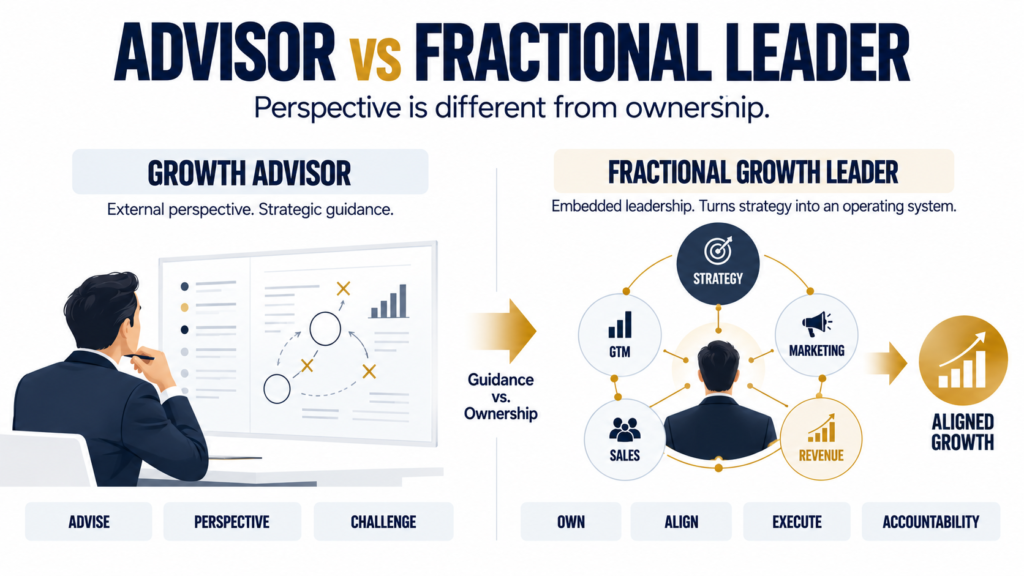
For founders and CEOs evaluating fractional growth leadership vs growth advisor support, the distinction is primarily about ownership, involvement, and accountability.
A growth mentor typically provides perspective, experience, and guidance. A fractional growth leader operates much closer to the business, helping translate strategy into priorities, coordinate teams, establish operating rhythms, and drive execution.
This distinction matters when a company is dealing with inconsistent pipeline, unclear priorities, fragmented marketing, or a lack of senior growth leadership. Fractional growth leadership can provide executive-level capability without necessarily requiring a full-time executive hire, while an advisor or mentor can provide targeted external perspective.
The right choice depends less on title and more on the company’s current growth problem, internal capabilities, and required level of ownership.
What a Growth Advisor Does
A growth advisor primarily provides perspective and strategic guidance.
The advisor may review the company’s growth strategy, challenge assumptions, identify opportunities, introduce frameworks, or help the founder think through major decisions.
Typical advisor responsibilities include:
- Reviewing the existing growth strategy consulting approach
- Challenging positioning and GTM assumptions
- Providing industry perspective
- Reviewing growth metrics
- Advising on major strategic decisions
- Making introductions where appropriate
- Helping founders avoid predictable mistakes
- Acting as a sounding board for the leadership team
An advisor generally does not become the operational owner of the growth function.
For example, a Series A SaaS founder might meet with an advisor twice a month to discuss positioning, pipeline, pricing, and expansion strategy. The founder and internal team remain responsible for implementing those decisions.
A growth mentor may operate similarly, although mentoring often places greater emphasis on the development of the founder or executive rather than ownership of a business function.
Advisor model at a glance
| Dimension | Growth Advisor |
| Primary role | Guidance |
| Time commitment | Usually limited |
| Strategy | Advises |
| Execution | Usually does not own |
| Team management | Limited |
| Decision authority | Founder retains it |
| Accountability | Primarily advisory |
| Best use | Perspective and strategic challenge |
This model can work well when the company already has capable leaders who need an external perspective rather than another operator.
What a Fractional Leader Does
A fractional leader is different because the role is closer to an executive position.
A fractional growth consultant, fractional chief growth officer, or fractional head of growth can become part of the company’s operating structure for a defined period or scope.
Harvard Business Review describes fractional leadership as a model in which organizations use experienced senior leaders on a part-time basis, particularly when they need senior capabilities without necessarily requiring a full-time executive.
The practical difference is ownership.
A fractional growth leader may:
- Establish growth priorities
- Build the growth roadmap
- Coordinate marketing and sales
- Define KPIs
- Improve demand generation
- Review funnel performance
- Establish operating rhythms
- Work with internal marketing teams
- Manage external specialists
- Support GTM decisions
- Participate in leadership meetings
- Report progress to the CEO or board
The role can therefore extend across strategy, execution, coordination, and accountability.
A fractional growth executive is not simply an advisor who attends occasional meetings. The person is integrated into the business at a defined level of responsibility.
For a company with marketing execution but no senior growth leadership, this distinction can be significant.
Example
Consider a U.S. B2B SaaS company with:
- A marketing manager
- Two content specialists
- A paid media specialist
- An SDR team
- Reasonable lead volume
- Poor marketing-to-sales conversion
- No unified growth strategy
A mentor might help the CEO identify the strategic problem.
An advisor might recommend changes to positioning, demand generation, and funnel management.
A fractional leader could take responsibility for coordinating those changes, establishing priorities, defining metrics, and working with the existing team to implement the growth plan.
That is the fundamental distinction.
Level of Involvement Compared
The clearest way to understand the models is to compare their involvement across the growth system.
| Area | Advisor / Mentor | Fractional Growth Leader |
| Strategic advice | High | High |
| Growth planning | Advisory | Ownership + collaboration |
| Execution oversight | Limited | High |
| Team coordination | Usually limited | Often significant |
| KPI ownership | Reviews | Helps establish and manage |
| Marketing alignment | Advises | Actively coordinates |
| Sales alignment | Advises | Actively coordinates |
| GTM execution | Strategic input | Strategic + operational |
| Leadership meetings | Periodic | Regular |
| Accountability | Recommendations | Defined business responsibilities |
A company should therefore avoid choosing based solely on hourly cost.
The more useful question is:
What level of leadership does the business actually need?
If the company needs someone to challenge the CEO’s assumptions once or twice a month, an advisor may be sufficient.
If the company needs someone to build and operate the growth function alongside internal teams, fractional leadership may be more appropriate.
This distinction is particularly relevant to growth consulting services, business growth consulting, and revenue growth consulting, because those engagements can range from strategic guidance to hands-on growth leadership.
Accountability Differences
Accountability is one of the strongest differences between the two models.
An advisor generally provides recommendations. Management decides whether and how those recommendations are implemented.
A fractional leader typically has a defined operating mandate. That can include responsibility for priorities, processes, reporting, team alignment, and execution progress.
This does not mean a fractional leader can independently control every revenue outcome.
Revenue is affected by many factors, including:
- Product-market fit
- Pricing
- Sales execution
- Market conditions
- Customer retention
- Competitive pressure
- Product capability
- Budget
- Organizational capacity
Instead, accountability should be defined around controllable responsibilities.
A practical accountability framework
Before an engagement begins, establish:
1. Business objective
What business problem is the engagement designed to address?
2. Scope
Which growth functions are included?
3. Decision rights
What can the fractional leader decide independently?
4. Internal responsibilities
Which activities remain with the CEO, sales leader, marketing team, or other executives?
5. Metrics
Which leading and lagging indicators will be monitored?
6. Review cadence
How frequently will performance and priorities be reviewed?
A clear growth leadership team structure prevents confusion about whether the external leader is advising, managing, or simply executing.
McKinsey’s research on CEO leadership similarly emphasizes the importance of clear responsibilities around strategy, organizational alignment, leadership, and resource allocation.
Which Fits Your Stage
The appropriate model depends on the company’s current maturity.
| Company situation | Advisor / Mentor | Fractional Leader |
| Founder needs strategic perspective | ✓ | |
| Strong internal growth leader already exists | ✓ | |
| Leadership team needs occasional challenge | ✓ | |
| Marketing activity lacks strategic direction | ✓ | |
| Sales and marketing are disconnected | ✓ | |
| No senior growth owner exists | ✓ | |
| Company needs a growth operating rhythm | ✓ | |
| GTM execution requires coordination | ✓ | |
| CEO wants a sounding board | ✓ | |
| Internal team needs senior leadership | ✓ |
Early-stage company
An early-stage company may benefit from a growth mentor or advisor when the founder primarily needs experience and perspective.
Growth-stage company
As the organization adds employees, channels, markets, and revenue targets, coordination becomes more important.
A fractional leader may become useful when the company has execution resources but lacks someone responsible for connecting strategy, marketing, sales, demand generation, and revenue priorities.
Scaling company
A company approaching a more complex growth phase may eventually need a full-time executive.
Fractional leadership can potentially serve as an interim leadership model, capability-building period, or bridge while the organization determines what its permanent growth leadership structure should look like.
Using Both Together
The two models do not have to compete.
In some organizations, an advisor and fractional leader can serve complementary roles.
For example:
CEO / Founder
↓
Growth Advisor
Strategic challenge and external perspective
↓
Fractional Growth Leader
Growth strategy, coordination, execution leadership
↓
Marketing + Sales + Revenue Teams
Execution
The advisor can challenge the strategic direction while the fractional leader translates that direction into an operating system.
However, the roles must be clearly separated.
| Advisor | Fractional Leader |
| Challenges strategy | Converts strategy into priorities |
| Provides perspective | Leads operating rhythm |
| Offers experience | Coordinates execution |
| Independent viewpoint | Embedded leadership |
| Limited involvement | Defined ongoing involvement |
For example, a healthtech startup might use a fractional growth leader to coordinate demand generation and GTM execution while an experienced fractional growth advisory board member provides periodic strategic perspective to the CEO and board.
This arrangement only works when responsibilities are explicit. Otherwise, the company can end up paying two external parties to provide overlapping recommendations.
A simple decision framework
Ask these four questions:
- Do we primarily need perspective?
Consider an advisor or mentor. - Do we need someone to own a growth function?
Consider fractional leadership. - Do we have execution teams but no senior growth direction?
Fractional leadership may address the leadership gap. - Do we already have strong growth leadership but want independent challenge?
An advisor may add more value.
The central distinction is straightforward:
Advisors help leaders make better decisions. Fractional leaders help organizations turn those decisions into an operating system.
For companies evaluating startup growth strategy consulting, SaaS growth consulting, or go to market strategy consulting, that distinction should be established before selecting the engagement model.
GrowAnant approaches fractional growth leadership as a strategy-first growth partnership, connecting strategic priorities with demand generation, GTM execution, and revenue-focused operating systems rather than treating growth as a collection of isolated marketing activities.
References
Harvard Business Review: How Part-Time Senior Leaders Can Help Your Business
Frequently Asked Questions
No.
An advisor primarily provides strategic guidance, perspective, and challenge. A fractional leader takes a more active role in the organization and may have defined responsibility for strategy, execution coordination, team alignment, and performance management.
A fractional growth consultant can therefore operate much closer to the company’s internal leadership team than a traditional advisor.
In an advisory relationship, the company’s leadership team generally retains responsibility for decisions and implementation.
In a fractional leadership engagement, responsibilities should be explicitly defined in the fractional growth leadership contract. The leader may own specific growth functions, processes, KPIs, or strategic initiatives, while the CEO and leadership team retain accountability for broader company performance.
The most important requirement is clarity around scope, decision rights, metrics, and reporting.
Yes.
An advisor can provide independent strategic perspective while a fractional leader manages the operating side of growth.
However, their responsibilities should not overlap unnecessarily. The advisor should generally challenge and inform the strategy, while the fractional leader translates priorities into execution and operating processes.
There is no universal answer because cost depends on experience, scope, time commitment, complexity, and engagement structure.
An advisor with limited involvement may require less investment than a fractional executive. However, comparing price alone can be misleading because the two models provide different levels of involvement.
The more useful comparison is between the business problem, required level of ownership, expected scope, and available internal capability.