
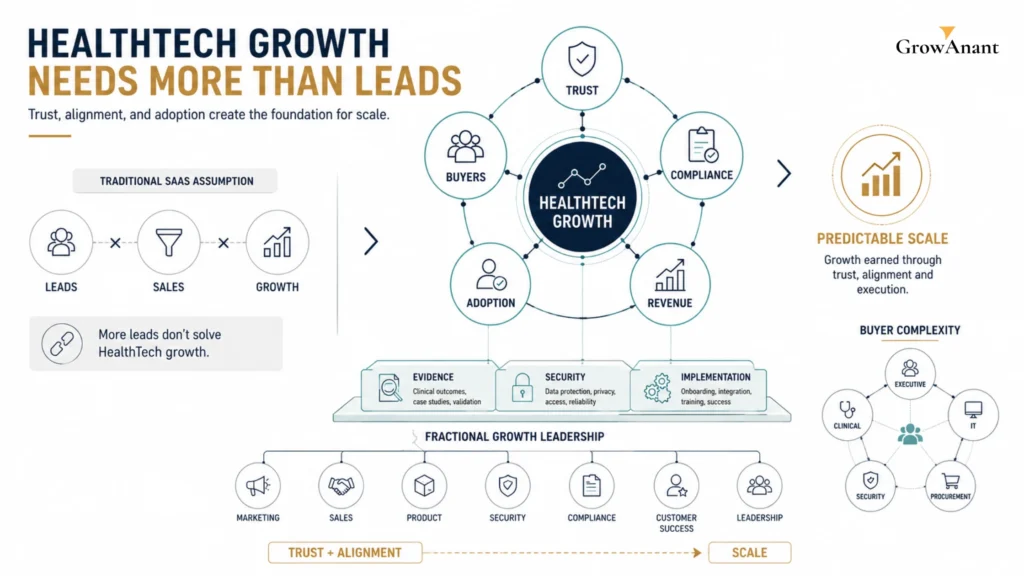
Healthcare technology is a different growth environment from conventional software. fractional growth leadership healthtech requires more than applying a standard SaaS acquisition playbook. HealthTech and healthcare SaaS companies must navigate complex buying committees, long sales cycles, trust requirements, regulatory considerations, integration concerns, and pressure to demonstrate measurable business value.
A fractional growth consultant or fractional chief growth officer can provide senior strategic direction without requiring a full-time executive hire. The objective is to connect positioning, GTM strategy, demand generation, sales alignment, and revenue measurement into one coordinated growth system.
McKinsey notes that healthcare technology organizations face increasing technology complexity, cybersecurity concerns, and potentially six- to twelve-month onboarding cycles for some healthcare environments.
Why Healthcare SaaS Growth Is Different
Healthcare SaaS growth is shaped by a fundamentally different buying environment.
In conventional B2B SaaS, a founder may sell primarily to one economic buyer or a relatively small buying committee. In healthcare, a product may need approval from executives, clinical stakeholders, IT, security, procurement, compliance, and finance.
The result is a more complex growth equation:
Market Need + Clinical/Operational Value + Trust + Compliance Readiness + Economic Proof + Adoption
This makes healthcare SaaS growth less dependent on simply generating more leads.
| Conventional SaaS | Healthcare SaaS |
| Faster experimentation | Longer validation cycles |
| Smaller buying groups | Multiple stakeholders |
| Product-led adoption may work | Enterprise approval often matters |
| Feature differentiation | Trust and business value are critical |
| Shorter onboarding | Integration can be complex |
| Growth marketing focus | Growth plus domain credibility |
McKinsey identifies healthcare technology as an important growth area, with software platforms increasingly helping providers and payers improve efficiency, connectivity, and technology-enabled workflows.
For a HealthTech founder, this means the growth strategy must account for the entire path from awareness to implementation.
Regulatory & Buyer Complexity
Regulatory requirements are not simply a legal issue. They can influence positioning, sales enablement, onboarding, partnerships, product communication, and market entry.
A growth leader should therefore work closely with legal, compliance, product, security, and sales teams.
The practical framework is:
Understand → Validate → Communicate → Prove → Scale
1. Understand
Map the regulations, security expectations, procurement requirements, and organizational processes affecting the target buyer.
2. Validate
Confirm that positioning and claims are appropriate for the market and supported by available evidence.
3. Communicate
Translate technical and compliance capabilities into language that executives and operational buyers understand.
4. Prove
Build credible evidence through case studies, pilots, references, operational results, and implementation experience.
5. Scale
Only after the commercial and operational model is repeatable should the company aggressively expand acquisition.
A fractional growth executive should not operate independently from these functions. The role is to coordinate them around commercial priorities.
This is particularly important for healthcare startups selling into hospitals, health systems, payers, physician groups, or other regulated organizations.
Building Trust With Long Sales Cycles
Trust is one of the most important growth assets in healthcare.
A healthcare buyer is rarely evaluating only whether software has useful features. They may also be asking:
- Can we trust this company?
- Will implementation disrupt operations?
- Can our teams adopt it?
- Is the technology secure?
- Can the vendor support us?
- Is the business financially stable?
- Can the solution demonstrate measurable value?
McKinsey has highlighted the “stickiness” of healthcare customers and long contract cycles, making new-business development particularly important for sustained growth.
This changes the role of marketing.
Instead of optimizing primarily for lead volume, a fractional head of growth should build a trust system.
HealthTech Trust Framework
| Trust Layer | Example |
| Expertise | Healthcare-specific insights |
| Evidence | Customer results and case studies |
| Security | Clear security documentation |
| Credibility | Relevant partnerships and references |
| Adoption | Implementation methodology |
| Business value | Quantifiable operational outcomes |
A healthcare SaaS company selling revenue-cycle software, for example, should not rely solely on product demonstrations. Its demand generation strategy should explain the operational problem, demonstrate expertise, address implementation concerns, and provide evidence of business value.
This is where growth strategy consulting becomes more valuable than isolated campaign execution.
Growth Leadership Priorities
A fractional growth leader should establish priorities based on the company’s stage and bottleneck.
For an early-stage HealthTech company, the priority may be positioning and ICP validation.
For a growth-stage healthcare SaaS company, it may be pipeline predictability, sales efficiency, expansion, or entering additional healthcare segments.
Priority Framework
1. Positioning
Define exactly who the product is for, what problem it solves, and why the buyer should care.
2. ICP and Buying Committee
Map economic buyers, users, influencers, blockers, and approval stakeholders.
3. GTM System
Connect messaging, demand generation, sales enablement, partnerships, and conversion processes.
4. Pipeline
Track qualified opportunities rather than treating raw leads as the primary measure of growth.
5. Revenue
Connect marketing and sales activity to closed revenue, retention, expansion, and customer economics.
6. Operating Rhythm
Create a monthly growth review covering performance, bottlenecks, experiments, and strategic decisions.
A fractional growth leadership contract should therefore define more than meetings and deliverables. It should clarify strategic ownership, decision-making responsibilities, KPIs, and collaboration with internal teams.
What the Fractional Leader Should Own
- Growth roadmap
- GTM priorities
- ICP refinement
- Positioning
- Demand generation strategy
- Funnel analysis
- Marketing and sales alignment
- Growth experimentation
- Leadership reporting
What Should Remain Cross-Functional
- Regulatory decisions
- Clinical validation
- Product development
- Security approval
- Legal interpretation
- Healthcare compliance
The fractional leader coordinates commercial strategy without replacing specialist ownership.
Channel Considerations
Healthcare SaaS companies should avoid choosing channels simply because they work for conventional B2B software.
The channel should match the buying process.
| Channel | Best Strategic Use |
| Executive education and category authority | |
| SEO | Capturing high-intent problem searches |
| Webinars | Demonstrating expertise |
| Industry events | Trust and relationship development |
| Partnerships | Access to established healthcare networks |
| Long-cycle lead nurturing | |
| Account-based marketing | Engaging defined healthcare organizations |
| Case studies | Reducing perceived buyer risk |
For example, a healthcare workflow platform targeting U.S. health systems may benefit more from account-based outreach, executive thought leadership, industry partnerships, and high-intent content than from broad consumer-style acquisition.
The objective is not to maximize activity across every channel. It is to build a repeatable path from qualified account → trusted engagement → sales conversation → implementation → expansion.
A growth partner such as GrowAnant can support this by connecting growth consulting services, GTM planning, demand generation, and revenue measurement into a unified operating system rather than treating each channel as an independent campaign.
Common Mistakes
1. Treating HealthTech like ordinary SaaS
Generic SaaS acquisition tactics often overlook healthcare’s buying complexity.
2. Optimizing for lead volume
A large number of poorly qualified healthcare leads can consume significant sales resources without improving pipeline quality.
3. Ignoring implementation
Healthcare buyers care about what happens after the contract is signed. Implementation should be part of the value proposition.
4. Underestimating trust
Strong product messaging cannot compensate for weak evidence, unclear security information, or limited healthcare credibility.
5. Selling only to the executive
The executive may approve the purchase, but operational, clinical, IT, security, and procurement stakeholders can influence the decision.
6. Measuring only marketing metrics
Traffic, impressions, and leads are useful diagnostic indicators. Leadership should also monitor qualified pipeline, sales velocity, conversion rates, acquisition economics, retention, and expansion.
7. Hiring execution before establishing strategy
Adding marketers before defining ICP, positioning, ownership, and measurement can increase activity without solving the underlying growth problem.
Frequently Asked Questions
Healthcare SaaS growth is often harder because buyers operate within complex organizational, regulatory, operational, security, and procurement environments. Multiple stakeholders may influence a purchase, while implementation and trust can significantly affect the sales process.
There is no universal healthcare sales-cycle length. It varies significantly by product, buyer, organization size, procurement process, integration requirements, and regulatory considerations. Some healthcare technology implementations can involve onboarding periods of six to twelve months or longer.
The strongest channel mix depends on the ICP and buying process. Common options include industry partnerships, account-based marketing, LinkedIn, SEO, webinars, events, email nurturing, thought leadership, and customer evidence. The priority should be qualified pipeline rather than maximum channel activity.
Healthcare experience can be highly valuable because the leader must understand complex buying committees, trust requirements, long sales cycles, and healthcare-specific commercial considerations. However, the fractional leader should also bring strong capabilities in business growth consulting, GTM strategy, demand generation, measurement, and cross-functional leadership.