
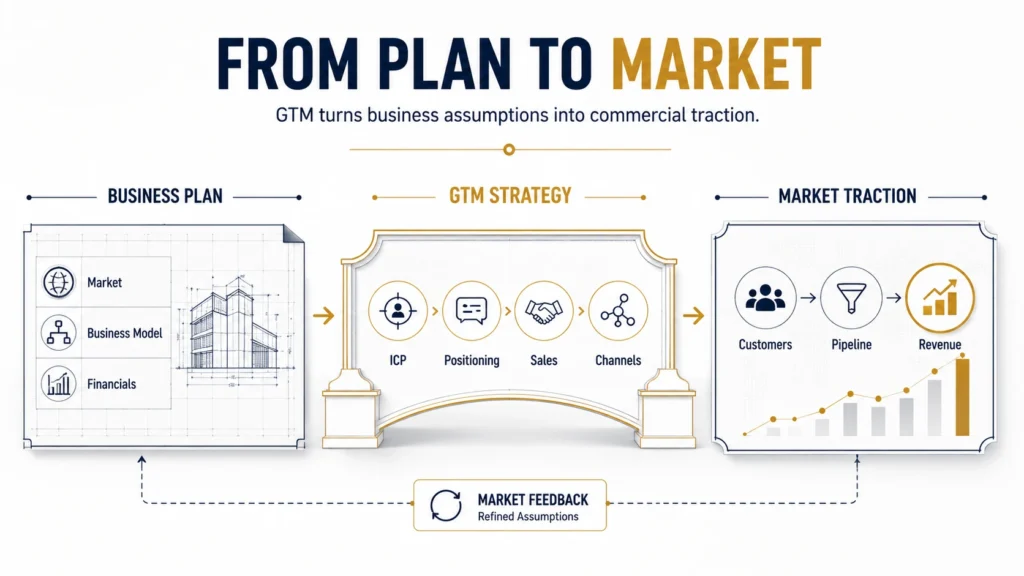
A founder deciding between go to market vs marketing plan is often asking the wrong question. A business plan and a go-to-market strategy solve different problems, and new ventures generally need both.
A business plan explains how the company will operate, compete, generate revenue, and allocate resources. A GTM strategy explains how a specific product, service, market, or venture will reach the right buyers and turn market opportunity into commercial traction.
The distinction matters because strong financial assumptions do not automatically create customer demand. The U.S. Small Business Administration describes a business plan as a roadmap for structuring, running, and growing a business, while its marketing guidance positions marketing planning as a component that turns broader strategy into action.
What a Business Plan Covers
A business plan is the broader operating and economic blueprint for a company.
It typically addresses:
- Business model
- Target market
- Products or services
- Competitive environment
- Organization and management
- Marketing and sales
- Revenue model
- Cost structure
- Funding requirements
- Financial projections
- Growth assumptions
For a startup founder, the business plan answers:
Can this business become a viable and sustainable company?
The SBA notes that business plans can help founders structure, operate, and grow their businesses, as well as communicate the opportunity to investors and potential partners.
A practical business-plan framework looks like this:
| Area | Core Question |
| Market | Is there a sufficiently attractive opportunity? |
| Customer | Who will buy? |
| Offer | What are we selling? |
| Business model | How will we make money? |
| Competition | Why can we compete? |
| Operations | What resources are required? |
| Financials | What investment and economics are required? |
| Growth | How can the company scale? |
This is where business strategy consulting USA can help founders connect market assumptions, financial logic, competitive positioning, and operating priorities.
However, a business plan can remain too high-level for an actual launch.
Knowing that a SaaS company will target mid-market U.S. businesses does not tell the team which buyer to approach first, what message to use, which sales motion to deploy, or which channels should generate initial demand.
That is where GTM planning begins.
What a GTM Strategy Covers
A go-to-market strategy translates a business opportunity into a practical market-entry and revenue system.
HubSpot describes GTM strategy as a step-by-step approach for bringing a product to market and driving demand, including target audience, positioning, pricing, sales, distribution, and cross-functional alignment.
A GTM strategy answers:
How will we successfully reach, convert, and serve the right market?
Its core components usually include:
| GTM Component | Key Question |
| ICP | Who should we prioritize first? |
| Market | Which segment or geography should we enter? |
| Positioning | Why should buyers choose us? |
| Messaging | What problem and outcome should we communicate? |
| Pricing | What commercial model fits the market? |
| Sales motion | How will customers buy? |
| Channels | Where will we reach them? |
| Partnerships | Who can accelerate market access? |
| Launch | How will we coordinate market entry? |
| Measurement | Which metrics indicate traction? |
For a B2B SaaS startup entering the United States, the business plan may state:
“We will sell subscription software to U.S. mid-market companies.”
The GTM strategy needs to go further:
“We will initially target U.S. revenue leaders at 200 to 1,000 employee SaaS companies, position the product around reducing pipeline inefficiency, use founder-led outbound and targeted content to validate demand, and build a repeatable sales motion before expanding the ICP.”
That level of specificity turns strategy into execution.
Where They Overlap
The business plan and GTM strategy should not contradict each other.
They should operate as connected layers.
Business Plan → GTM Strategy → Execution
Business strategy
Defines the company opportunity and economic model.
↓
GTM strategy
Defines how the company will capture a specific market opportunity.
↓
Marketing and sales execution
Turns the GTM strategy into campaigns, conversations, opportunities, and customers.
This relationship is especially important for companies using go to market strategy consulting, growth strategy consulting, or business growth consulting.
Consider a hypothetical healthtech startup.
Its business plan may identify healthcare providers as the target market and project subscription revenue.
Its GTM strategy must determine:
- Which provider segment comes first
- Who the economic buyer is
- Which regulatory concerns affect adoption
- How the solution should be positioned
- Whether sales should be direct or partner-led
- How long the buying process may take
- What proof is required
- Which market should be tested first
Business Plan vs GTM Strategy
| Dimension | Business Plan | GTM Strategy |
| Primary purpose | Define business viability | Define market execution |
| Scope | Company-wide | Product, market, segment, or launch |
| Financial model | Central | Supporting input |
| Customer strategy | Broad | Specific and actionable |
| Sales motion | General | Detailed |
| Channels | High-level | Prioritized |
| Positioning | Strategic | Buyer-specific |
| Timing | Long-term | Launch and growth cycles |
| Owner | Founder/leadership | Cross-functional GTM team |
| Update frequency | Periodic | More frequently |
A useful rule is:
The business plan explains the business. The GTM strategy explains how the business wins in a particular market.
Sequencing Both for a Launch
Founders often ask which document should come first.
The better approach is sequential but iterative.
Step 1: Define the Business Opportunity
Start with market research, customer problems, competitive conditions, business model, and economic assumptions.
The output is the foundation of the business plan.
Step 2: Validate the Target Market
Do not treat the initial target market as permanent.
Assess:
- Market attractiveness
- Buyer urgency
- Competitive intensity
- Ability to reach buyers
- Willingness to pay
- Sales complexity
- Product fit
For companies pursuing market entry strategy USA, this step becomes particularly important because assumptions from another geography may not transfer directly to the U.S. market.
Step 3: Build the GTM Strategy
Translate the business opportunity into:
ICP → Positioning → Messaging → Offer → Pricing → Sales Motion → Channels → Partnerships
Step 4: Build the Launch Plan
Convert strategic decisions into owners, timelines, campaigns, sales enablement, partnerships, and measurement.
Step 5: Connect GTM Metrics to the Business Plan
The business plan may project revenue.
The GTM system should establish the leading indicators that make that revenue assumption measurable.
For example:
Target revenue → Required customers → Required opportunities → Required qualified conversations → Required demand
This creates a direct connection between commercial assumptions and execution.
Launch Readiness Checklist
- Business model validated
- Target market defined
- ICP prioritized
- Competitive landscape assessed
- Positioning established
- Pricing assumptions tested
- Sales motion defined
- Acquisition channels selected
- Demand generation plan created
- Launch responsibilities assigned
- Revenue assumptions connected to GTM metrics
- Feedback and iteration process established
For startups using startup growth strategy consulting, this approach prevents the common problem of having an impressive business plan but an undefined path to customers.
Common Confusion Points
“Is GTM just another marketing plan?”
No.
Marketing is an important component of GTM, but GTM is broader.
A GTM strategy can include product positioning, pricing, sales, distribution, partnerships, customer success, and market-entry decisions. HubSpot similarly distinguishes GTM strategy from marketing strategy by emphasizing the broader cross-functional scope of GTM.
“Does the business plan already include marketing?”
Usually, yes.
But a business plan’s marketing section is generally not detailed enough to serve as the complete operating blueprint for a launch.
The business plan may state:
“We will acquire customers through digital marketing and direct sales.”
The GTM strategy should determine:
Which buyers, which channels, which message, which sales process, which offer, which sequence, and which metrics?
“Can a GTM strategy change the business plan?”
Yes.
This is one of its most valuable functions.
Suppose a startup initially expects to sell to large enterprises. During GTM validation, the team discovers that mid-market customers have a shorter buying process and stronger product fit.
That evidence may change:
- Revenue assumptions
- Sales hiring
- Pricing
- Product priorities
- Marketing investment
- Cash-flow forecasts
- Market expansion timing
GTM is therefore not merely an execution document. It can become a validation mechanism for the broader business model.
“Should founders build both documents at the same time?”
They should be developed as connected processes rather than isolated documents.
A practical sequence is:
Business assumptions → Market validation → GTM strategy → Launch → Market feedback → Business-plan refinement
This creates a feedback loop instead of treating the original business plan as fixed.
For growth-stage companies, growth roadmap consulting can help connect these layers into a longer-term operating roadmap. A strategic growth partner such as GrowAnant can also help align GTM planning, demand generation, marketing execution, and revenue priorities so that market activity remains connected to the broader business model.
References
U.S. Small Business Administration: Write your business plan
HubSpot
What is a Go-to-Market Strategy? GTM Plan Template + Examples
Frequently Asked Questions
A GTM strategy can be represented within a business plan through its marketing and sales sections, but a detailed GTM strategy is usually a more specific operating framework. The business plan covers the broader company, while GTM focuses on how a product, service, or venture reaches and converts a defined market.
The broader business assumptions should generally come first because they establish the market opportunity, business model, financial logic, and strategic direction. The GTM strategy can then translate those assumptions into a practical market-entry and customer-acquisition approach.
However, the process should remain iterative. GTM validation may reveal that assumptions in the original business plan need to change.
Requirements vary by investor and stage. A business plan, pitch materials, financial model, and market strategy can all serve different purposes.
The important point is that investors need confidence that the company understands both the business opportunity and the practical path to customers. The SBA notes that business plans are commonly used to communicate a business opportunity to investors and lenders.
A business plan should be revisited when major assumptions change, such as the business model, market, funding requirements, or financial outlook.
A GTM strategy generally requires more frequent iteration because customer feedback, channel performance, competitive conditions, positioning, and sales results can change quickly.
The key is not updating documents for the sake of documentation. Both should evolve when evidence changes the underlying business or market assumptions.